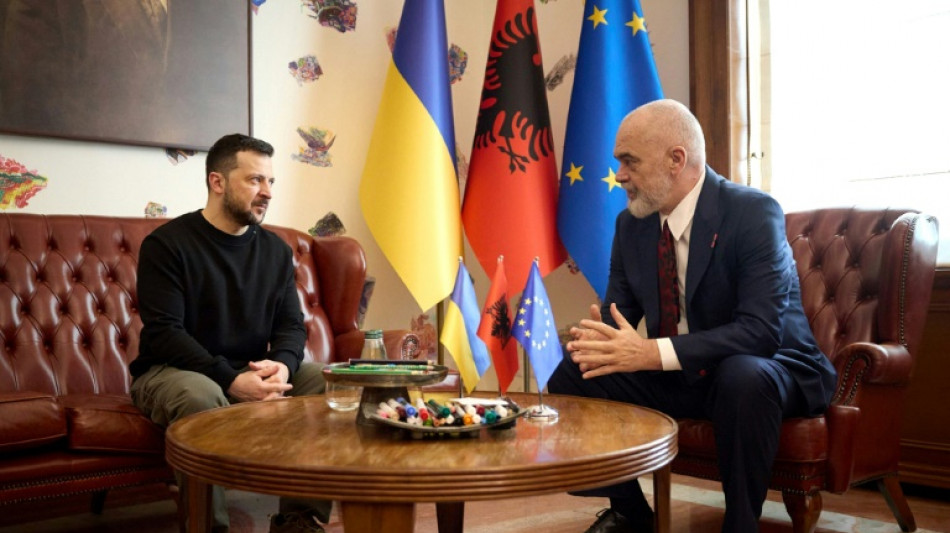
Zelensky rallies Balkan allies for support, weapons / Photo: Handout - UKRAINIAN PRESIDENTIAL PRESS SERVICE/AFP
Ukrainian President Volodymyr Zelensky on Wednesday appealed to Balkan leaders for greater backing to help fend off Russian forces, noting an ammo shortage was impacting frontline troops.
Zelensky has been crisscrossing the globe in recent weeks to rally support for his embattled country, as fresh US support is tangled in domestic politics and Russia has made battlefield advances.
During opening remarks at the meeting in Albania, Zelensky thanked Balkan leaders for their military and humanitarian support over the past two years of war, but emphasised that supplies were still running low at the frontline.
"We see the problems with the supply of ammunition which are affecting the situation on the battlefield," said Zelensky, adding that his administration was interested in hosting a future "Ukrainian-Balkans defence industry forum".
Following a sitdown with Albania's Prime Minister Edi Rama on Wednesday, the Ukrainian president said the two sides were exploring further defence cooperation.
"Since the first days of the full-scale invasion, Albania has supported Ukraine in our struggle for freedom and territorial integrity," Zelensky wrote on X.
"Today we also discussed Ukraine's defence needs and potential joint arms production," he added.
- Urgent need for help -
Albania, a NATO member since 2009, has been a vocal supporter of Ukraine but has stayed largely quiet in public about supplying Kyiv with arms.
During a visit to Albania earlier this month, US Secretary of State Antony Blinken praised Tirana's backing of Ukraine.
"It was one of the first countries to send military aid to Ukraine in the wake of the Russian aggression –- guns, ammunition, mine resistant vehicles –- and it's currently one of the top ten per capita in terms of its support for Ukraine and security assistance," Blinken said.
Leaders from across the Balkans -- including Serbia's President Aleksandar Vucic, Croatian Prime Minister Andrej Plenkovic, and Kosovo President Vjosa Osmani -- were in attendance at the summit in Tirana.
Serbia remains a rare outlier in the region for refusing to sanction Russia, while Ukraine has never formally recognised Kosovo's independence declaration in 2008.
Despite the lack of ties, Kosovo's president said the government in Pristina was supportive of Ukraine.
"The moment of joint recognition will come with the freedom of Ukraine," Osmani told reporters as she entered the summit.
Zelensky has repeatedly pleaded with allies for more aid, warning that Ukrainian victory depends on the West boosting support.
Already outgunned, his country is fending off a renewed Russian offensive with dwindling ammunition that has had to be rationed.
EU allies are rallying to address that shortfall with a Czech-led plan to buy artillery from outside the bloc.
More than two years after Russia's invasion, the EU is facing the prospect of having to shoulder more of the aid burden as funds from the United States dry up.
Political infighting in the US Congress has stalled a vital $60 billion aid package, with the Republican right-wing, led by 2024 presidential candidate Donald Trump, souring against Ukraine's cause.
House Speaker Mike Johnson, an ally of former president Donald Trump and head of a razor-thin Republican majority, has refused to allow a vote on the package.
French President Emmanuel Macron meanwhile provoked backlash from fellow allies and a warning from the Kremlin this week when he raised the possibility of sending Western troops into Ukraine.
Before arriving in Tirana, Zelensky stopped in Saudi Arabia, where he sought to promote his peace plan and discuss potential prisoner of war exchanges.
Saudi Arabia maintains relations with both Russia and Ukraine and has mediated between the warring parties before, including a deal struck in September 2022 that saw the release of more than 200 captive Ukrainians.
I.Mertens--LCdB