'Last resort': Donors mull air drops for aid to desperate Gaza / Photo: - - AFP
With the humanitarian situation in Gaza increasingly desperate, donors are considering delivering relief supplies from the sky, as the UN warns famine is "almost inevitable".
The amount of aid brought into the territory by truck has plummeted during nearly five months of war, and Gazans are facing dire shortages of food, water and medicines.
A frenzied scramble for food from a truck convoy delivering aid to northern Gaza left more than 100 people dead on Thursday, according to the Hamas-run territory's health ministry, after Israeli forces opened fire on the crowd.
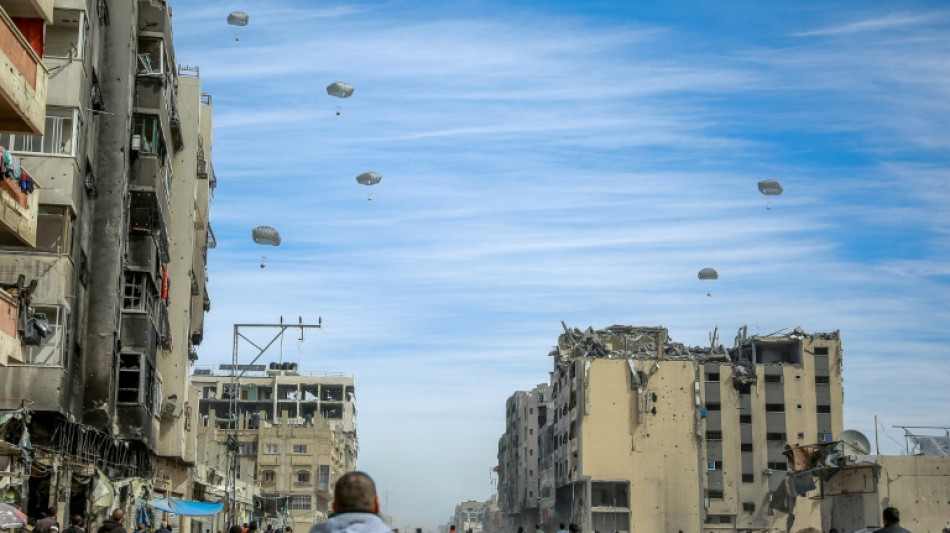
With most aid convoys halted, some foreign militaries have air-dropped supplies to Gaza instead, sending long lines of aid pallets floating down into the war-torn territory on parachutes.
Jordan has been conducting many of the operations since war broke out on October 7, with the support of countries including Britain, France and the Netherlands.
Imad Dughmosh from Al-Sabra in central Gaza told AFP he managed to get some food and water from the aid drops, but there hadn't been enough for everyone waiting.
"In the end, I took bags of pasta and cheese, but my cousins were not able to get anything," the 44-year-old said.
"I was happy because I took some food for the children, but it was not enough."
- Humanitarian crisis -
Deliveries into Gaza have been reduced to a trickle since the war began on October 7 with an unprecedented Hamas attack on southern Israel that resulted in the deaths of about 1,160 people, mostly civilians, Israeli figures show.
Israel's retaliatory offensive against Hamas has killed 30,228 people, mostly women and children, according to the health ministry.
In northern Gaza, where Israel began its ground operation, many residents have been reduced to eating animal fodder.
Ten children have died of "malnutrition and dehydration", the health ministry said Friday.
Amid growing US concern, media reports suggested Washington too was considering air-drops into Gaza.
A US official confirmed Washington was considering all options, but warned air drops "are a drop in the bucket" compared to the need.
As well as the risks of dropping parcels onto crowded camps and cities, residents of the coastal territory told AFP many aid pallets had ended up in the Mediterranean.
"Most of the aid fell into the sea today, and also the parachutes that fell on Thursday and Wednesday all fell into the sea, except for a very small number," said Hani Ghabboun, who lives in Gaza City with his wife and five children.
He said Gazans need "hundreds of tonnes of aid to confront the famine and feed the people."
- 'Extremely challenging' -
Jens Laerke, spokesman for the UN humanitarian office OCHA said Friday there were "many issues" with air drops, which are better for small, specific missions.
"Aid that comes in in that way is a last resort," he said, saying it was "not the solution that we prefer" for Gaza.
"Overland transfer is simply better, more efficient, more effective and less costly."
But he warned: "If something doesn't change, a famine is almost inevitable on the current trends."
The UN has accused Israeli forces of "systematically" blocking access to Gaza -- something Israel denies.
Historical examples of successful airlifts include the 1948-49 Berlin Airlift when pilots flew supplies to West Berlin, bringing in more than two million tonnes of supplies to prevent the population from starving. Most of the aid was landed in Berlin but some of it was air-dropped.
Aid groups, including the UN agency for Palestinian refugees UNRWA, say a better option for Gaza is for Israel to open border crossings and allow safe road convoys in.
A spokesman for the UN chief Antonio Guterres told reporters that nearly 1,000 trucks are waiting at the Egyptian border and ready to move.
"Air drops are extremely challenging," Stephane Dujarric said at a briefing this week. "(But) all options remain on the table".
Jeremy Konyndyk, president of Refugees International, said air drops can only "help on the margins".
One plane can deliver the equivalent of two truckloads of aid, but at 10 times the cost, he told the BBC World Service on Friday.
"Rather than dropping food from the air, we should be putting immense pressure and using leverage on the Israeli government to allow aid in through more traditional channels that actually deliver at scale," he said.
Z.Barbier--LCdB