Chad opposition says soldiers 'executed' leader ahead of election / Photo: - - AFP
Chad's main opposition on Friday accused junta soldiers of having executed its leader "at point blank range" in an assault on the party's headquarters ahead of a long-promised May election.
Yaya Dillo Djerou was the leading opponent and a cousin of Mahamat Idriss Deby Itno, who was proclaimed transitional president by the junta in 2021.
Dillo died on Wednesday after troops surrounded the office of his Socialist Party Without Borders in the capital N'Djamena, in what the party says was an "execution". The government denied the accusation.
The violence came a day after Chad's military rulers announced a presidential election for May 6.
The voting would end a three-year transition period and aim to restore constitutional rule.
Dillo, 49, had told AFP before his death that people wanted to "physically eliminate me" ahead of the election in which he -- and Deby Itno -- planned to run.
Accounts of what happened during the assault, when gunfire was heard, differ widely between government officials and the party.
"It's an execution, they fired at him at point blank range to execute him for becoming a problem," his party's general secretary Robert Gamb said Friday.
Communications Minister Abderaman Koulamallah, the government's spokesman, rejected the accusation.
"We didn't execute anyone," he told AFP. "He opposed his arrest, there were exchanges of bullets.
"There was no execution."
In New York, UN Secretary-General Antonio Guterres's spokesman voiced concern about the killing.
"It's very important that there'd be restraint ahead of the first round of the presidential elections on May 6," Stephane Dujarric said.
"It's important that people respect the rule of law."
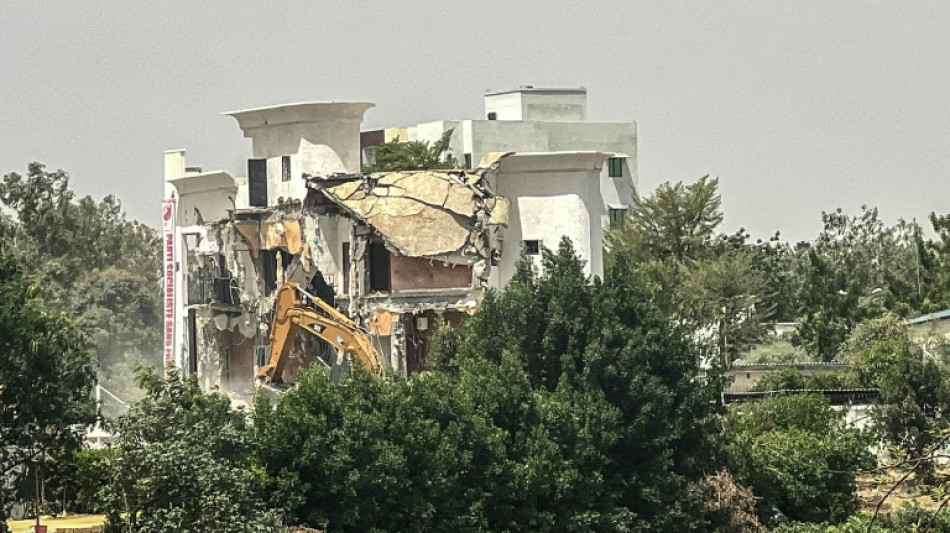
In Chad's capital a large excavator was demolishing the three-storey building housing the Socialist Party Without Borders on Friday afternoon.
An army security cordon kept people away and armoured vehicles could be seen around the property.
The government had accused Dillo of leading an attack against the offices of Chad's internal security agency the night before his death. He denied any involvement.
- 'No weapon' -
Security forces had this week sought the arrest of a member of Dillo's party over an alleged attempt to kill the supreme court president last month.
The government said the attack on the internal security offices, which killed several people, had been an act of reprisal.
Four soldiers and three supporters of Dillo died in Wednesday's fighting, according to the government.
Dillo had "retreated" to his party headquarters, Koulamallah said on Thursday, adding: "He didn't want to surrender and fired on law enforcement."
But his party and other opposition politicians have accused government forces of deliberately killing Dillo.
"You can't attack an opponent alone in an office with a whole arsenal of war," Gamb told AFP by telephone, adding that Dillo "had no weapon".
Dillo was a rebel who became a minister and then an opposition chief, and regularly complained that the May ballot was being arranged to assure Deby Itno's victory.
The death of Dillo removes the transitional president's top rival in the vote.
"There isn't an opponent today who can pose a threat in the race for the presidency," said Enrica Picco of the International Crisis Group.
"With the assassination of Yaya Dillo, the government has struck a major blow before the elections so that everyone falls into line," said a regional African expert and diplomat, asking to remain anonymous.
"It's a very strong message sent to the opposition, to its own sceptics and to the Zaghawas," he said. The transitional president "wants to short-circuit any opposition".
Dillo and his cousin are from the same Zaghawa ethnic minority, which has dominated Chad's politics for more than three decades.
The nation is part of central Africa's tumultuous Sahel region that has been gripped by jihadist insurgencies for more than a decade.
Chad is the last Sahel nation to house French troops following the forced withdrawal of French soldiers from Mali, Burkina Faso and Niger in the last couple of years following coups.
Paris has remained silent over recent events in N'Djamena after strongly criticising military rule in Mali, Burkina and Niger.
"There is a risk of (France) being accused of double standards," said Elie Tenenbaum of the French Institute for International Relations (IFRI). "It can be politically embarrassing."
He promised a return to civilian rule and elections within 18 months, but extended the transition by two years.
yas-rm-hpn-gir/kjm/bp/js
I.Kusters--LCdB