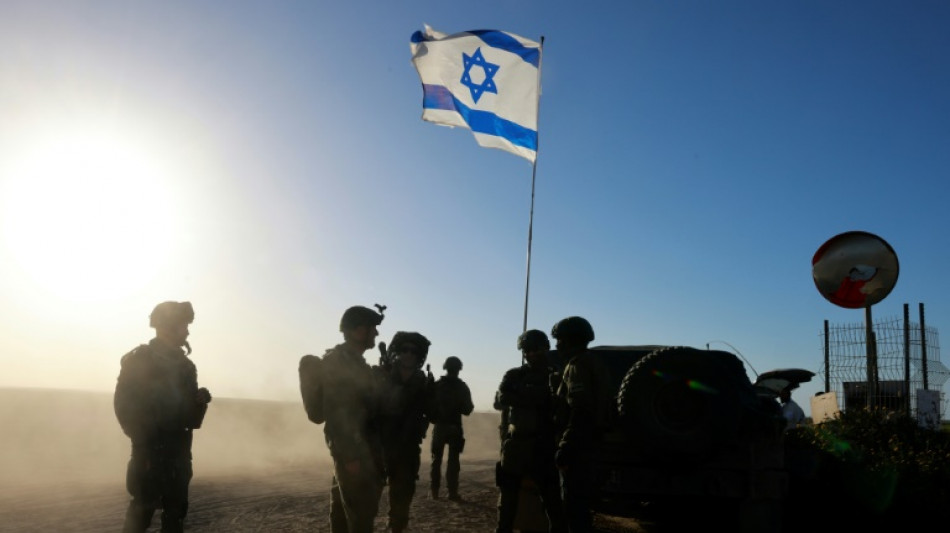
Diplomatic push for Israel-Hamas ceasefire intensifies / Photo: Menahem Kahana - AFP
International mediators and Hamas delegates were in Cairo Tuesday for talks to try to secure a pause in the war in Gaza ahead of the start of the Muslim holy month of Ramadan.
Envoys from the Palestinian militant group and the United States were expected to meet with Qatari and Egyptian mediators for a third day of negotiations over a six-week truce, the exchange of dozens of remaining hostages for hundreds of Palestinian prisoners and the flow of aid to Gaza.
Israeli delegates have so far stayed away from the negotiations, despite growing diplomatic pressure for a truce before Ramadan early next week.
Israeli media reported that the country's mediators boycotted the talks after Hamas failed to provide a list of living hostages.
Senior Hamas leader Bassem Naim told AFP however, that details on the prisoners "were not mentioned in any documents or proposals circulated during the negotiation process".
Israel has said it believes 130 of the 250 captives taken by Hamas in the October attack that triggered the war remain in Gaza, but that 31 have been killed.
As conditions in the besieged Palestinian territory deteriorate and the spectre of famine looms, Israel is facing increasingly sharp rebuke from its top ally the United States.
Vice President Kamala Harris expressed "deep concern about the humanitarian conditions in Gaza" during talks in Washington on Monday with Israeli war cabinet member Benny Gantz.
The same day, the World Health Organization said an aid mission to two hospitals in northern Gaza had found horrifying scenes of children dying of starvation, amid dire shortages of food, fuel and medicines.
"The lack of food resulted in the deaths of 10 children," said WHO chief Tedros Adhanom Ghebreyesus after the agency visited the Al-Awda and Kamal Adwan hospitals over the weekend.
In Gaza's main southern city Khan Yunis, which has seen heavy fighting, people described finding decomposing bodies lying in streets lined with destroyed homes and shops.
"We want to eat and live. Take a look at our homes. How am I to blame, a single, unarmed person without any income in this impoverished country?" said Nader Abu Shanab, pointing to the rubble with blackened hands.
- UN tensions -
The Hamas attack on southern Israel on October 7 resulted in about 1,160 deaths, most of them civilians, according to an AFP tally based on official Israeli figures.
Israel's retaliatory offensive has killed 30,534 people, mostly women and children, according to the health ministry in the Hamas-ruled territory.
Tensions between Israel and the United Nations erupted Monday, with Israel recalling its ambassador over the handling of allegations of sexual assault by Hamas militants during the October attack.
Israel has accused the United Nations of taking too long to respond to the claims, as the body published a report on Monday that said there were "reasonable grounds to believe" rapes were committed in Hamas' attack, and that hostages taken to Gaza have also been raped.
"In most of these incidents, victims first subjected to rape were then killed, and at least two incidents relate to the rape of women's corpses," the report said.
Shortly before the report's release, Israel said it was recalling its UN Ambassador Gilad Erdan over what it said was an attempt by the body to "silence" information of sexual violence by Hamas.
UN Secretary-General Antonio Guterres's spokesman denied trying to suppress the report.
Israel previously accused about a dozen employees of the United Nations agency for Palestinian refugees (UNRWA) of involvement in the October 7 Hamas attack that began the war.
UNRWA is at the centre of efforts to provide humanitarian relief in Gaza, where aid groups warn of looming famine after nearly five months of war between Israel and the Islamist group.
UNRWA on Monday said members of its staff had been tortured by Israel, with Israel's army accusing the agency of employing more than 450 "terrorists".
Phillipe Lazzarini, the head of UNRWA, has said that Israel provided no evidence against his former employees.
- Lebanon strikes -
The war has sparked violence across the region, including near-daily exchanges of fire between Israeli forces and Lebanon's Hezbollah movement.
"A diplomatic solution is the only way to end the current hostilities" and achieve "a lasting fair security arrangement between Lebanon and Israel", US envoy Amos Hochstein told reporters in Beirut on Monday, adding that "a temporary ceasefire is not enough".
"A limited war is not containable," he said after meeting with parliament speaker Nabih Berri, a Hezbollah ally.
On Monday, a foreign worker in northern Israel was killed and seven Indian workers were wounded in a missile strike near the Lebanese border, Israeli medics said.
Israel's army said late Monday it had carried out strikes on Hezbollah targets in southern Lebanon in response.
Hezbollah said three paramedics affiliated with the group had been killed in an Israeli strike.
Their claim came after marine security firm Ambrey reported a Liberian-flagged vessel was targeted and reportedly struck off Yemen.
burs-mca/lb
J.Jaspers--LCdB