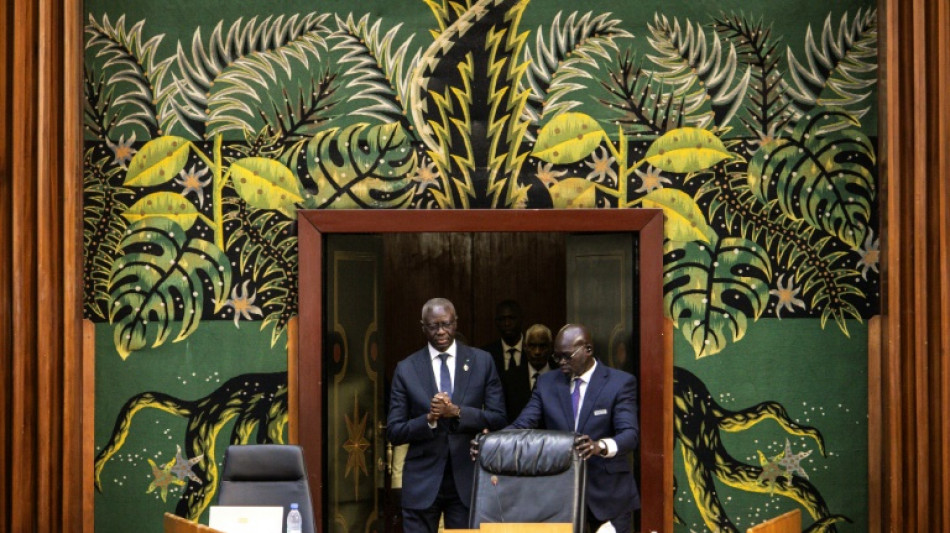
Senegal should vote at end of March after weeks of crisis / Photo: JOHN WESSELS - AFP
Senegalese voters should finally head to the polls at the end of March, following a string of announcements late Wednesday marking the latest twist in weeks of crisis triggered by the delay to the presidential election.
But there is still some confusion on the precise date of the first-round vote.
While President Macky Sall set March 24 as the date, Senegal's top constitutional body said it should take place on March 31.
Either way, the election would happen before Sall's mandate ends on April 2, which was one of the key drivers of the turmoil.
Sall sparked one of Senegal's worst crises in decades with his last-minute postponement of the presidential election, originally scheduled for February 25.
The poll delay triggered deadly protests in the traditionally stable West African country, with much of the opposition and civil society suspecting the president of trying to prolong his term in office.
No date has yet been set for the second round.
"Fixing the election date beyond the term of office of the current President of the Republic is contrary to the Constitution," the Constitutional Council said in a document authenticated by AFP Wednesday.
The constitutional body said it was taking the place of the executive, given the latter's "inertia" in setting the date.
Acknowledging the sudden change in the electoral calendar, the presidency late on Wednesday announced that Prime Minister Amadou Ba had been "released" from his post to lead the presidential campaign for Sall's camp.
He has been replaced by Interior Minister Sidiki Kaba, a spokesman said.
- Amnesty -
Sall had on Monday asked the Constitutional Council for its opinion on recommendations resulting from a "national dialogue" which he had convened to try and find a way out of the turmoil.
The dialogue had recommended elections be held on June 2 and suggested Sall remain in office until his successor is installed.
Senegal's Constitutional Council on Wednesday rejected the proposal that the election be held on June 2.
In a separate ruling, the Constitutional Council also said the presidential race should include the list of 19 presidential candidates already approved by the body.
The decision went against a recommendation proposed after the "national dialogue", which suggested the list of candidates should be re-examined.
The "national dialogue" to set a new election date had been one of President Sall's attempts to find a way out of the political turmoil.
The other was a controversial amnesty bill covering acts linked to deadly protests in recent years.
Lawmakers debated the bill and adopted it late Wednesday by 94 votes in favour and 49 against.
Critics say it would shield the perpetrators of serious crimes, including homicides.
The law grants an amnesty for all offences or crimes, whether tried or not, committed between February 1, 2021 and February 25, 2024 "relating to demonstrations or having political motivations".
- 'Calm political climate' -
Senegal witnessed several episodes of deadly unrest between 2021 and 2023, triggered in particular by a bitter stand-off between now-imprisoned opposition figure Ousmane Sonko and the state.
Dozens were killed, hundreds injured, and hundreds more arrested in riots which saw clashes with security forces and major damage to property.
Sonko, who came third in the 2019 presidential election, has been detained since July 2023 and was disqualified from this year's presidential race.
Questions had swirled around whether an amnesty would be applied to Sonko, and what this would mean for his possible return to the presidential race.
The decisions of the Constitutional Council appeared to rule out a comeback by Sonko.
But the amnesty could pave the way for his release from prison, as well as that of his party's number two, Bassirou Diomaye Faye.
The presidency has said the amnesty is intended to "calm the political and social climate".
The law "has reconciliation as its sole objective... President Macky Sall is not hiding any bad intentions," said Farba Ngom, an MP from the president's camp, during the debate.
Dozens of opponents could be freed as soon as the law is published, but many political and social actors oppose the bill.
"This law is a licence to continue murdering the Senegalese people. Amnesty law, amnesia law, not in my name. Justice for the murdered and tortured," said opposition MP Guy Marius Sagna during the parliamentary debate.
K.Cox--LCdB