Mediators struggle as Gaza war enters sixth month / Photo: - - AFP
Mediators struggled on Thursday to reach a truce in Israel's war with Hamas that entered its sixth month with dozens more killed, according to the health ministry in the Hamas-run territory threatened by famine.
The ministry said 83 more people had been killed over the previous day, adding to a toll it says has reached 30,800, mostly women and children, in a war that China called "a disgrace to civilisation".
Fighting began after an unprecedented October 7 attack by Hamas on southern Israel that resulted in about 1,160 deaths, most of them civilians, Israeli figures show.
The militants also took around 250 Israeli and foreign hostages, some of whom were released during a week-long truce in November. Israel believes 99 of them remain alive in Gaza and that 31 have died.
US President Joe Biden has urged Hamas to accept a ceasefire plan with Israel before the Muslim fasting month begins, as early as Sunday depending on the sighting of the crescent moon.
However, mediators in Egypt have struggled to overcome tough obstacles, while the United Nations has repeatedly warned that famine looms for Palestinians trapped by the fighting.
"It is a tragedy for humankind and a disgrace for civilisation that today, in the 21st century, this humanitarian disaster cannot be stopped," said Chinese Foreign Minister Wang Yi.
China, historically sympathetic to the Palestinian cause, has been calling for a ceasefire since the war began.
- 'What can we do?' -
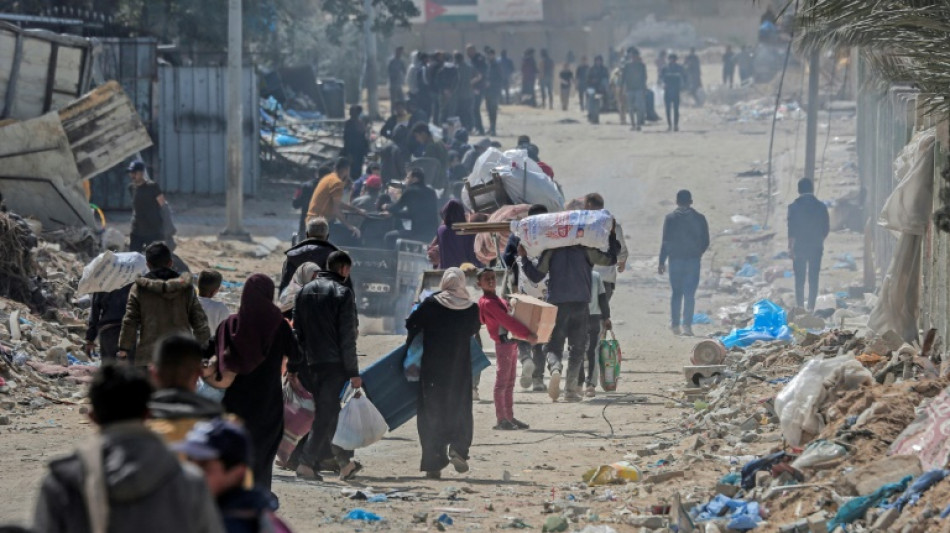
By late January the war had damaged around half of all buildings in Gaza and rendered the territory "uninhabitable" for its 2.4 million people, a UN agency said, warning the impact would only worsen if the war continued.
The health ministry on Wednesday said 20 people have died of malnutrition and dehydration, at least half of them children. One of the latest victims was a 15-year-old girl who died at Gaza City's Al-Shifa Hospital, it said.
Only limited aid has reached Gaza's north.
The United Nations on Wednesday again cited "access constraints" as among the factors limiting essential water and other services, while United States Vice President Kamala Harris has said Israel "must not impose any unnecessary restrictions" on aid delivery.
"Children are dying of hunger-related diseases and suffering severe levels of malnutrition," the World Food Programme (WFP) said.
In the wasteland of Jabalia, northern Gaza, Palestinians gathered to receive free meals at a donation point.
"There is no gas to cook our food on. There is no flour, or rice," said Bassam al-Hou, standing beside large, blackened cooking pots among the dusty rubble.
He said children "are dying and fainting in the streets from hunger. What can we do?"
The health ministry said more than 100 people were killed in chaos last week when thousands of people swarmed aid trucks. Gaza officials blamed the deaths on Israeli gunfire, while the army insisted most were trampled or run over.
Another truck convoy was diverted by Israeli troops within Gaza late on Tuesday and then stopped by "a large crowd of desperate people who looted the food", the WFP said.
- Rescued from rubble -
Such incidents will continue unless aid can "really flood" the north, said James McGoldrick, interim UN humanitarian coordinator for the Palestinian Territories.
"We've been given the green light" from Israeli authorities to use a military road on the eastern side of Gaza to reach the north, McGoldrick said.
In Khan Yunis, southern Gaza's largest city, dozens of people went to inspect their homes and take what belongings they could recover after Israeli forces pulled out of the city centre, an AFP correspondent said.
Gaza's Civil Defence agency said Israeli forces "destroyed all water, sewage, electricity, communications, and road networks" in central Khan Yunis.
The army has yet to respond to an AFP request to confirm a withdrawal from the area, but both the army and Hamas authorities said military operations were continuing in the city's western area.
Witnesses told AFP violent clashes had also occurred in the Zeitun district of Gaza City and Shuka, a village in Rafah, where around 1.5 million people have sought refuge near the Egyptian border but have been unable to escape the fighting.
Hala Hazem Hamada, 15, was rescued on Tuesday after three days under the rubble of a home where her family had sought shelter near Khan Yunis. An encounter with Israeli troops left six members of her family dead, including her parents.
- Pressure -
Israeli Prime Minister Benjamin Netanyahu has faced increasing public pressure over the fate of hostages still held in Gaza, and from a resurgent anti-government protest movement.
The war has highlighted deep divisions between Netanyahu and Benny Gantz, a member of his war cabinet who made an unauthorised trip to Washington and London this week.
Netanyahu has vowed to push on with the campaign to destroy Hamas, before or after any truce deal. Hamas has insisted on a full Israeli withdrawal and complete ceasefire.
The proposed deal would pause fighting for "at least six weeks", see the "release of sick, wounded, elderly and women hostages" and allow for "a surge of humanitarian assistance", the White House said.
South Africa petitioned the International Court of Justice on Wednesday to impose more emergency measures against Israel over what it described as "widespread starvation" in Gaza.
The war claimed its first reported fatalities after months of missile and drone attacks by Iran-backed Yemeni rebels on ships in the Red Sea area vital for world trade.
The US military said the crew reported three fatalities after a Huthi missile hit the Barbados-flagged, Liberian-owned M/V True Confidence.
burs-it/dv
W.Blondeel--LCdB