Plans gather pace for Gaza maritime aid corridor / Photo: - - AFP
The United States plans gathered pace on Friday to get aid by sea into Gaza, where the UN has repeatedly warned of famine and Israel has been accused of limiting aid as it battles Hamas militants.
In his annual State of the Union address to Congress, President Joe Biden said the US military would "lead an emergency mission to establish a temporary pier in the Mediterranean on the coast of Gaza that can receive large shipments carrying food, water medicine and temporary shelters."
Senior administration officials said this effort builds on an initiative proposed by Cyprus for a maritime aid corridor. In the Cypriot port of Larnaca on Friday, European Union chief Ursula Von der Leyen expressed hope the corridor could open this Sunday.
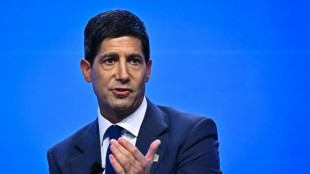
The United States and other countries have already been parachuting food and other assistance into Gaza but air or sea delivery is not the best way, said Sigrid Kaag, the United Nations aid coordinator for the Palestinian territory.
"The diversification of the supply routes via land" remains the optimal solution, Kaag said.
Biden, whose administration has been increasingly vocal about the war's consequences for civilians, delivered some of his strongest comments yet, as hopes dimmed for a new truce before Ramadan, the Muslim holy month which could begin Sunday depending on the lunar calendar.
"To the leadership of Israel I say this -- humanitarian assistance cannot be a secondary consideration or a bargaining chip," said Biden, whose country provides billions of dollars in military aid to Israel.
- Trucks queueing -
The war in Gaza began after Hamas's unprecedented October 7 attack on southern Israel that resulted in about 1,160 deaths, most of them civilians, according to Israeli figures.
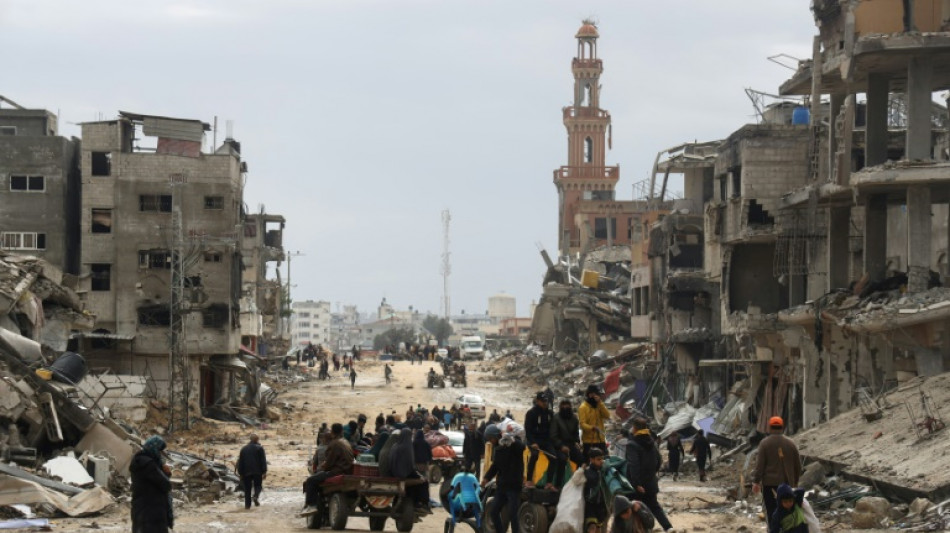
Israel has responded with a relentless bombardment, alongside a ground offensive, that the health ministry in Hamas-run Gaza said has killed at least 30,878 people, mostly women and children.
It said the latest toll includes 78 fatalities over the previous 24 hours.
US officials said a "number of weeks" would be required before aid deliveries to the planned port could begin, but they said the administration would not "be waiting on the Israelis".
The temporary port will feature a pier that will "provide the capacity for hundreds of additional truckloads of assistance each day", a senior Biden administration official said.
The United Nations has cited "access constraints" as among the factors limiting essential water and other services.
The situation is particularly acute in Gaza's north, where residents have been forced to eat animal fodder and even leaves.
"I saw kilometres (miles) of trucks queueing on four lanes, all waiting to get into Gaza" from Egypt, Delomier, 61, told AFP in France after eight days in Gaza for Handicap International - Humanity & Inclusion (HI).
"Planes fly over to drop a few pallets, whereas just behind (the border) there are kilometres of pallets waiting that could just be let in," he said.
Desperate Gazans have swarmed the aid trucks which do make it in to the territory.
- A bloodied shroud -
On February 29, in one such incident in north Gaza, more than 100 people were killed when Israeli forces opened fire on crowds scrambling for food aid from a convoy, according to the health ministry.
But the Israeli army on Friday said its initial probe found troops "fired precisely" at suspects who posed a threat to them.
A UN report said February saw a 50 percent increase in coordinated aid missions facilitated by Israel across Gaza, though few were in the north.
Manal Draymali, 44, a Palestinian woman displaced to Rafah, in Gaza's far south, said that with firewood scarce, "we scavenge for plastic and other discarded items from trash" to cook.
She and others said they had nothing to celebrate on Friday's International Women's Day.
Roughly 1.5 million Palestinians have sought refuge in Rafah on the Egyptian border but there, too, they are not safe.
At the city's Al-Najjar hospital, a man held the body of a child shrouded in a white cloth soaked through with blood. The child was among several people killed in strikes that hit a residential area, an AFP correspondent said.
Biden had urged Hamas to accept a ceasefire plan with Israel before Ramadan, but Hamas negotiators left talks with mediators in Egypt to consult with the movement's leadership in Qatar.
Hamas's delegation voiced dissatisfaction with Israeli responses so far before leaving Cairo, although US ambassador to Israel Jack Lew denied the talks had "broken down".
- Truce efforts continue -
A Hamas official also said negotiations were not over.
"The mediators informed Hamas that efforts will continue to reach an agreement," the official told AFP, requesting not to be named as he was not authorised to speak on the matter.
Israeli war cabinet member Gadi Eisenkot said Hamas was under "very serious pressure" from mediators to make a "counter-offer".
"Then it will be possible to advance it and take a position," he said.
In their October attack, Hamas militants took about 250 Israeli and foreign hostages, some of whom were released during a week-long truce in November. Israel believes 99 hostages remain alive in Gaza and that 31 have died.
Israeli Prime Minister Benjamin Netanyahu has faced increasing public pressure over the fate of hostages still held, and from anti-government protests.
He has vowed to press on with the campaign to destroy Hamas, before or after any truce deal.
The impact of the war has been felt across the Middle East, including in the Red Sea area vital for world trade where Yemen's Huthi rebels have repeatedly fired drones and missiles at ships.
The US military said Friday it had conducted another round of "self-defence strikes" against rebel targets in Yemen.
burs-it/dv
B.Janssens--LCdB