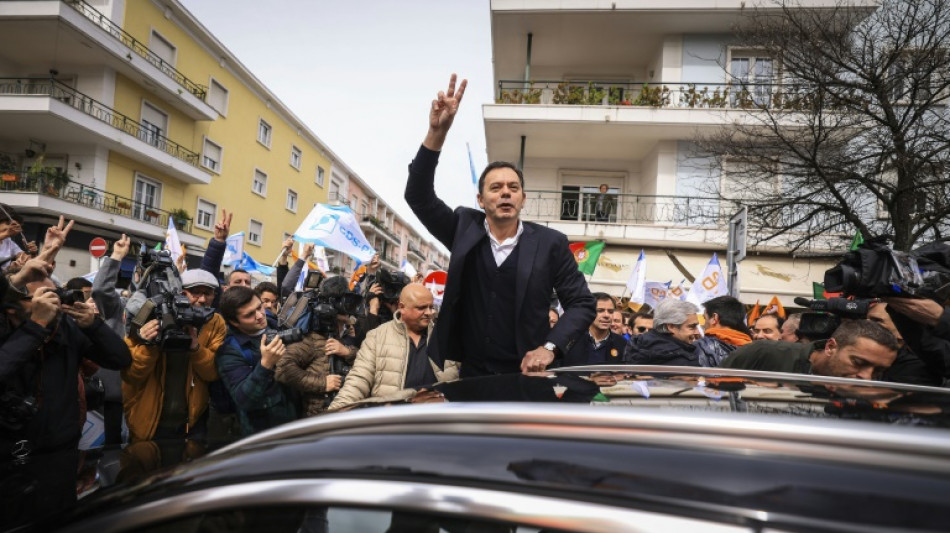
Campaigning wraps up in Portugal snap vote with right ahead / Photo: PATRICIA DE MELO MOREIRA - AFP
Waving colourful flags, hundreds of campaigners took to Lisbon's streets on Friday ahead of Portugal's weekend snap election, with polls giving the opposition centre-right an edge after eight years of Socialist rule.
Support for the Democratic Alliance (AD) has inched up in the final days of the campaign to hit 32.6 percent against the Socialists' 27.9 percent, according to Radio Renascenca's poll aggregator.
But analysts warned the results of Sunday's general election remained wide open due to the large number of undecided voters.
Far-right party Chega, led by former television football commentator Andre Ventura, is tipped to more than double the 7.2 percent it won in the last election in 2022.
That scenario would make it a kingmaker in a new parliament and add momentum to Europe's swing to the populist right.
Angela Loureiro, a 51-year-old lawyer, brought her 16-year-old daughter to an AD street rally in Lisbon's upscale Alvalade neighbourhood.
"I am tired of these incompetent people who have governed us. It is unthinkable that this country has regressed in eight years," she told AFP as other AD supporters waved orange party flags around her.
The election, Portugal's second in two years, was called after Socialist leader Antonio Costa, 62, resigned in November following an influence peddling probe that involved a search of his official residence and the arrest of his chief of staff.
Costa himself has not been accused of any crime but he decided not to run again.
Under Costa, unemployment has dropped, the economy expanded by 2.3 percent last year -- one of the fastest rates in the eurozone -- and public finances have improved.
But surveys indicate many voters feel Costa's government squandered the outright majority it won in 2022 by failing to improve unreliable public health services and education, or address a housing crisis that has sparked noisy street protests.
"The positive macroeconomic context is not reflected in the quality of life of the Portuguese because of inflation, low wages or problems with state services," said political scientist Marina Costa Lobo of Lisbon's Social Sciences Institute.
- 'New energy' -
Costa defended his record during a lunch with party supporters and said the Socialists' new leader, 46-year-old economist and former infrastructure minister Pedro Nuno Santos, "would give a new impetus, a new energy to the path we began in 2015".
If the polls are accurate and the AD comes first but falls short of an outright majority, it could still struggle to form a government.
The party's leader, 51-year-old lawyer Luis Montenegro, has steadfastly refused any post-election agreement with anti-establishment party Chega, which has said it would demand to be part of a rightist coalition government in exchange for parliamentary support.
Montenegro "has ruled out any post-election agreement with Chega. However, this may prove the only way for the centre-right party to govern," said Agnese Ortolani, principal economist at the Economist Intelligence Unit.
Chega's "potential inclusion in or support for a Democratic Alliance-led right-wing coalition would shift policy further to the right".
- Far right woos youths -
Founded in 2019, Chega calls for tougher measures to fight corruption, stricter controls over immigration and chemical castration for paedophiles. Its campaign billboards feature the slogan: "Portugal needs a clean-up".
And as in other European nations where the far right has gained ground, Chega has grown faster among youths than older people. Polls indicate it is the most popular party in Portugal among those aged 18-34.
At a Chega rally in Caparica, a southern Lisbon suburb, Joseph Reis, a 20-year-old student, said he believed the party "will do the things that are needed to get the country out of the state it is in more quickly."
F.Claes--LCdB