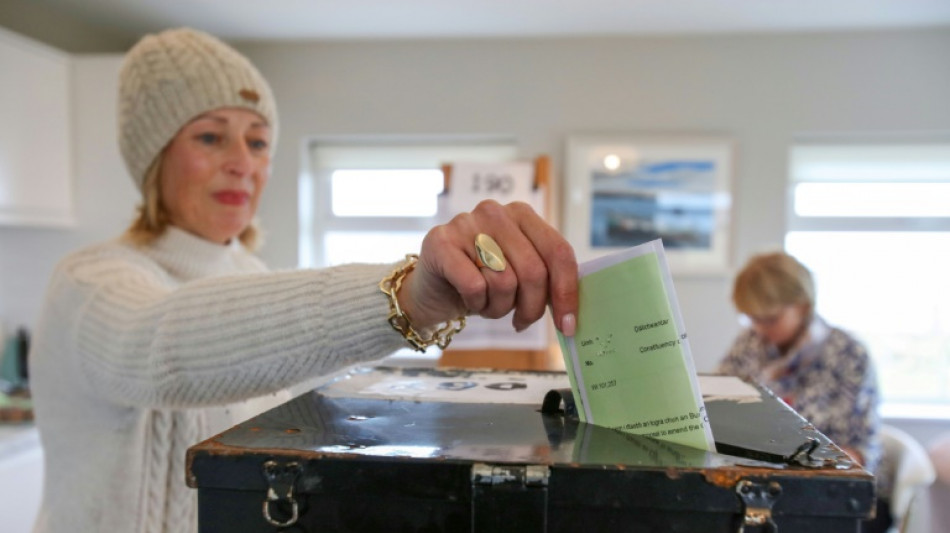
Ireland referendum on family and women's roles defeated: Varadkar / Photo: PAUL FAITH - AFP
A dual referendum in Ireland on redefining family and women's roles in the constitution has been defeated, Prime Minister Leo Varadkar said on Saturday.
The government had supported the proposed changes, which would have widened the definition of the family and clarified out-dated language about the duties of women in society.
"I think it's clear at this stage, that the family amendment and the care amendment referendums have been defeated," Varadkar said at a press conference in Dublin.
The votes are the latest attempt to reflect the changing face of European Union member Ireland, and the waning influence of the once-dominant Catholic Church.
But by 1200 GMT it was clear that counting was showing a trend towards a "No" on the two questions about care and family.
- Defeated comprehensively -
Varadkar said the referendums had been "defeated comprehensively on a respectable turnout".
"It was our responsibility to convince a majority of people to vote yes," he said.
"I think we struggled to convince people of the necessity or need for the referendum at all, let alone detail the wording.
"That's obviously something we're going to have to reflect on into the weeks and months ahead."
The two proposals -- called the family amendment and the care amendment -- aimed to change the text of Article 41 in the Irish constitution, written in 1937.
The first asked citizens to expand the definition of family from those founded on marriage to also include "durable relationships" such as cohabiting couples and their children.
The second proposed replacing old-fashioned language around a mother's "duties in the home" with a clause recognising care provided by family members to one another.
The constitution, the core legal text of the nation, can only be modified through a national referendum.
The country of 5.3 million opted to end constitutional limits on same-sex marriage in 2015 and abortion in 2018.
- Smooth passage -
All the major political parties had supported a "Yes-Yes" vote and until recently polls predicted a smooth passage for both on International Women's Day.
But "No" campaigners argued the concept of "durable relationship" was undefined and confusing and that women and mothers are being "cancelled" from the constitution.
Meanwhile, ultra-conservative voices argued the changes could constitutionally protect polygamous relationships and increase immigration via migrant family reunions -- claims all denied by the government.
Sinn Fein leader Mary Lou McDonald told reporters the government had failed to convince voters to vote "yes" by not consulting with the opposition "or with other stakeholders."
"People were left with an unbalanced decision to make and I think it's a great pity that the government went on this kind of solo run, and they've had their answer," she said.
Ireland's deputy leader, Micheal Martin has said "the majority were not persuaded by the arguments for changing the Constitution in this way".
"While the constitutional change was rejected, it is clear that the need for continued action to support families and to respect principles of equality was not challenged," he said in comments quoted by the Irish Times.
Peadar Toibin, the leader of conservative Aontu part -- the only parliamentary party to back a "No-No" vote -- told AFP that the outcome of the referendums was "a significant victory" for the people against the political establishment.
The government "sold these amendments as if they were progressive and kind of virtue signalling changes to the Constitution," he said.
Final results in both votes are expected by late Saturday.
Nearly 3.5 million people were eligible to cast their ballot.
L.Moonen--LCdB