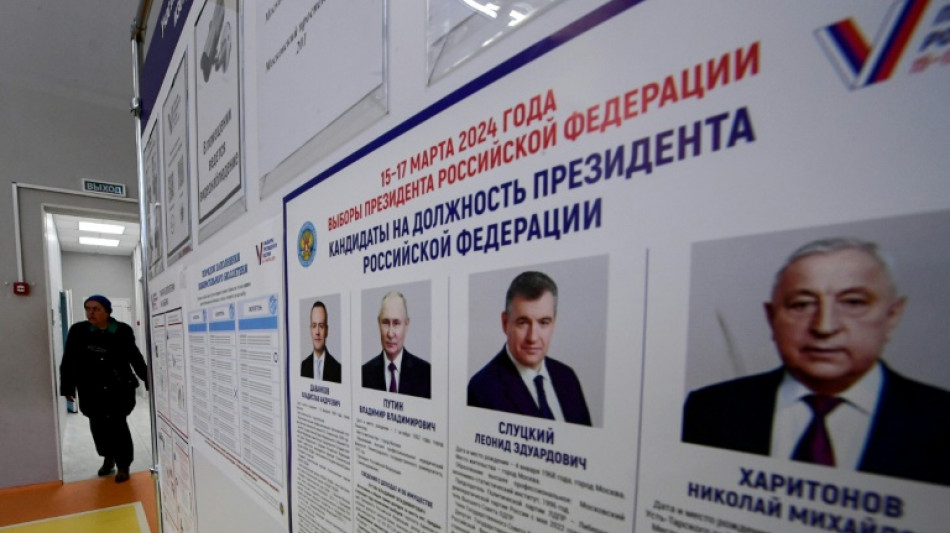
Russian ballot boxes vandalised as presidential vote starts / Photo: Olga MALTSEVA - AFP
The first day of voting in Russia's presidential election was marred by acts of vandalism at polling stations Friday, with at least nine arrests for pouring dye into ballot boxes and arson attacks.
Vladimir Putin is set to secure another six years in the Kremlin after a three-day vote he has cast as a show of Russians' loyalty and support for his military assault on Ukraine, now in its third year.
Despite authorities warning that election-day protesters faced heavy punishment, at least nine were arrested for acts of vandalism at polling stations.
In Moscow, video showed a woman setting a voting booth alight, filling a polling station with smoke, while another showed a woman pouring green dye into a ballot box.
Four others in the Russian regions of Voronezh, Karachay-Cherkessia and Rostov were detained for similar offences, while in Saint Petersburg and the Siberian region of Khanty-Mansi, women were detained for throwing Molotov cocktails at polling stations.
A man was detained for lighting fireworks inside a polling station in the Urals city of Chelyabinsk, while in Russian-occupied southern Ukraine, an explosive device was detonated at a voting site.
Close to the border with Ukraine, a wave of Ukrainian drone and artillery strikes killed two people in the Belgorod region.
- 'Not to stray' -
Russia also launched one of its deadliest missile attacks of the conflict, killing at least 14 in a strike on the Black Sea port city of Odesa.
The strikes cap one the heaviest weeks of aerial attacks since the start of conflict and come after a week of cross-border raids by pro-Kyiv guerilla fighters, bringing Putin's two-year conflict into Russian territory once again.
In power as president or prime minister since the final day of 1999, victory in the three-day vote would allow Putin to stay in power until 2030 -- longer than any Russian leader since Catherine the Great in the 18th century.
On the eve of the vote, Putin urged Russians to back him in the face of a "difficult period" for the country.
"We have already shown that we can be together, defending the freedom, sovereignty and security of Russia ... Today it is critically important not to stray from this path," he said Thursday on state TV.
The Kremlin leader's confidence is riding high.
His troops have secured their first territorial gains in Ukraine in nearly a year and his most strident opponent of the last decade, Alexei Navalny, died in an Arctic prison colony last month.
- 'Above all, victory' -
In Moscow, a few dozen residents queued in the morning sun to be among the first in the capital to cast their ballots.
"It's important to vote, for Russia's future," said 70-year-old Lyudmila.
She backed Putin and was hoping for "above all, victory" in Ukraine, she said.
Another Putin voter, Natan, 72, said he wanted the government to "increase employment, work to ensure that there is no war, stability in the country".
With all of Putin's major opponents dead, in prison or in exile, the outcome of the vote is not in any doubt.
Election authorities barred the few genuine opposition candidates who tried to run against Putin and a state-run pollster predicted this week that Putin would secure more than 80 percent of the vote.
Western governments and Kyiv have denounced the election as a "sham" and "farce".
- 'Landslide victory' -
Voting was also being organised in occupied parts of eastern Ukraine that Russia claims to have annexed.
Armed soldiers in full combat gear accompanied election officials in the eastern Donetsk region as they set up mobile voting stations on small tables in the street and on the hoods of Soviet-era cars.
Kyiv said holding the election in eastern Ukraine and Crimea, which Russia annexed in 2014, was "illegal."
On Friday, European Council President Charles Michel sarcastically congratulated Putin on his "landslide victory".
It was unclear whether the spate of polling station incidents was a coordinated protest against the ballot or isolated incidents.
Russia's opposition has called for voters to form queues at polling stations on Sunday, the final day of voting, as a form of protest.
Moscow prosecutors warned Friday that they would punish anybody involved in mass rallies.
- Aerial attacks -
Putin put his offensive on Ukraine front and centre of his campaign.
But the fallout from Putin's military offensive risked overshadowing his election procession at home.
Kyiv launched some of its largest air attacks on Russia this week -- some reaching hundreds of kilometres into Russian territory -- and pro-Kyiv guerilla fighters have staged a series of brazen cross-border raids.
Ukrainian attacks on the Belgorod border region on Friday killed at least two people, the regional governor said. Three children were killed in the Russian-held Ukrainian city of Donetsk, its mayor said.
Kremlin spokesman Dmitry Peskov told reporters on Friday the saboteurs were "trying to destabilise the elections, one way or another".
Russia's FSB security agency also announced a flurry of arrests of Russians it said were plotting attacks on crucial infrastructure to try to disrupt the elections and thwart Russia's military offensive.
Y.Simons--LCdB