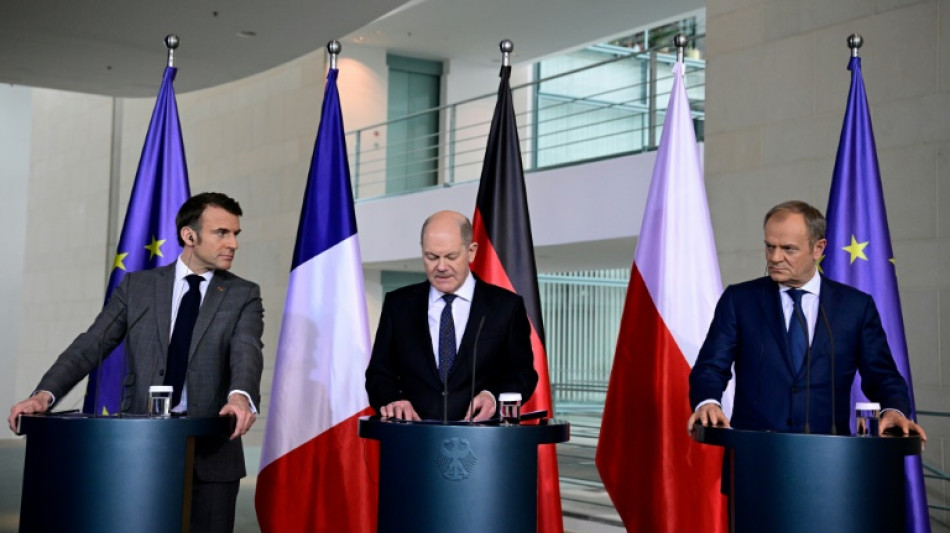
Scholz, Macron and Tusk affirm unity on Ukraine / Photo: Tobias SCHWARZ - AFP
Germany, France and Poland made a show of solidarity behind Kyiv, as the leaders came together in Berlin on Friday to mend their disagreements on how to support Ukraine in its war against Russia.
The three countries of the so-called Weimar Triangle were "united" in their aim to "never let Russia win and to support the Ukrainian people until the end", French President Emmanuel Macron said.
Allied help would continue for "as long as it takes", German Chancellor Olaf Scholz said standing next to Macron and the Polish Prime Minister Donald Tusk.
"The Russian president should know we will not let up in our support for Ukraine," Scholz told journalists, who were not given an opportunity to ask questions.
The chancellor and the French president came together before the three-way talks on Friday to clear the air after weeks in which the two very publicly disagreed over their Ukraine strategy.
Simmering disagreements between the two over the delivery of long-range missiles to Kyiv and the possibility of joining the conflict threatened to undermine cooperation between the allies.
Macron's taboo-breaking refusal last month to rule out putting troops on the ground in Ukraine also prompted a stern response from Berlin and other European partners.
The French president has not recanted from his position, but stressed that Western allies would not take the initiative.
"We will continue -- as we have since the first day -- to never prompt an escalation," Macron said Friday.
- 'One voice' -
Friday's meeting showed that talk of discord between Ukraine's backers is "not correct", Tusk said.
"Today we spoke with one voice", he added.
Ahead of the three-way summit, the Polish premier said the trio had "to mobilise all of Europe" to provide Kyiv with much-needed aid.
Ukraine has recently faced a series of battlefield setbacks, as its forces have run critically low on ammunition and Western aid has dried up.
A massive US aid package of $60 billion remains blocked in Congress by right-wing Republicans.
President Joe Biden acknowledged Tuesday that stopgap aid from the United States of $300 million dollars was "not nearly enough".
The EU is pushing to bolster weapons and ammunition production by its defence industry, but with the war now in its third year, it is still struggling to ramp up output.
To respond to the shortfall, Ukraine's European backers would look further afield for new supplies, following a Czech initiative from February to purchase extra ammunition outside the EU.
Efforts to increase production would continue, including "with partners in Ukraine", Scholz said.
- 'Capabilities and means' -
The allies would also work together to supply "long-range rocket artillery" to Ukraine through an already announced voluntary coalition, Scholz said.
The delivery of weapons with the capacity to hit deep behind Russian lines has been a sore point for the chancellor.
The deployment of the long-range missiles would risk dragging German soldiers into the conflict and risk an escalation, Scholz has said by way of explanation.
The chancellor did not mention the Taurus in his statements to the press on Friday.
The issue has been a particular source of tension between Scholz and Macron, who has pointedly urged allies not to be "cowards" in supporting Ukraine.
Macron welcomed the creation of a "coalition on deep strikes" that was "open to all according to their capabilities and means".
R.Michiels--LCdB