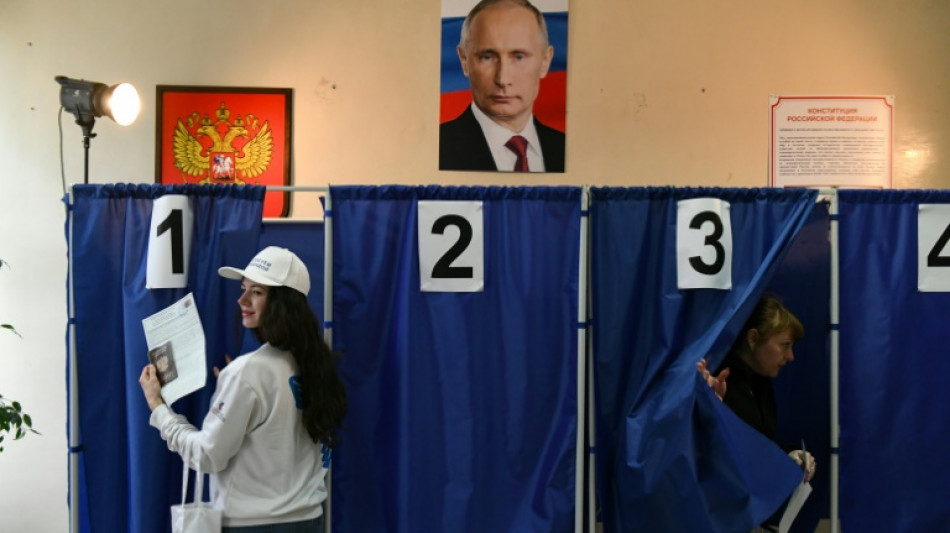
Protest call as Russian vote to confirm Putin wraps up / Photo: STRINGER - AFP
Kremlin critics called for massive protests at Russian polling stations on Sunday for the final day of a presidential election that is guaranteed to cement Vladimir Putin's hardline rule.
The three-day vote has already been marred by a surge in fatal Ukrainian bombardments and a series of incursions into Russian territory by pro-Ukrainian sabotage groups.
There have also been acts of protest in the first days of polling, with a spate of arrests of Russians accused of pouring dye into ballot boxes or arson attacks.
Before his death in an Arctic prison last month, opposition leader Alexei Navalny, who galvanised mass anti-Putin rallies, urged Russians to protest on Sunday.
His widow, Yulia Navalnaya, has reiterated his call in the run-up to the election and said protesters should show up in large numbers at the same time to overwhelm polling stations.
She called for protestors to spoil ballots by writing "Navalny" on them, or vote for candidates other than Putin.
Any public dissent in Russia has been harshly punished since the start of Moscow's offensive in Ukraine on February 24, 2022 and there have been repeated warnings from the authorities against election protests.
A Moscow resident in his twenties told AFP he would take part in the protest at 12:00 pm (0900 GMT) in the capital, "just to see young supportive faces around... feel some support around me, and see the light in this dark tunnel."
The man, who declined to give his name for security reasons, said he hoped the demonstration would show the authorities "that there are people in this country against the conflict... against the regime."
- 'Difficult period' -
The 71-year-old Putin, a former KGB agent, has been in power since the last day of 1999 and is set to extend his grip over the country until at least 2030.
If he completes another Kremlin term, he would have stayed in power longer than any Russian leader since Catherine the Great in the 18th century.
He is running without any real opponents, having barred two candidates who opposed the conflict in Ukraine.
The Kremlin has cast the election as an opportunity for Russians to show they are behind the assault on Ukraine, where voting is also being staged in Russian-held areas.
In a pre-election address on Thursday, Putin said Russia was going through a "difficult period".
"We need to continue to be united and self-confident," he said, describing the election as a way for Russians to demonstrate their "patriotic feelings".
The voting will wrap up in Kaliningrad, Russia's westernmost time zone, at 1800 GMT and an exit poll is expected to be announced shortly after that.
A concert on Red Square is being staged on Monday to mark 10 years since Russia's annexation of Ukraine's Crimea peninsula -- an event that is also expected to serve as a victory celebration for Putin.
- 'No validity' -
Ukraine has repeatedly denounced the elections as illegitimate and a "farce", and its foreign ministry has urged Western allies not to recognise the result.
UN Secretary-General Antonio Guterres, as well as more than 50 member states, have slammed Moscow for holding the vote in parts of Ukraine, with Guterres saying that the "attempted illegal annexation" of those regions has "no validity" under international law.
Ahead of the election, Russian state media have played up recent gains on the front and portrayed the conflict as a fight for survival against attacks from the West.
In Ukraine, a Russian missile strike on the Black Sea port city of Odesa on Friday killed 21 people including rescue workers responding to an initial hit -- an attack President Volodymyr Zelensky described as "vile".
On the Russian side, the army has reported repeated attempts by Ukrainian sabotage groups to cross into Russia and the local governor in Belgorod region on Saturday decreed that shopping malls and schools would be shut for two days in the main city Belgorod and the surrounding district following recent strikes.
B.Francois--LCdB