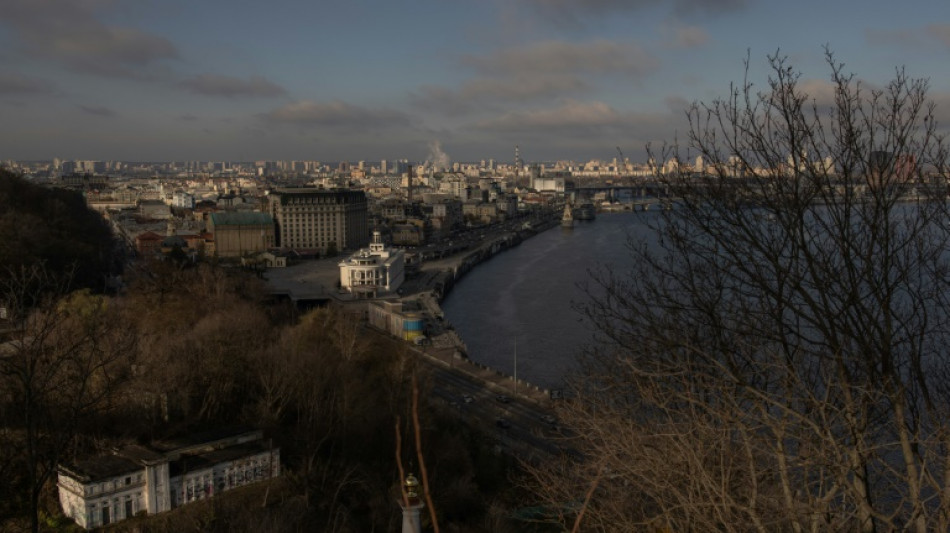
Explosions heard in centre of Ukraine capital Kyiv / Photo: Roman PILIPEY - AFP/File
Explosions rang out in the centre of Ukraine's capital on Thursday, following air alerts prompted by Russian missiles and drones, a day after several civilians were killed on both sides of the conflict.
Around ten loud blasts were heard by AFP journalists from 05:00 am (0300 GMT) in Kyiv, as well as air defence fire.
Ukrainian air defence forces shot down "about three dozen enemy missiles, including ballistic missiles, over Kyiv and in the vicinity of the capital," the city's military administration said on Telegram, adding that the raid had lasted three hours.
It said 10 people were wounded, including an 11-year-old girl and a 38-year-old man, with two taken to hospital.
Rocket fragments fell onto a kindergarten in the Sviatoshynskyi district of the capital, according to Kyiv mayor Vitali Klitschko, while an apartment building and a car caught fire in other areas of the city.
The last major Russian strikes on the Ukrainian capital took place at the end of January.
On Wednesday, a fresh round of aerial bombardments left civilians dead in Ukraine and Russia as strikes escalate in the third year of the war.
Ukrainian authorities reported five people killed by a Russian missile in Kharkiv, Ukraine's second-largest city, with another nine injured and five more unaccounted for as search and rescue operations continued into the night.
Kyiv's army is facing manpower and ammunition shortages amid political wrangling in the US Congress that has raised uncertainty over the future of Western support.
- 'Massive strikes' -
Directly across the border from Kharkiv, the governor of Russia's Belgorod region said multiple attacks had killed three people.
Since Wednesday, the region has come under "massive strikes, including with the use of multiple rocket launcher systems," Governor Vyacheslav Gladkov said on Telegram, referring to a border district targeted by air attacks and ground incursions by armed groups from Ukraine.
Two people were killed there, and another man was killed in the regional capital, also called Belgorod, when shrapnel from a shelling attack hit his car, Gladkov said.
Kyiv has escalated drone, rocket and artillery fire on the region over the last two weeks, in a wave of attacks launched in the lead-up to Russia's presidential elections. Pro-Ukrainian paramilitaries have also attempted armed raids across the border.
Some schools in Belgorod would shift to remote learning, Gladkov said, a day after he ordered 9,000 children to be evacuated from areas closest to the Ukrainian border.
In Moscow, Russian President Vladimir Putin has vowed to restore order to the border regions, as the fallout from his invasion continues to spill into Russian territory.
Russian forces have secured their first territorial gains in almost a year and this week claimed to have made further advances in the eastern Donetsk region.
In the south of the country, Russian shelling killed two people outside the city of Kherson, and in the east, another two were killed in the Donetsk region.
- Delayed international aid -
Ukrainian President Volodymyr Zelensky called for Western air defences after Wednesday's attack, increasing pressure on its key military backer, the United States, to unlock a $60-billion military aid package stalled in Congress.
Republicans in the US House of Representatives have been blocking a sweeping aid package since last year, with the funding caught up in domestic arguments over President Joe Biden's immigration policies.
Washington has provided tens of billions of dollars in support since Moscow invaded in February 2022.
Ukraine's Foreign Minister Dmytro Kuleba said Tuesday that he was shocked the aid package has not yet been unlocked.
Zelensky has said the West had vital air defence systems that could save Ukrainian lives if delivered to his country.
But despite the aid delay, Sullivan has said he was "confident" the impasse would be overcome.
Kyiv also signed security deals with Italy, Britain, France, Germany and Denmark in recent weeks.
Australia, which signed a new defence agreement with the United Kingdom on Thursday, has also agreed to join a coalition with the UK and Latvia that aims to supply drones for the Ukrainian war effort.
Ukraine's Prime Minister Denys Shmyhal said his country also received $1.8 billion in aid from Canada, part of $2.2 billion in financial and military support pledged by Ottawa.
"These are important funds that will help our government finance the deficit, including social programmes to help Ukrainians," Shmyhal said on Telegram late Wednesday.
B.Francois--LCdB