Fasting and funerals: Violence darkens West Bank Ramadan / Photo: RONALDO SCHEMIDT - AFP
Normally festive Ramadan nights have become rife with danger in the Israeli-occupied West Bank, said hospital director Wisam Bakr, as surging violence casts a long shadow over the Muslim fasting month.
His hospital in the northern West Bank city of Jenin has been on the front line of the spike in violence since Hamas's unprecedented October 7 attack on Israel triggered the war that is still raging in the Gaza Strip.
Instead of breaking the daily Ramadan fast with family and friends, "at night we try not to go outside... because the night is not safe," said Bakr.
"At any hour there may be a raid" by Israeli forces, he said.
As Israel pursues its withering military campaign to eliminate Hamas in Gaza, violence in the West Bank involving Israeli forces or settlers -- already rising before the war -- has spiked to levels unseen in two decades.
Since October 7, the Jenin Government Hospital has received 44 people killed and 264 people wounded in Israeli raids, said the director Bakr.
Beyond the casualties and damage the frequent military operations have caused, residents of Jenin -- a stronghold of Palestinian armed groups -- said the violence has translated into quiet streets, subdued celebrations and anxiety.
"There are no people" on the streets, said Mohammed Omar, a sweets vendor who has spent his whole life in Jenin refugee camp, one of the West Bank's most crowded and impoverished, and the site of repeated Israeli raids.
- 'Afraid for my children' -
According to Omar, the heavy atmosphere of this year's Ramadan can be felt not just in the immediate aftermath of raids and strikes, but also on relatively quiet days.
"People are staying in their homes, afraid of the bombing, and they don't have money to spend," he said.
Even if they did, they would likely have some trouble getting around, as many streets have been damaged and some rendered impassable by Israeli bulldozers carrying out demolitions.
Israel routinely demolishes the homes of Palestinians accused of carrying out attacks, arguing that such measures act as a deterrent, while critics say this policy amounts to collective punishment.
Bakr said the violence and fear had taken a toll on the hospital's staff and made for a much more reserved Ramadan.
Their work is high-pressure, with casualties often arriving at night and overwhelming emergency medics.
"Nowadays I hurry up" to get home after the daily fast ends at sunset, "because I'm afraid not only for me, but for my children too," Bakr said.
Last week Israeli forces killed two men inside the hospital, in what the military described as "counterterrorism activity" against "armed suspects".
In footage stored on Bakr's phone, one of the men, Mahmud Abu al-Haija, wearing jeans and a black sweater, is gunned down just outside the emergency ward, leaving a bright red streak of blood on the floor as others drag him away.
The man's aunt, Farha Abu al-Haija, told AFP that he was "neither a resistance fighter nor a weapon bearer", and that he had run to the hospital seeking safety.
Both of the slain men's bodies were draped in green Hamas flags and adorned with headbands of the militant group's armed wing for their funeral, AFP footage showed.
- 'Ramadan wasn't like this' -
"There is sadness, anger, pain."
At least 444 Palestinians have been killed by Israeli forces or settlers across the West Bank since October 7, according to the Palestinian health ministry.
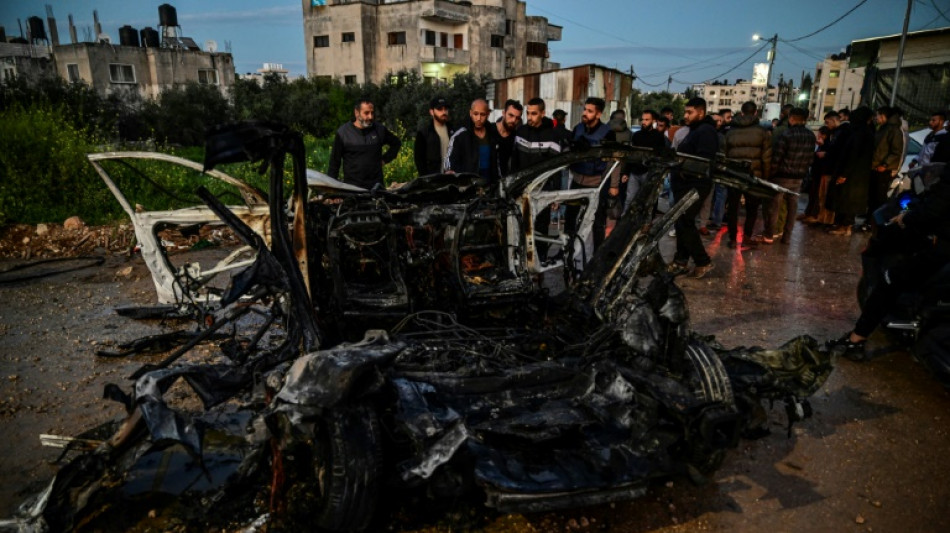
Mokhles Turkman was driving home from work on Wednesday, planning to break the fast with his family, when he heard a loud explosion -- a strike Israel said had targeted Palestinian militants.
As Turkman, 29, learned that the blast had killed three men, he abandoned his original plans and decided instead to join the funeral procession through the streets of Jenin.
One of those killed was an Islamic Jihad "commander", according to the Israeli military, which also accused him of a deadly attack last year that killed an Israeli civilian.
"Ramadan was never like this," Turkman told AFP, as young men fired automatic weapons into the sky and others lowered the three bodies into freshly dug graves.
He said he attended the funeral "to stand with the people".
"We want to stand with their families, let them know that we are all united."
H.Vermeulen--LCdB