Gang violence drives thousands from Haiti's capital, hunger sets in / Photo: Clarens SIFFROY - AFP
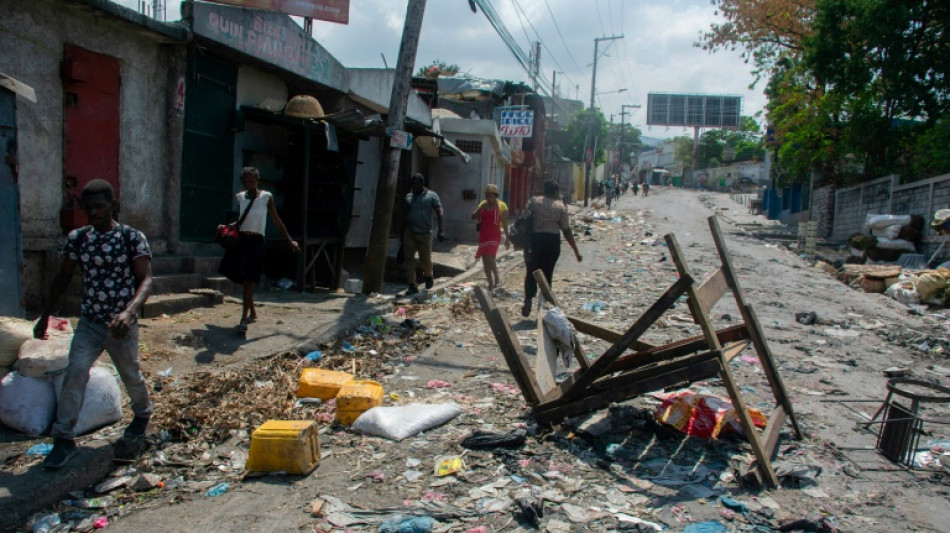
Rampant gang violence in Port-au-Prince has triggered the exodus of tens of thousands of people from the Haitian capital where Friday charred bodies lay in the streets and residents battled a growing food security crisis.
Following the latest clashes between police and heavily armed gangs, an AFP correspondent saw several bodies in the city center and in the suburb of Delmas. A resident told AFP he had seen more dead lying in another suburb, Petion-Ville.
The harrowing scenes played out as the tiny, impoverished Caribbean country continued to wait for the establishment of a promised transitional government meant to restore stability.
Added to the political chaos and street violence is the specter of desperate hunger.
Farhan Haq, a spokesman for the UN secretary-general, said new figures show nearly five million people -- about half the population -- face "crisis or worse levels of acute food insecurity" and that of these, some 1.6 million face "emergency" insecurity.
The UN's International Organization for Migration said that more than 33,000 people have fled the metropolitan area of Port-au-Prince in two weeks.
On Friday, there was an uneasy calm in the capital after a day marked by several gang attacks and a police operation which led to the death of a gang leader, Ernst Julme alias "Ti Greg."
He had escaped from prison during a mass breakout organized by gangs at the beginning of March.
Some roads were still barricaded and most businesses, schools and government offices were closed.
- Power vacuum -
Haitians seeking safety have mostly headed to the Great South area, which is already hosting 116,000 displaced people.
The host communities "do not have sufficient resources that can enable them to cope with these massive displacement flows coming from the capital," according to the International Organization for Migration.
Haiti has been rocked by violence for weeks, starting with the coordinated gang offensive to release thousands of prisoners and to demand the resignation of Prime Minister Ariel Henry.
Henry, stranded outside the country after the violence shut down the main airport, agreed on March 11 to step down and to allow the formation of an interim government.
But negotiations have been slow, despite pressure from neighboring Caribbean countries and the United States.
The impasse leaves Haiti rudderless after years of growing political and economic dysfunction.
President Jovenel Moise, who appointed Henry, was assassinated in 2021 and never replaced. Henry has led the country since, with no elections held since 2016.
The transitional council currently being organized would name an interim prime minister to oversee a national vote.
The gangs, meanwhile, are increasingly filling the power vacuum.
"Over the past few days, gangs have advanced into new areas of the capital," Ulrika Richardson, the UN humanitarian coordinator for the country, said on Thursday, describing an “extremely alarming” situation.
str-gma-abd-iba/mdl/sms/bgs
T.Luyten--LCdB