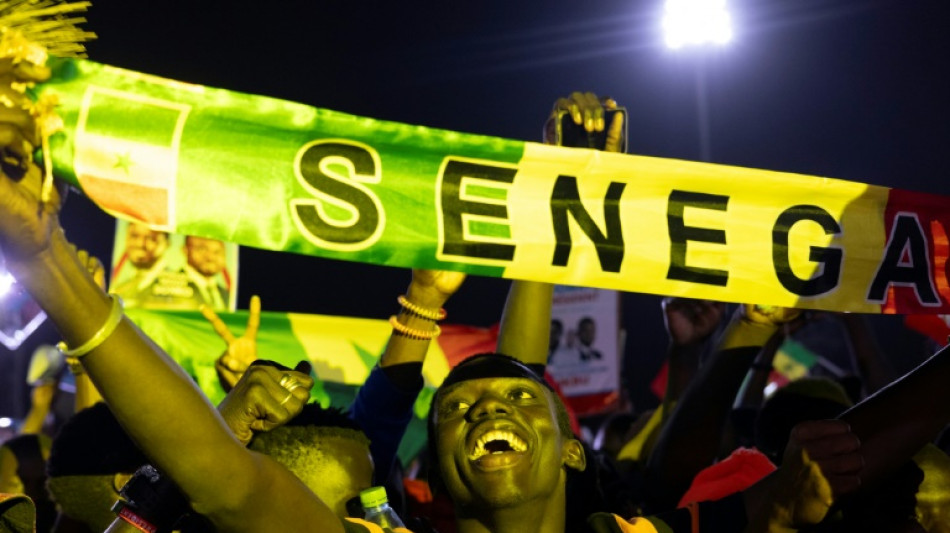
Senegal votes for new president after years of crisis / Photo: MARCO LONGARI - AFP
The Senegalese go to the polls on Sunday to elect a new president in a totally unpredictable race after three years of turmoil and political crisis.
Some 7.3 million voters are registered in the West African nation where two favourites have emerged: the ruling coalition's former prime minister Amadou Ba and anti-establishment candidate Bassirou Diomaye Faye.
They were both once tax inspectors but now appear to have little in common. Ba, aged 62, is offering continuity, while the 43-year-old Faye promises profound change and left-wing pan-Africanism.
Both say they will claim a first-round victory -- but a second round looks probable with 15 other candidates in the field, including a sole woman, at a date yet to be decided.
Former Dakar mayor Khalifa Sall, 68, is considered to have an outside chance.
The eventual winner will be tasked with steering traditionally stable Senegal out of its recent troubles, and managing revenues from oil and gas reserves that are shortly to start production.
Voting will end at 1800 GMT and provisional results could be known overnight. The first official results are expected during the coming week.
Senegal has traditionally been considered a beacon of democracy and stability in the coup-hit region, where Russia is strengthening its influence.
- Raucous campaign -
Hundreds of observers will be out representing civil society, the African Union, the ECOWAS regional group and the European Union.
A raucous campaign, lasting just two weeks after being shortened, followed a dramatic last-minute delay to the election date, originally scheduled for February 25.
President Macky Sall's intervention to delay the presidential vote sparked unrest that left four people dead.
Sall, who won praise abroad last year by renouncing a possible third-term bid, said he called off the vote over fears it would not go smoothly.
After weeks of political crisis, the country's top constitutional body stepped in and forced him to reset the date to March 24, despite clashing with the Muslim fasting month of Ramadan.
Sall's hand-picked would-be successor Amadou Ba has positioned himself as a last bastion against "bandits", and urged people to vote "for experience and competence instead of entrusting the reins of the country to adventurers".
"We don't need officials who need two years of apprenticeship," Ba said at his final campaign rally on Friday.
"We need to consolidate what we have. We need to go even faster and further."
He has vowed to create one million jobs in five years -- but he will also face the darker side of Sall's legacy which includes mass arrests, persistent poverty, with 20 percent unemployment and thousands setting off on the perilous voyage to Europe each year.
- Radical reform -
The recent unrest in Senegal was the latest chapter in episodes of violence since 2021, triggered partly by the stand-off between the firebrand opposition figurehead Ousmane Sonko and the state.
Economic and social tensions, as well as concerns that Sall would run for a third term, also fuelled the unrest that left dozens killed and hundreds arrested.
The election has also been fired up by a rapidly passed amnesty law that led to the March 14 release from prison of opposition leaders Faye and the charismatic Sonko.
Although Faye is Sonko's deputy, he is only on the ballot because Sonko has been barred from standing and in voters' eyes, they are a package deal.
The duo have attacked Ba as "the greatest danger facing Senegal today".
They have also questioned where his wealth came from, branding him a "billionaire civil servant" who "will be the president of foreign countries".
Faye pledged Friday to bring "radical reform" to Senegal, to renegotiate mining, oil and gas and defence contracts, while at the same time offering assurances to foreign investors.
"Henceforth we will be a sovereign State, independent, which will work with everyone, but in win-win partnerships", he said.
Sonko has drawn a passionate following with Senegal's youth through his rhetoric on sovereignty, as well as attacks on elites, multinationals and colonial ruler France.
Experts have warned of the potential for tensions to flare on Sunday and after -- particularly if Ba wins in the first round, or Faye fails to reach the second.
E.Celis--LCdB