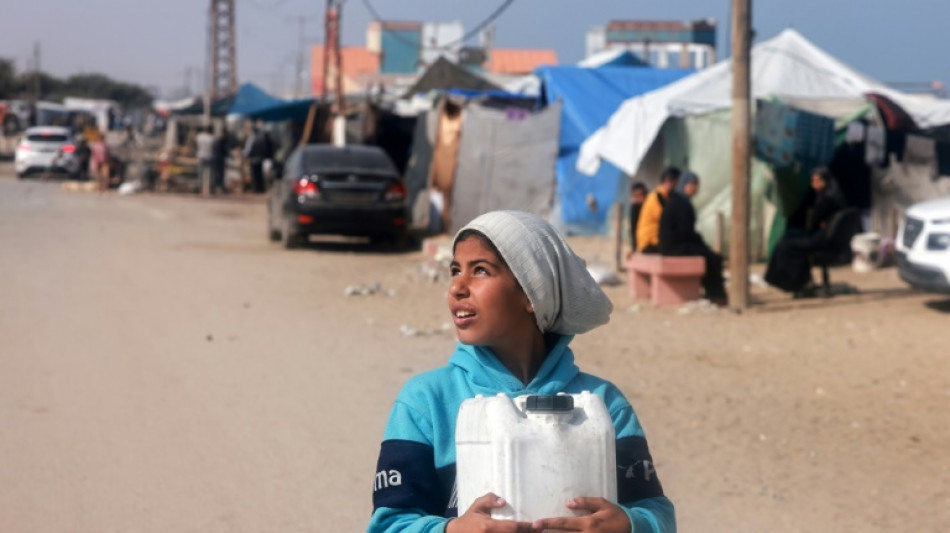
Deadly chaos at Gaza aid distribution as WHO renews hospital warning / Photo: MOHAMMED ABED - AFP
An aid delivery in Gaza descended into chaos on Saturday with shots fired and a Red Crescent paramedic reporting five people killed, as almost six months of Israeli bombardment has left hundreds of thousands in the Palestinian territory in desperate need.
Israel's siege, sparked by a deadly militant attack on October 7, brings nightly air strikes and in recent days major operations around several hospitals, which it says are used by Palestinian militant groups -- claims denied by Hamas.
The World Health Organization warned on Saturday that Gaza had just 10 "minimally functioning" hospitals for its more than two million people, with its chief Tedros Adhanom Ghebreyesus saying around 9,000 patients urgently needed treatment abroad.
UN agencies have warned repeatedly that the northern part of Gaza is on the verge of famine and called it a man-made crisis because aid lorries are backed up on the Egypt-Gaza border awaiting long checks by Israeli officials. Israel has denied responsibility.
The top UN court has ordered Israel to allow in aid and the UN Security Council has adopted a resolution demanding an "immediate ceasefire" but neither has affected the situation on the ground.
Israel and Hamas have been unable to agree a truce in indirect talks in Qatar, with each side blaming the other for the failure to reach a deal.
But Israeli Prime Minister Benjamin Netanyahu approved a new round of talks on Friday with negotiators expected to resume their work on Monday.
- 'Not enough aid' -
A Red Crescent paramedic at a nearby hospital said five people were killed and dozens injured by gunfire and a stampede during a rare aid distribution in north Gaza, which has received the least help.
Witnesses told AFP shots were fired both by Gazans overseeing the aid delivery and Israeli troops nearby, and panicked lorry drivers drove quickly away, hitting people trying to get the food. The Israeli military told AFP it had "no record of the incident described".
Aid deliveries have become increasingly fraught as the needs of Gazans increase.
Foreign powers have ramped up airdrops of aid but several people have been killed by falling crates, or stampedes or drowned trying to retrieve packages from the Mediterranean.
Two charities have organised aid deliveries by sea, with their second mission in just over two weeks setting sail from Cyprus on Saturday.
Their flotilla is carrying around 400 tonnes of supplies.
"There is not enough aid getting through to Gaza and we need to open as many ways as possible," Juan Camilo of World Central Kitchens, one of the charities, said in a video shot from the flotilla and posted on social media.
UN agencies have said repeatedly that overland deliveries are the only way of supplying aid in the volume needed.
Palestinian Dalia al-Afifi, displaced to Deir el-Balah in central Gaza, has constructed a home from the cans received in aid packages to "make a point to the world" about the plight of the territory.
"This must stop. Our lives are not just cans," she told AFP.
The Israeli bombardment continued apace into Saturday with the health ministry in the Hamas-run Gaza Strip saying at least 82 people were killed overnight.
The Hamas press office said "civilian houses" had been hit by dozens of Israeli strikes. The Israeli military said it had struck dozens of targets including militants and their compounds.
The war began with Hamas's October 7 attack that resulted in about 1,160 deaths in Israel, mostly civilians, according to an AFP tally of Israeli official figures.
Israel's retaliatory campaign against Hamas has killed at least 32,705 people, mostly women and children, according to the health ministry.
- Netanyahu under pressure -
With the health situation increasingly dire, Tedros said roughly 9,000 patients needed to leave Gaza for "lifesaving health services, including treatment for cancer, injuries from bombardments, kidney dialysis and other chronic conditions".
The WHO said Gaza had 36 hospitals before the war but now had only 10.
Israel's military accuses Hamas and the Islamic Jihad militant group of hiding inside medical facilities, using patients, staff and displaced people for cover -- charges the militants have denied.
The army said Saturday it "continued to eliminate" militants around Gaza's largest hospital, Al-Shifa, with around 200 reported killed after 13 days of its operation.
Hamas said Saturday Israeli troops were also continuing their "aggression" against Nasser Hospital and were besieging Al-Amal Hospital, both in the southern city of Khan Yunis.
In their October attack, Palestinian militants seized about 250 hostages. Israel believes about 130 remain in Gaza, including 34 who are presumed dead.
Netanyahu is under domestic pressure, facing regular demonstrations over his failure to bring home all the captives.
"Prime minister, on behalf of the hostage men and women, on behalf of the people of Israel, give the negotiators in Qatar the order. Do not return without a deal," said former hostage Raz Ben Ami during a rally in Tel Aviv.
A central plank in the truce talks in Qatar has been negotiating the release of the hostages alongside a truce and access for humanitarian aid.
The US is Israel's chief military backer, but tensions has been mounting with the US urging Netanyahu not to launch a full ground invasion of Rafah, the southern Gaza city where most of the population have fled.
The Wall Street Journal reported, citing unnamed officials, that Washington had nonetheless approved billions of dollars of bombs and fighter jets for Israel in recent days.
burs-jxb/kir
F.Claes--LCdB