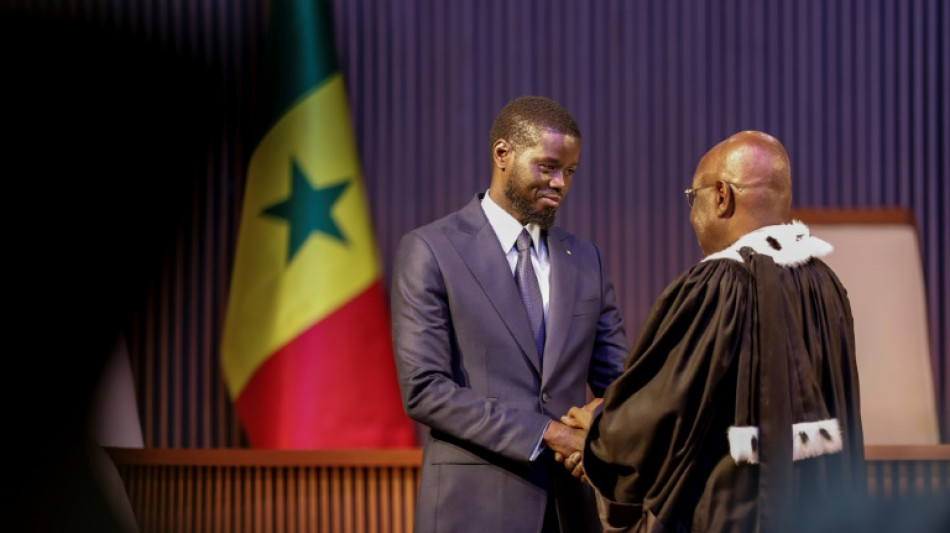
Senegal's youngest president Faye vows systemic change, sovereignty / Photo: John WESSELS - AFP
Senegal's left-wing pan-Africanist Bassirou Diomaye Faye was sworn in on Tuesday as the country's youngest president, pledging systemic change, greater sovereignty and calm after years of deadly turmoil.
The 44-year-old, who has never before held an elected office, swept to a first-round victory on a promise of radical reform just 10 days after being released from prison.
"Before God and the Senegalese nation, I swear to faithfully fulfil the office of President of the Republic of Senegal," Faye said before hundreds of officials and several African heads of state at an exhibition centre in the new town of Diamniadio, near the capital Dakar.
He also vowed to defend "the integrity of the territory and national independence, and to spare no effort to achieve African unity".
The former tax inspector becomes Senegal's fifth president since independence from France in 1960 and the first to openly admit to a polygamous marriage.
"I am aware that the results of the ballot box express a profound desire for systemic change," Faye said in a brief speech after taking the presidential oath.
Faye was among a group of political opponents freed from prison 10 days before the March 24 presidential ballot under an amnesty announced by previous president Macky Sall, who had tried to delay the vote.
Faye's campaign was launched while he was still in detention.
"I have painful memories of the martyrs of Senegalese democracy, the amputees, the wounded and the former prisoners," Faye said Tuesday, referring to the past three years of political unrest that left dozens dead and hundreds arrested.
"I will always bear in mind the heavy sacrifices made in order never to disappoint you," he added.
Faye said he clearly heard the "aspiration for greater sovereignty, development and well-being" in the West African nation.
But he reiterated to foreign partners "Senegal's openness to trade that respects our sovereignty and meets the aspirations of our people, in a mutually beneficial partnership".
He also urged "more solidarity" between African countries "in the face of security challenges".
The formal handover of power with Sall was to take place at the presidential palace in Dakar.
- Reconciliation, sovereignty -
Working with his populist mentor Ousmane Sonko, who was barred from the election, Faye had declared their priorities in his victory speech: national reconciliation, easing a cost-of-living crisis and fighting corruption.
On the campaign trail, he had vowed to restore national sovereignty over key assets such as the oil, gas and fishing sectors.
Faye wants to leave the regional CFA franc, which he sees as a French colonial legacy, and to invest more in agriculture with the aim of reaching food self-sufficiency.
After three tense years in the traditionally stable nation, his democratic victory has been hailed from Washington to Paris, via the African Union and the European Union.
US Secretary of State Antony Blinken on Monday spoke with Faye by telephone and "underscored the United States' strong interest in deepening the partnership" between their two countries, the State Department said.
On the international stage, Faye seeks to bring military-run Burkina Faso, Mali and Niger back into the fold of the regional Economic Community of West African States (ECOWAS) bloc.
- New generation of politicians -
Commonly known as Diomaye, or "the honourable one", he won the election with 54.3 percent of the vote.
It was a remarkable turnaround after the government had dissolved the Pastef party he founded with Sonko in 2014, and Sall postponed the election.
Faye, a practising Muslim from a humble background with two wives and four children, represents a new generation of youthful politicians.
He has voiced admiration for US ex-president Barack Obama and South African anti-apartheid hero Nelson Mandela.
However, Faye and the government he will shortly unveil face major challenges.
He does not have a majority in the National Assembly and will have to look to build alliances to pass new laws, or call a legislative election, which will become an option from mid-November.
Many youths have considered the future so bleak they have risked their lives to join the waves of migrants trying to reach Europe.
E.Willems--LCdB