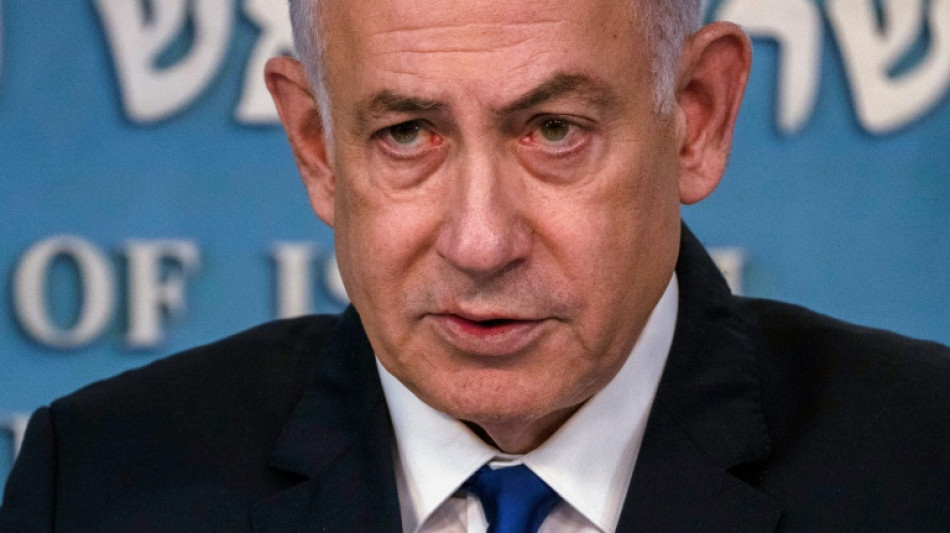
Bye, bye Bibi: Is the game up for Israel's great survivor Netanyahu? / Photo: Leo Correa - POOL/AFP/File
Benjamin Netanyahu, the Houdini of Israeli politics and its longest serving prime minister, has been written off many times before.
But with thousands of protesters on the streets every night this week demanding he resign, and growing anger at his handling of the war in Gaza, many wonder how long the veteran political escapologist can survive.
The usually bullish Netanyahu, 74, appears both physically and politically fragile.
Deeply unpopular -- no more than four percent of Israelis trust him, according to one poll late last year -- the war in Gaza is taking its toll on the man Israelis call Bibi.
Visibly frail and sallow, he was short-tempered and distracted during a television speech Saturday which his former minister and Likud colleague Limor Livnat called "catastrophic".
The left-wing daily Haaretz said he looked "like a frightened tyrant".
Netanyahu was even more gaunt when he left hospital in Jerusalem Tuesday after a hernia operation only to have to face the ire of the international community after an Israeli strike killed seven aid workers for a US-based group in Gaza.
"It happens in war," Netanyahu said with a tact which may not have been appreciated in the White House, which said it was "heartbroken" at the deaths.
"Netanyahu has been buried politically many times before and bounced back," said Emmanuel Navon, a former Likud member and political science professor.
"But this time is different because of October 7. It is not the same country. It's over for Bibi.
"He is 74, doesn't do any exercise, has a very hard job and he had a pacemaker put in six months ago."
- Blamed for October 7 'disaster' -
But Navon doubts Netanyahu will be forced from office by the new wave of mass street protests despite the fury of the hostages' families.
Einav Zangauker, the mother of one of the 134 still held in Gaza, branded him a "pharaoh, a slayer of first-borns" at Tuesday night's rally outside parliament in Jerusalem, the fourth consecutive night of protests.
They have seen hostage families uniting with anti-government demonstrators who spent nine months on the streets last year trying to stop controversial judicial reforms pushed by Netanyahu's far-right allies.
The "disaster" of October 7 would have killed off any other politician. But Navon compared Netanyahu's hold over the ruling Likud party to Donald Trump's over US Republicans.
"Likud lawmakers are petrified to be penalised in the next primaries by the 'Trio' -- Bibi, his wife and his son who decide everything," said the professor at Tel Aviv University.
"Peoples' political lives depend on him. He has surfed populism, his candidates now tend to be conspiracy theory wackos. It is not the same party of 20 years ago."
- Divide and rule -
With his coalition reeling from crisis to crisis, enemies seem to be circling as never before around the leader of Israel's most right-wing government ever.
Prosecutors are pushing ahead with a corruption trial against him despite the war, and protesters tried to break through police barriers to get to his home on Tuesday for the second time in four days.
Even his defence minister, Likud stalwart Yoav Gallant, is defying him over the deeply divisive issue of ultra-Orthodox Jews escaping compulsory military service even as the war in Gaza rages and another looms with Iran-backed Hezbollah in Lebanon.
Netanyahu has long relied on the support of religious parties to govern.
"Excusing a whole community when the military needs so much more manpower is unforgivable," General Reuven Benkler told AFP at an anti-government rally Monday.
The 65-year-old came out of retirement to serve in the north after the Hamas attack which resulted in 1,160 deaths in Israel, mostly civilians, according to an AFP tally of Israeli official figures.
Israel's retaliatory campaign has killed at least 32,916 people, mostly women and children, according to the health ministry in Hamas-run Gaza.
Benkler said the "hostages will not come home while Bibi is still in power", adding that Netanyahu was dragging out the war in Gaza to prolong his rule -- a claim endlessly repeated at the protests.
"He doesn't give a damn about anyone else apart from himself."
Netanyahu's three-decade hold over Israeli politics was based on divide and rule, Navon said. And his claim that only he could keep the country safe, October 7 shattered that.
His promise of elections in 2026 was "delusional", the analyst said. "But protesters' demands for them now are also unrealistic. The end of the year when the war has been won in Gaza and the north is more likely," he added.
"You nurtured and raised Hamas," she added, and yet "you call us traitors (for protesting during a war) when you are the traitor."
P.Verhoeven--LCdB