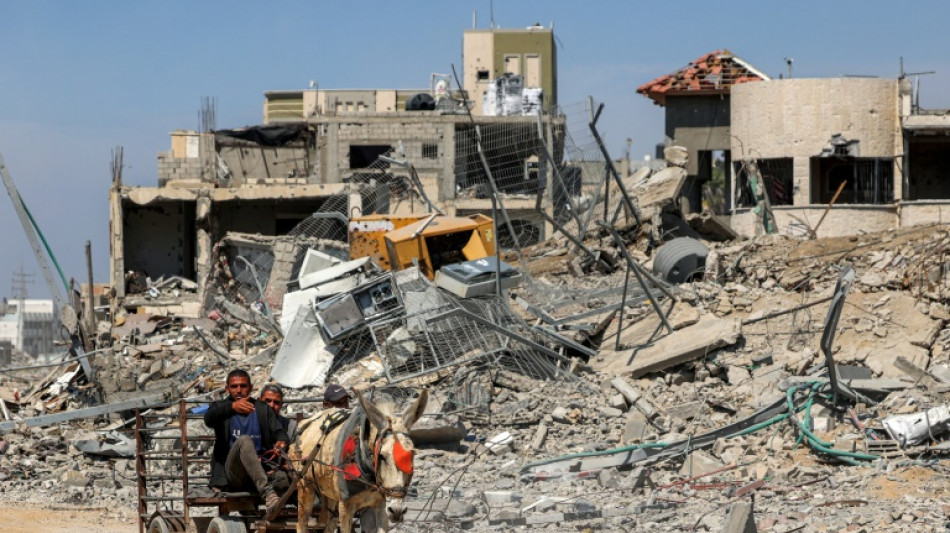
Gaza truce talks make 'significant progress': Egypt state media / Photo: - - AFP
Talks in Cairo towards a Gaza truce and hostage release deal have made "significant progress", Egyptian state-linked media reported Monday, more than half a year into the war started by the October 7 attack.
Israel kept up the pressure, warning that it was ready for future military operations against Hamas in Gaza's far-southern city of Rafah, the last area so far spared a ground invasion.
Israel on Sunday pulled its forces out of the southern Gaza Strip and the main city there, Khan Yunis, allowing large numbers of displaced Palestinians to return to the devastated urban area.
But Defence Minister Yoav Gallant stressed that the aim was for Israeli forces "to prepare for future missions, including... in Rafah" on the Egyptian border.
Israeli Prime Minister Benjamin Netanyahu, marking half a year of war since the unprecedented attack of October 7, also said Israel was "one step away from victory".
But, as truce talks resumed, Netanyahu also told his cabinet that "Israel is ready for a deal", adding that "there will be no ceasefire without the return of hostages".
International pressure has mounted on Israel to end the war which has brought mass civilian casualties and destroyed swathes of the coastal Palestinian territory.
Israel's main ally, diplomatic backer and arms supplier the United States last week demanded a ceasefire and hostage release deal along with ramped-up aid deliveries.
US President Joe Biden sharpened his tone after voicing "outrage" over an Israeli strike that killed seven aid workers from the US-based food charity World Central Kitchen.
While Israel and Hamas have kept up bellicose rhetoric, they have also sent negotiators to Cairo, joined by mediators from the United States, Egypt and Qatar.
Egyptian state-linked news outlet Al-Qahera reported "significant progress being made on several contentious points of agreement", citing an unnamed high-ranking Egyptian source.
The outlet said Qatari and Hamas delegations had left Cairo and were expected to return "within two days to finalise the terms of the agreement".
US and Israeli delegations were also due to leave the Egyptian capital "in the next few hours" for consultations over the next 48 hours, it added.
- 'Better than tents' -
Israel's 98th commando division withdrew from Khan Yunis on Sunday and left Gaza "in order to recuperate and prepare for future operations," the army told AFP.
After troops left the largely destroyed city, a stream of displaced Palestinians walked there, hoping to return to their homes from temporary shelters in Rafah, a little further south.
Maha Thaer, a mother of four returning to Khan Yunis, said she would move back into her badly damaged apartment, "even though it is not suitable for living, but it is better than tents".
The war was sparked by the October 7 attack against Israel by Hamas militants that resulted in the deaths of 1,170 people, mostly civilians, Israeli figures show.
Hamas and Islamic Jihad militants also took more than 250 Israeli and foreign hostages, 129 of whom remain in Gaza, including 34 the army says are dead.
Thousands gathered on Sunday in front of Israel's parliament to demand the return of the hostages.
"Stay strong, you who are still there," cried 17-year-old former hostage Agam Goldstein with tears in her eyes.
Israel's retaliatory offensive has killed at least 33,175 people in Gaza, mostly women and children, according to the health ministry in the Hamas-run territory.
Vast areas of Gaza have been turned into a rubble-strewn wasteland, with damage to infrastructure, mostly housing, estimated at $18.5 billion, a World Bank report said.
Charities have accused Israel of blocking aid, but Israel has defended its efforts and blamed shortages on aid organisations' inability to distribute assistance once it gets in.
"The denial of basic needs -- food, fuel, sanitation, shelter, security and health care -- is inhumane and intolerable," World Health Organization chief Tedros Adhanom Ghebreyesus wrote on social media platform X.
Aid trucks entered Gaza via the Rafah border crossing with Egypt on Sunday, and medical supplies were brought in via Israel's Erez crossing in the north.
- Iranian threats -
As the war in Gaza has raged, the Middle East has also seen a surge of violence involving Iran-backed militant groups in Lebanon, Syria, Iraq and Yemen.
Israel was widely blamed for a strike early last week on the consulate building in Syria of its arch foe Iran, sparking retaliatory threats from the Islamic republic.
An adviser to Iran's supreme leader warned Sunday that Israeli embassies were "no longer safe" after the strike in Syria that killed seven Revolutionary Guards members.
Gallant said the army had "finished all its preparations to react to any scenario that could arise regarding Iran".
The Israeli army also said it had reached "another phase" of preparation on its northern border with Lebanon, where it has traded fire with Iran-backed Hezbollah for months.
Israeli fighter jets struck a compound of Hezbollah's elite Radwan Forces "in the area of Khiam", near the Israeli-occupied Golan Heights, as well as a command centre near Toura, northeast of Tyre, the army said.
The Huthis have launched dozens of missile and drone attacks on shipping in the Red Sea and the Gulf of Aden since November, leading to US retaliatory strikes against Huthi targets.
Iran's top diplomat Hossein Amir-Abdollahian hailed "the brave support of the Yemeni nation for the oppressed Palestinian nation", speaking in Oman on Sunday.
burs-jd/fz
M.Franck--LCdB