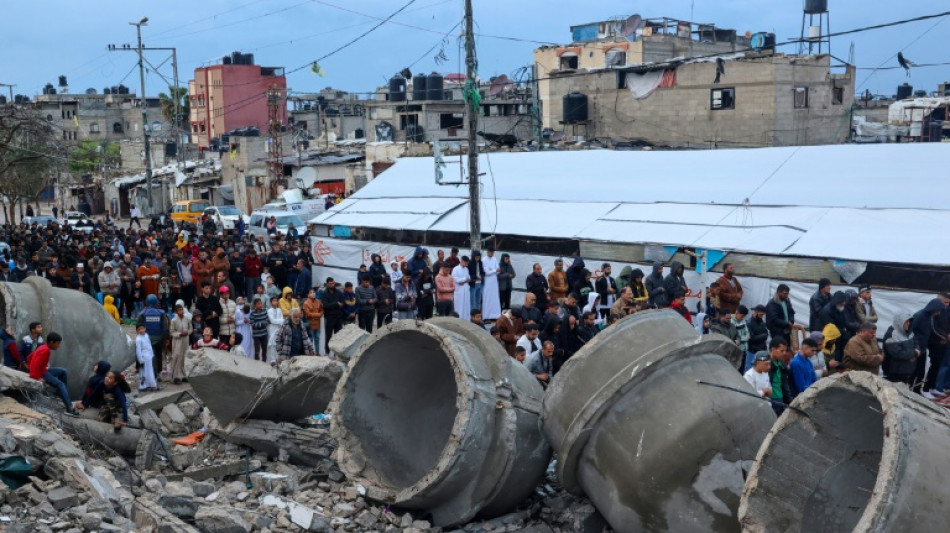
Gazans mark 'saddest' Eid with little to celebrate or eat / Photo: - - AFP
Gazans did their best to celebrate the end of Ramadan in the driving rain on Wednesday, as the war raged on with 14 killed, including children, in a strike on their home, the Hamas-run territory's health ministry said.
The Israeli military said it struck several targets on the first day of the Eid al-Adha holiday, with a jet hitting a rocket launch site and troops killing a "terrorist cell" in close quarters fighting.
An AFP photographer witnessed the aftermath of the the bombing of the home in Nuseirat refugee camp in central Gaza. Family members clutched the bodies of dead children at the Al-Aqsa Martyrs Hospital in nearby Deir el-Balah.
There was no immediate comment from the Israeli army.
Israel said 468 aid trucks -- a record since the war began -- were allowed into Gaza on the eve of the holiday which marks the end of the Muslim fasting month and is traditionally celebrated with family gatherings.
But with the United Nations warning the besieged territory is on the verge of famine, there was little to feast on for the 2.4 million residents of Gaza, up to 1.5 million of whom are crammed into camps around the far-southern city of Rafah.
The faithful gathered at dawn outside the city's flattened Al-Farooq Mosque, where worshipper Khairi Abu Singer complained that Israel's relentless bombardment had even "deprived Palestinians from praying inside their mosques".
Father-of-four Ahmed Qishta, 33, told AFP there was little to celebrate at what should be a joyous time.
"We prepared sweets and biscuits from the aid we got from the UN and now we are giving it to the children. We try to be happy but it is difficult."
He said they went to pray at the graves of family members killed in the war before going to the Ibn Taymiyyah mosque for Eid prayers.
There has never been "such an Eid -- all sadness, fear, destruction and a grinding war," he said.
Abir Sakik, 40, who fled her home in Gaza City with her family and is now living in a tent in Rafah, said she had no "ingredients for the cakes and sweets" she would usually make.
Instead she made cakes from crushed dates. "We want to rejoice despite all the blood, death and shelling," she told AFP.
- 'Enough of war' -
Sakik said that despite it being a religious holiday, the Israeli military "committed a massacre and killed women and children" in the camp.
"We are tired and weary -- enough, enough of war and destruction," she said, adding that Gazans were desperate for a truce.
"We try to bring joy to the children. Before all this, there was a great atmosphere at Eid with the children's toys, the Eid cakes, the food, the chocolates in every house -- everything was sweet and beautiful.
"But they destroyed all of Gaza," she said.
Rafah resident Moaz Abu Moussa said that "despite the pain and massacres, we will show our happiness in these difficult circumstances".
"We don't care about the war, we will live Eid like other Muslims and show our happiness to the displaced people and families of martyrs and detainees."
Meanwhile in Jerusalem tens of thousands of worshippers poured into the Al-Aqsa mosque compound, Islam's third holiest site, for morning prayers.
"It's the saddest Eid ever," said nurse Rawan Abd, 32, from Israeli-annexed east Jerusalem. "At the mosque you could see the sadness on people's faces."
In the occupied West Bank, the atmosphere was even more sombre, with many Palestinians in the flashpoint northern city of Jenin visiting its cemetery to pray for those who have been killed since the Gaza war began.
The conflict erupted with an unprecedented cross-border attack by Hamas on October 7 that resulted in the death of 1,170 people in Israel, mostly civilians, according to an AFP tally of Israeli official figures.
U.Laurent--LCdB