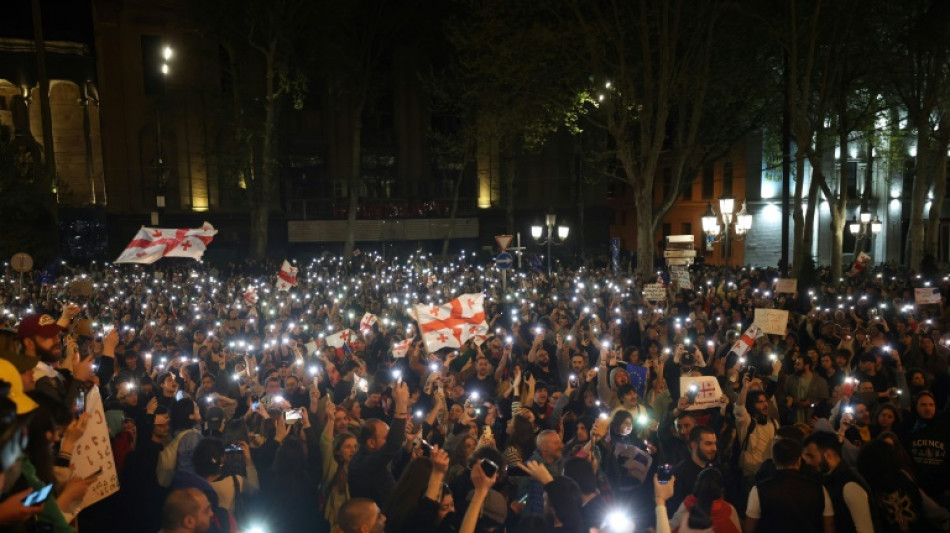
Georgian MPs proceed with controversial 'foreign influence' law / Photo: Giorgi ARJEVANIDZE - AFP
Georgian lawmakers gave a first green light Wednesday to a controversial "foreign influence" law that has sparked mass street protests over concerns it would undermine Tbilisi's European aspirations.
The bill, which 83 ruling Georgian Dream party MPs backed after its first reading, has been criticised as mirroring a repressive Russian law on "foreign agents" used there to silence dissent.
Opposition deputies boycotted the vote, and on Monday and Tuesday night thousands took to the streets to protest the draft law.
In chaotic scenes past midnight, Georgian riot police chased demonstrators in the labyrinth of narrow streets near parliament, beating them and making arrests, an AFP journalist saw.
Several local media outlets said police had attacked their journalists.
Another protest is scheduled for Wednesday evening.
- Further away from the EU -
If adopted, the bill would require any independent NGO and media organisation receiving more than 20 percent of funding from abroad to register as an "organisation pursuing the interests of a foreign power".
The proposed measure has sparked a backlash both inside Georgia and in the West.
A similar bill targeting "foreign agents" was dropped last year after mass protests outside the parliament building in Tbilisi, during which police used tear gas and water cannon against demonstrators.
The turmoil comes ahead of crucial parliamentary elections in October, seen as a key democratic test for the Black Sea country.
The bill still needs to pass votes following its second and third readings -- and get past a highly likely presidential veto.
But the ruling Georgian Dream party holds a commanding majority in the legislature, allowing it to pass further stages and vote down a presidential veto without the backing of any opposition MPs.
President Salome Zurabishvili -- who is at loggerheads with the ruling party -- said the measure contradicted "the will of the population" and denounced it as "a Russian strategy of destabilisation".
Parliament Speaker Shalva Papuashvili insisted the initiative was about "boosting transparency" and said it would not damage Tbilisi's bid for EU membership.
But European Council President Charles Michel said the law "will bring Georgia further away from the EU and not closer".
In December, the EU granted Georgia official candidate status. But it said Tbilisi would have to reform its judicial and electoral systems, reduce political polarisation, improve press freedom and curtail the power of oligarchs before membership talks could be formally launched.
A former Soviet republic, Georgia has sought for years to deepen relations with the West, but the current ruling party is accused of trying to steer the Black Sea nation toward closer ties with Russia.
Once seen as leading the democratic transformation of ex-Soviet countries, Georgia has in recent years been criticised for perceived democratic backsliding.
Y.Simons--LCdB