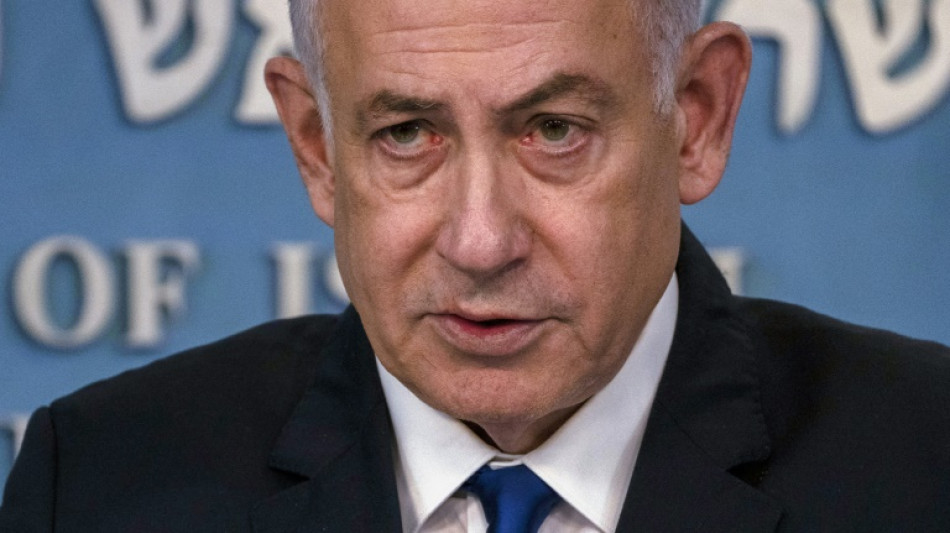
Israel reserves 'right to protect itself' after Iran attack: Netanyahu / Photo: Leo Correa - POOL/AFP
Israel's Prime Minister Benjamin Netanyahu said Wednesday his country will decide how to respond to Iran's unprecedented attack as world leaders called for restraint to avoid escalation.
The Israeli military has vowed to respond to Iran's missile and drone weekend attack, prompting a diplomatic flurry aiming to calm a region already on the edge due to the Israel-Hamas war raging in Gaza since October 7.
Washington and Brussels have pledged to ramp up sanctions against Iran, while British Foreign Secretary David Cameron and his German counterpart Annalena Baerbock became the first Western envoys to visit Israel after the attack.
Netanyahu told the visiting ministers that Israel "will reserve the right to protect itself," his office said.
The pair offered "all kinds of suggestions and advice" during a meeting, Netanyahu said. "However, I would also like to clarify: we will make our decisions ourselves."
For his part, Cameron said that "we're very anxious to avoid escalation and to say to our friends in Israel: It's a time to think with head as well as heart."
Baerbock emphasised that "the region must not slide into a situation whose outcome is completely unpredictable."
Tehran has vowed to hit back if its arch foe Israel responds to the Saturday attack, which itself was launched in retaliation to a deadly strike on Iran's Damascus consulate building earlier this month.
- Iran military parade -
As Iran marked its annual Army Day, it showed off a range of its weapons Wednesday, including attack drones and longer-range ballistic missiles, in a military parade in Tehran.
President Ebrahim Raisi has warned after the attack that "the slightest act of aggression" by Israel would lead to "a fierce and severe response".
In the large-scale assault late Saturday, Iran and allied groups launched over 300 missiles and drones carrying a combined payload of 85 tonnes at Israel, according to the Israeli army.
Damage and casualties were limited as Israel's air defences intercepted most of them with the help of US, British, French and Jordanian forces.
Israel's military chief Herzi Halevi has vowed "a response" to Iran's first ever direct attack, while military spokesman Daniel Hagari stressed that Iran would not get off "scot-free".
It remained unclear how and when Israel might strike, and whether it would target Iran directly or attack its interests or allies abroad in places such as Lebanon, Syria, Iraq and Yemen.
Lebanon's Iran-backed Hezbollah group and Israeli forces have been exchanging near daily cross-border fire with Israel since the Gaza war began.
Hezbollah said it launched drones and missiles into Israel on Wednesday, which the army said wounded 14 soldiers, six of whom seriously.
- US, EU to toughen sanctions -
Israel's top ally the United States has made clear it won't join any attack on Iran, vowing instead to level more sanctions targeting Iran's missile and drone programme, its Islamic Revolutionary Guard Corps and the Iranian defence ministry.
EU foreign policy chief Josep Borrell said Brussels was also working to expand sanctions against Iran, including its supply of drones and other weapons to Russia and to proxy groups around the Middle East.
Germany's Baerbock said that Berlin and Paris were in favour of a European sanctions regime against Iranian drones to be extended to include "missile technologies in Iran's arsenal".
Cameron also urged the G7 to adopt new "coordinated sanctions against Iran," ahead of a meeting with counterparts from the Western-led grouping in Italy.
- Deadly strikes in Gaza -
The sharply heightened Israel-Iran tensions have threatened to overshadow the Gaza war, even as deadly bombardment and combat raged on unabated in the besieged territory.
Talks toward a truce and hostage release deal have stalled for now, said Qatari Prime Minister Sheikh Mohammed bin Abdulrahman Al-Thani, a key mediator, despite months of effort also involving US and Egyptian officials.
The Israeli military said Wednesday its aircraft had "struck over 40 terror targets throughout the Gaza Strip" over the past day.
When one strike hit the southernmost city of Rafah, where 1.5 million Palestinians are sheltering, Jamalat Ramidan said she "woke up to the sounds of girls shouting 'mama, mama, mama'."
As she fled the carnage alongside children, they stumbled over "body parts and corpses scattered all over the place," Ramidan told AFP.
Vast areas of Gaza have been devastated by more than six months of war, while its 2.4 million people have suffered under an Israeli siege that has blocked most water, food, medicines and other vital supplies.
The war was triggered by an unprecedented attack on Israel by Hamas on October 7 that resulted in the deaths of 1,170 people, mostly civilians, according to an AFP tally based on Israeli official figures.
The militants also took about 250 hostages, of whom Israel estimates 129 remain in Gaza, including 34 who are presumed dead.
Israel's devastating retaliatory offensive has killed at least 33,899 people in Gaza, mostly women and children, according to the health ministry in the Hamas-run territory.
- Israel rejects famine claims -
Israel has faced growing global opposition to the relentless fighting in Gaza, which the United Nations and aid agencies have warned has pushed the north of the territory to the brink of famine.
But Netanyahu rejected any claims about famine on Wednesday, saying Israel is doing "above and beyond" what is needed "on the humanitarian issue," his office said.
The UN said it would launch an appeal on Wednesday for $2.8 billion to help Palestinians in Gaza and in the occupied West Bank.
The bloodiest ever Gaza war has also revived the push for Palestinian statehood as part of a two-state solution to the decades-long conflict.
However the veto-wielding United States has repeatedly expressed opposition to the move.
burs-jd/fz/dl/ami
J.Hermans--LCdB