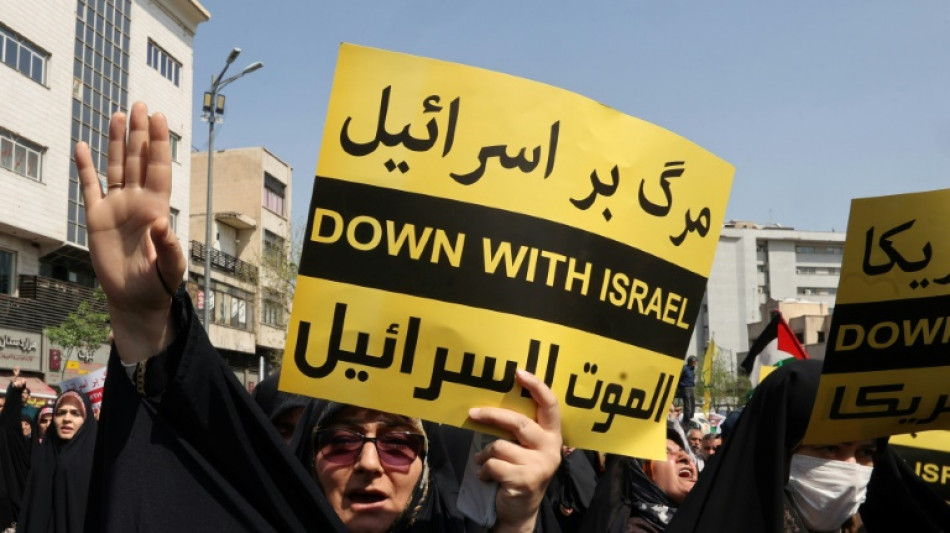
Calls for calm after reported Israeli strike on Iran / Photo: Atta KENARE - AFP
World leaders appealed for calm Friday after reported Israeli retaliation against Iran added to months of tense spillover from the war in Gaza, with Iranian state media reporting explosions in a central province.
Israeli officials made no public comment on the reported attack and Iranian officials played down its significance.
Iranian Foreign Minister Hossein Amir-Abdollahian said the Israeli micro-drones used in the operation had caused no deaths or damage, dismissing it as a "desperate attempt to make a victory out of their repeated defeats".
Israel had warned it would hit back after Iran fired hundreds of missiles and drones at it almost a week ago, in retaliation for a deadly April 1 air strike -- widely blamed on Israel -- that levelled the Iranian consulate in Damascus and killed seven Revolutionary Guards.
Air defence systems over several cities were activated, official media reported, after state television said explosions were heard near Iran's third city of Isfahan.
An unidentified Israeli official told The Washington Post the "strike" was retaliation for Iran's drone and missile barrage and intended to signal Israel was able to hit inside Iran.
Iran's Tasnim news agency, citing "informed sources", denied that Iran had been attacked from outside.
"Contrary to the rumours and claims" made in foreign media, "there are no reports of an attack from abroad", Tasnim said.
Three Iranian officials told The New York Times that small drones carried out the "attack", possibly launched from inside Iran, and that its radar systems had not detected unidentified aircraft entering Iranian airspace.
Fars news agency reported "three explosions" close to Qahjavarestan, near Isfahan airport and the 8th Shekari army airbase.
Iran's space agency spokesman Hossein Dalirian said there was "a failed and humiliating attempt to fly quadcopters, which were shot down".
There were "no reports of a missile attack", Dalirian said on social media platform X.
"Reports indicate there was no major damage or large explosions caused by the impact of any air threat," the official IRNA news agency said.
- Nuclear sites undamaged -
Iran's army commander-in-chief Abdolrahim Mousavi attributed Friday's explosions to "the firing of anti-aircraft defence systems on a suspicious object".
He said there was "no damage", according to Tasnim.
Nuclear facilities in Isfahan were reported to be "completely secure", Tasnim said, and the UN's atomic watchdog confirmed "no damage" to Iran's nuclear sites.
Washington received advance notice of Israel's reported strike, but did not endorse it or play any part in its execution, US media quoted officials as saying.
President Joe Biden had promised "ironclad" support for Israel, but also urged it to "think carefully and strategically" before launching a response against Iran that could trigger a wider war.
- 'Dangerous cycle of retaliation' -
Last weekend Iran launched its first-ever attack directly targeting Israel.
With the help of the United States and other allies, Israel intercepted most of the more than 300 missiles and drones which Israel said Iran had launched. Minor damage and no deaths resulted.
Iran said its attack was in retaliation for the April 1 strike on its Damascus consulate which killed seven Revolutionary Guards, two of them generals.
Israeli Prime Minister Benjamin Netanyahu has been under international pressure over the civilian toll in Gaza's war, and an analyst said the consulate strike allowed Israel to take the focus off Gaza.
However, foreign ministers of the G7 group of developed economies, meeting in Italy on Friday, kept up that pressure.
The group said they opposed a "full-scale military operation in Rafah", where most of Gaza's population is sheltering, because it would have "catastrophic consequences" for civilians.
Alongside the Gaza war, violence involving Iran-backed groups has soared in the Middle East.
UN chief Antonio Guterres called for an end to "the dangerous cycle of retaliation", his spokesman said.
- 'Space to climb down' -
Analysts said spiralling tit-for-tat violence could still be avoided, provided Iran continues to play down the reported Israeli strike and Israel takes no further action.
Dr Sanam Vakil, director of the Middle East and North Africa programme at Britain's Chatham House think tank, said the reported strike had been "calibrated to avoid damage and further Iranian aggression".
"As long as Iran continues to deny the attack and deflect attention from it and no further hits are seen, there is space for both sides to climb down the escalation ladder for now," he said.
Nomi Bar Yaacov, associate fellow of the think tank's international security programme, said the attack had been "carried out in a manner that will allow Iran to deny the attack and draw a line under it".
On Tehran's streets, some called for peace.
In Jerusalem, some called for tougher action against Iran.
"I think they need to strike very hard, not like that," said antique dealer Amitay Bendavid.
China, Iran's largest trade partner, said Friday it would "continue to play a constructive role to de-escalate" Middle East tensions.
Russia said it made clear to Israel that Iran "does not want escalation".
Before this month, Iran and Israel had engaged in a shadow war of sabotage and assassinations for years. Now, those hostilities are out in the open.
burs-kir/dv
W.Blondeel--LCdB