US aid package advances as Ukraine, Russia trade strikes / Photo: Genya SAVILOV - AFP
Ukraine President Volodymyr Zelenksy welcomed news that US lawmakers had passed a massive aid package Saturday, as Kyiv and Moscow denounced each other over the latest exchange of deadly air strikes.
Western leaders also hailed the approval of the long-awaited $61-billion package for Ukraine's war effort, which is expected to make a swift passage through the US Senate.
"Today, we received the decision we expected: the US support package we fought so hard for," said Zelensky in his evening address.
"And it is a very significant package that will be felt by our soldiers on the frontline, as well as by our towns and villages suffering from Russian terror."
Foreign Minister Dmytro Kuleba thanked US lawmakers and called it "a bad day for Putin".
Zelenksy and Kuleba both expressed hopes the package would quickly pass the US Senate for approval by US President Joe Biden.
NATO chief Jens Stoltenberg also welcomed the news.
"This significant boost in aid will supplement the tens of billions of aid being provided to Ukraine by European Allies," he said.
EU chiefs Ursula von der Leyen and Charles Michel also welcomed the vote in a joint statement: "Ukraine deserves all the support it can get against Russia."
"The USA and Europe stand together on the side of freedom - against Putin's war of terror," Germany's Foreign Minister Annalena Baerbock wrote on X, formerly Twitter, calling it a "day of optimism".
In Moscow, Kremlin spokesman Dmitry Peskov said the vote had been expected.
"It will further enrich the United States of America and ruin Ukraine even more, by killing even more Ukrainians because of the Kyiv regime," he added.
- Deadly air strikes -
Earlier Saturday, Kyiv and Moscow accused each other of deadly strikes on civilians overnight.
Russian strikes killed three people in central and northeast Ukraine, according to local officials.
In Russia's western Belgorod region, cross-border Ukrainian attacks killed three people, said the local governor.
Ukrainian drones killed two people in Russia's Belgorod border region, its governor said early Saturday, while shelling later in the day fatally wounded a pregnant woman.
A residential building and a barn in the village of Poroz, near the frontier, has been "completely burned down", governor Vyacheslav Gladkov said. Another building was severely damaged.
"Tragically, two civilians died -- a woman who was recovering from a fractured femur, and a man who was caring for her," Gladkov wrote on Telegram.
He later said Ukraine shelling of the village of Novaya Tavolzhanka, had killed a pregnant woman and her unborn child.
"Doctors did everything possible to save both mother and child. But to great grief, the woman and the unborn baby died from their wounds," he said.
A Russian attack killed a man in Ukraine's central Dnipropetrovsk region, while artillery strikes on residential buildings in the northeastern city of Vovchansk left two others dead, officials said.
Russia fired at least seven missiles at Ukraine overnight, two of which were shot down by air defences, Ukraine's air force said.
Ukraine has in recent months pleaded for more air defences from its Western allies as it struggles to fend off a surge in deadly attacks on civilian infrastructure.
- Infrastructure targeted -
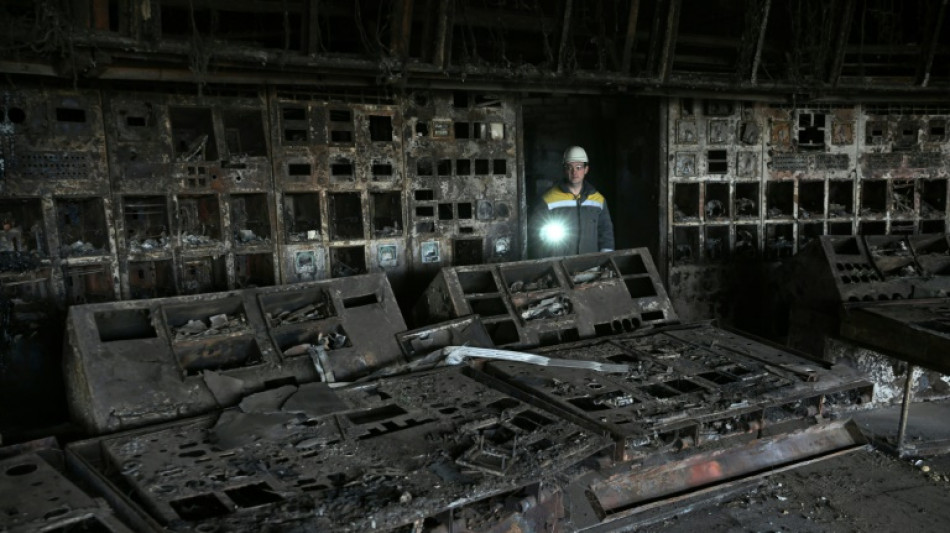
A source in Ukraine's defence sector told AFP that Kyiv had targeted eight Russian regions overnight in a "large-scale" drone strike.
It was aimed at "energy infrastructure that feeds Russia's military-industrial complex".
"At least three electrical substations and a fuel storage base were hit and caught fire," the source added, in a "joint operation" of Ukraine's SBU security service, army, and military intelligence.
Russia's defence ministry said it had intercepted 50 Ukrainian drones overnight, some of them hundreds of kilometres from the border, including near the capital Moscow.
"Air-defence forces shot the aerial vehicles down," governor Vasily Anokhin said. "However, as a result of falling debris, a tank with fuel and lubricants caught fire."
Kyiv has ramped up strikes on Russian oil and gas facilities in recent months, part of what it calls "fair" retaliation on infrastructure used to fuel Russia's war.
A.Gerard--LCdB