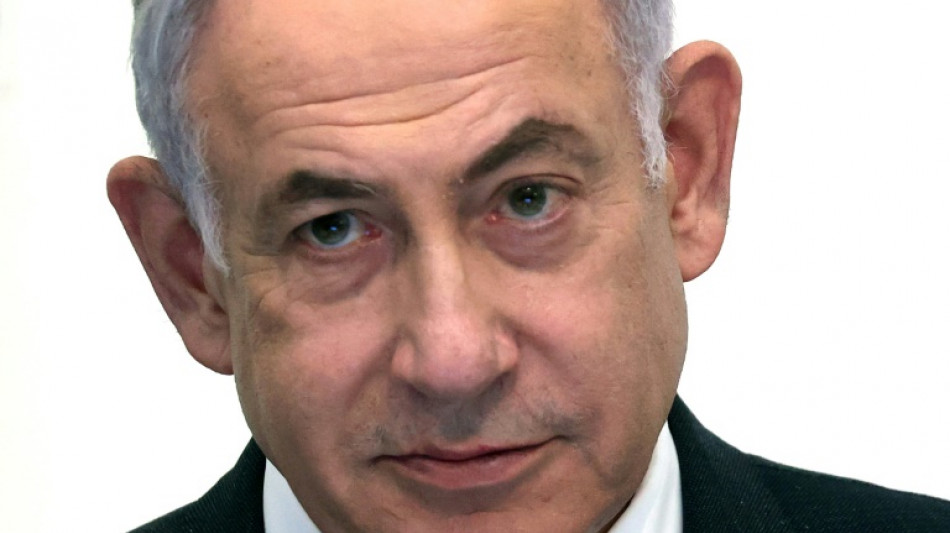
Israel PM says 'intense' phase of Gaza war winding down / Photo: GIL COHEN-MAGEN - POOL/AFP/File
A day after Israel's Prime Minister Benjamin Netanyahu said the "intense phase" of the Gaza war is winding down, the army bombed Hamas on Monday as the Palestinian militant group again demanded a permanent end to the fighting.
The right-wing premier spoke in a TV interview Sunday evening as his Defence Minister Yoav Gallant travelled to Washington for what Gallant called "critical" talks with Israel's top ally and arms supplier.
Netanyahu, in his first Israeli media interview since Hamas's October 7 attack started the bloodiest ever Gaza war, told Channel 14 that "the intense phase of the fighting against Hamas is about to end".
He stressed that this "doesn't mean that the war is about to end, but the war in its intense phase is about to end in Rafah," the far-southern city near Egypt that is the last part of Gaza to face a full ground invasion.
"The goal is to return the kidnapped and uproot the Hamas regime in Gaza," he said, again rejecting the permanent ceasefire demanded by Hamas over recent months of on-and-off talks involving US and other international mediators.
Netanyahu said Israel would then be able to "redeploy some forces to the north" on the border with Lebanon, where Israel has traded fire with the Hezbollah movement, but said this would be "primarily for defensive purposes".
As fears of a full-scale war in Lebanon have grown in recent weeks, Netanyahu said Israel would return its displaced citizens to their evacuated northern border communities, through diplomacy or by "another way".
When asked about Gaza post-war scenarios, he said Israel would maintain "military control in the foreseeable future" but that "we also want to create a civilian administration, if possible with local Palestinians" and regional backing.
Hamas slammed Netanyahu's comments as a "clear confirmation of his rejection of the recent (UN) Security Council resolution and the proposal of US President Joe Biden," who has urged a hostage release and truce agreement.
Hamas insisted any such deal must include a permanent ceasefire and full Israeli withdrawal in order to stop what it called "Netanyahu's attempts to evade, deceive and perpetuate the aggression and war of extermination against our people".
- US visit -
Israeli forces kept bombing targets on Monday across the besieged Gaza Strip, including in the Nuseirat and Rafah areas, witnesses said, while gun battles were reported in Zeitun.
The Israeli military said troops in the Rafah area had "eliminated a number of armed terrorists", dismantled tunnel shafts and found "large amounts of weapons".
In Gaza City, in the north, Al-Ahli hospital medics told AFP late Sunday that at least five people were killed in an air strike on a facility of the United Nations agency for Palestinian refugees, UNRWA.
The Israeli military said its jets struck militants who had "operated from within buildings that previously served as an UNRWA headquarters".
Israel has faced a global outcry over the surging civilian death toll, the punishing siege and the large-scale destruction in Gaza, and tensions have also grown between Netanyahu and Biden.
In his interview, Netanyahu said that Israel's fight against Iran-backed Hamas also aims "to set an example, to show that this would be the fate of those who massacre Jews", vowing that "we will win".
Gallant was expected to hold talks in Washington on Monday with Defense Secretary Lloyd Austin and Secretary of State Antony Blinken, after declaring on his departure that "our ties with the United States are more important than ever".
Netanyahu has accused Israel's biggest military supplier of slowing or freezing some arms and ammunition deliveries in recent months -- a claim which US officials have strongly rejected.
- 'Civil society unravelling' -
The war started with Hamas' October 7 attack on southern Israel that resulted in the deaths of 1,194 people, mostly civilians, according to an AFP tally based on Israeli official figures.
The militants also seized hostages, 116 of whom remain in Gaza although the army says 41 are dead.
Israel's retaliatory offensive has killed at least 37,598 people, also mostly civilians, Hamas-ruled Gaza's health ministry said.
Israel has also imposed a siege on Gaza's 2.4 million people, depriving them of most food and other essentials and driving many to the brink of starvation, the suffering alleviated only by sporadic aid shipments.
As the war has raged on, Israeli protesters have taken to the streets against Netanyahu and his right-wing government, demanding greater efforts to bring home the remaining hostages.
In his interview, Netanyahu, Israel's longest serving prime minister, asserted that, if his rule ends, "a left-wing government will... establish a Palestinian state", a scenario he called a threat to "our existence".
burs-jd/fz/ami
J.Jaspers--LCdB