Hamas says pulling out of Gaza truce talks, as Israel keeps up strikes / Photo: Eyad BABA - AFP
A Hamas official said Sunday the Palestinian group was withdrawing from Gaza truce talks, as Israeli bombardment hit a school a day after a deadly strike targeting militant commander Mohammed Deif.
Speaking after the strike on southern Gaza's Al-Mawasi, which the health ministry in the Hamas-run territory said killed at least 92 people, a senior official from Iran-backed Hamas cited Israeli "massacres" as a reason for suspending negotiations.
A second Hamas official said Deif, commander of the Islamist group's military wing, was "well and directly overseeing" operations despite the Israeli bombing raid which the military said was an attempt to kill him.
On Sunday Israeli forces struck a UN-run school in the central Nuseirat refugee camp which the military said "served as a hideout" for militants.
Health officials were not immediately able to give a precise casualty count but residents said some wounded were taken to hospitals.
It was the fifth attack in just over a week to hit a Gaza school used as shelter by displaced Palestinians.
The first Hamas official, quoting the group's Qatar-based political chief Ismail Haniyeh, said Israel's "lack of seriousness, continued policy of procrastination and obstruction, and the ongoing massacres against unarmed civilians" were behind the "decision to halt negotiations".
But, according to the official, Haniyeh had told international mediators Hamas was "ready to resume negotiations" when Israel's government "demonstrates seriousness in reaching a ceasefire agreement and a prisoner exchange deal".
Talks mediated by Qatar and Egypt, with United States support, have for months tried but failed to bring a halt to the war.
Israeli demonstrators, sometimes in the tens of thousands, have stepped up their actions demanding the government reach a deal to free the captives taken by militants on October 7.
The military's chief of staff Herzi Halevi said in a video message that "continuous... military pressure" could help create "the conditions for an agreement to return the hostages".
- Schools turned shelters -
Hamas's October 7 attack that sparked the war, now in its 10th month, resulted in the deaths of 1,195 people, mostly civilians, according to an AFP tally based on Israeli figures.
The militants seized 251 hostages, 116 of whom remain in Gaza including 42 the military says are dead.
Israel responded with a military offensive that has killed at least 38,584 people in Gaza, also mostly civilians, according to data provided by the Gaza health ministry.
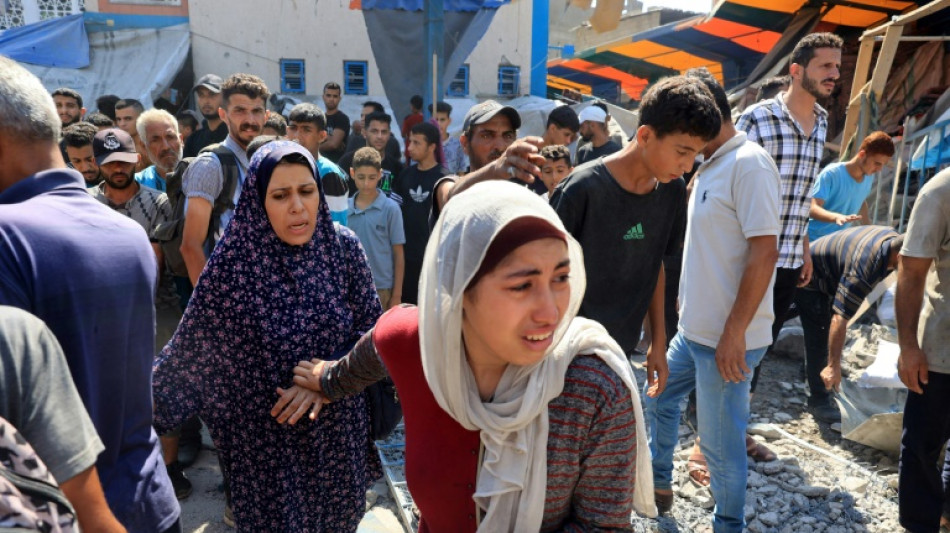
In Nuseirat, an AFP photographer saw part of the bombarded school complex damaged. Crowds of Palestinians, some visibly shaken and in tears, gathered in the courtyard.
At nearby Al-Awda hospital, the wounds of several children were bandaged.
With the vast majority of Gaza's 2.4 million people displaced at least once during the war, many have sought refuge in school buildings.
Four previous strikes on schools turned shelters since July 6 killed a total of at least 49 people, according to officials, medics and rescuers.
Israel says Hamas uses schools, hospitals and other public infrastructure for military purposes. Hamas denies the accusation.
An AFP journalist at the site of a strike in the city's Tal al-Hawa neighbourhood saw buildings reduced to rubble. The civil defence agency said rescuers had extracted the bodies of "two martyrs".
At the site of Saturday's strike in Al-Mawasi, on the Mediterranean coast, an AFP photographer saw the charred remains of tents as Palestinians searched through the wreckage for any salvageable items.
- 'Right to live' -
Al-Mawasi, near the cities of Khan Yunis and Rafah, had in May been declared a safe humanitarian zone by the Israeli military, which told civilians to evacuate to it. However, there have been multiple deadly incidents there blamed on Israeli strikes.
Israel's military on Sunday said one of Deif's associates, Rafa Salama, had been killed by the strike a day earlier "in the area of Khan Yunis".
Israel accused both Salama, commander of Hamas's Khan Yunis brigade, and Deif of helping to "mastermind" the October 7 attack.
Halevi, Israel's army chief, said Deif was at the site targeted along with "other terrorists and accomplices", but that it was "too early to conclude the results of the strike".
"Very few" civilians "were harmed", he added.
Philippe Lazzarini, head of the UN agency for Palestinian refugees, UNRWA, said on social media site X that the Al-Mawasi "attack and the mass casualties are a stark reminder that no one is safe in Gaza, wherever they are".
"The people of Gaza are children, women and men who... have the right to live and hope for a better future."
The deaths drew condemnation from governments across the region.
Turkish Foreign Minister Hakan Fidan said Israel does not intend to end the war and commits "new massacres each time there is a positive atmosphere" towards a truce.
R.Lacroix--LCdB