Gazans flee as Israel sets sights on safe zone / Photo: Bashar TALEB - AFP
Thousands of Gazans fled an Israeli-designated humanitarian zone Monday after the army ordered them to leave and warned of an imminent operation in response to rocket attacks.
Israeli Prime Minister Benjamin Netanyahu was on his way to Washington to deliver a crucial speech at what he said was a time of "great political uncertainty", following US President Joe Biden's decision not to seek re-election.
Netanyahu will meet Biden, who has pushed him to agree to a ceasefire with Hamas, more than nine months into the Gaza war ignited by the Palestinian militant group's October 7 attacks on Israel.
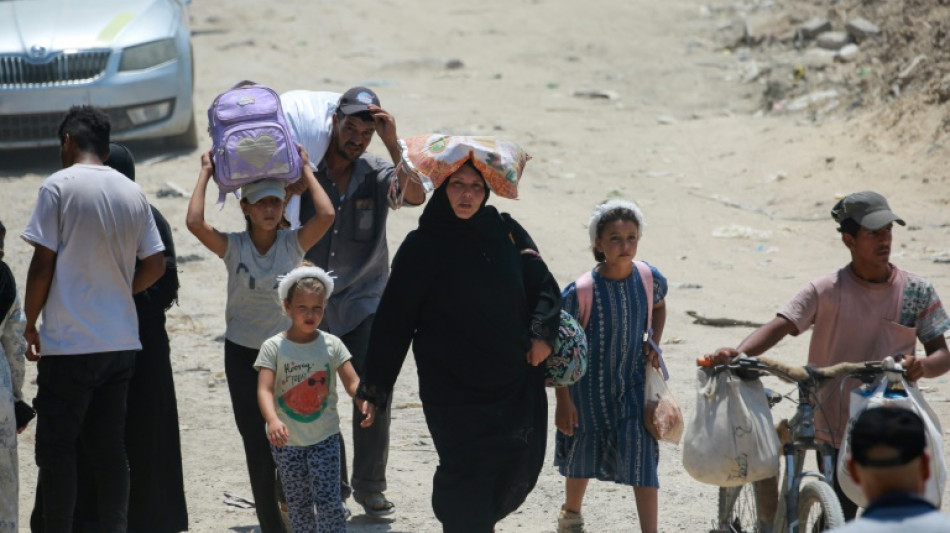
Fighting raged in Gaza as the Israeli military ordered Palestinians to evacuate part of a humanitarian zone, just two months after directing them there for their own safety.
The military said it issued the order to leave the eastern Khan Yunis sector of the Al-Mawasi humanitarian zone as it was "about to forcefully operate" to curb rocket fire.
Facing yet another displacement, Palestinians filled the dusty streets of Khan Yunis with cars, motorbikes, donkey-drawn carts, and on foot, carrying what belongings they could.
Hassan Qudayh said his family fled in "panic".
"We were happily making breakfast for our children, as we had been safe for a month, only to be stunned by shells, warning leaflets and martyrs in the streets," he told AFPTV.
"This is the 14th or 15th time we've been displaced.
"We want peace, not war. We want to be united. Enough! We've been suffering for 10 months."
- 'Tired and fed up' -
Hamas's October 7 attack on southern Israel resulted in the deaths of 1,195 people, mostly civilians, according to an AFP tally based on Israeli figures.
The militants also seized 251 hostages, 116 of whom are still in Gaza, including 44 the Israeli military says are dead.
Israel's retaliatory military campaign in Gaza has killed at least 39,006 people, also mostly civilians, according to data from the health ministry in Hamas-run Gaza.
The relentless fighting has plunged Gaza into a severe humanitarian crisis.
Yussef Abu Taimah from Al-Qarara in Khan Yunis said his family went to the humanitarian zone but found no space.
"Even the sidewalks are full of people and tents. We are tired and fed up. Enough of this displacement and migration".
In scorching summer heat, Palestinians at the Jabalia refugee camp in northern Gaza scoured ruins for water needed for drinking, bathing, and laundry.
For the Shanbari family, water is so precious they try not to spill a single drop.
Exhausted from the constant struggle for basics, the parents say their children are sick.
"All my children have fallen ill -- they're suffering from kidney failure, jaundice, itching, and cough," said Ahmed al-Shanbari. "I don't know what to say, and there aren't even any medicines available."
Nearby, huge sewage puddles, sometimes pond-sized, cover the roads.
- Fraught ties -
On the diplomatic front, months of intermittent talks for the first ceasefire and hostage-prisoner swap since November have yielded little progress.
Netanyahu will meet Biden on Tuesday and deliver a landmark speech to Congress on Wednesday, amid unprecedented strains between Israel and its ally the United States.
The Israeli leader has repeatedly resisted pressure from the Biden administration to accept a truce.
Washington fears a voter backlash over the mounting civilian war toll in Gaza, while protests by anti-government demonstrators and families of hostages in Israel are pressuring Netanyahu.
"Never before has the atmosphere been so fraught," said Steven Cook, a Middle East specialist at the Council on Foreign Relations.
"There is clearly tension in the relationship, especially between the White House and the Israeli prime minister," Cook said in a commentary.
Israel on Saturday attacked Yemen for the first time, in retaliation for a deadly drone strike on Tel Aviv by the Iran-backed Huthi rebels.
There were also further exchanges of fire between Lebanon's Iran-backed Hezbollah movement and the Israeli military at the weekend, as tensions remained high along the border.
On Sunday, Netanyahu's office said he was sending a negotiating team for new talks on a truce deal. He said the delegation would leave on Thursday, but it remains unclear where it will go.
Egypt, Qatar and the United States have been working unsuccessfully for months to secure a deal between Israel and Hamas.
M.Lenaerts--LCdB