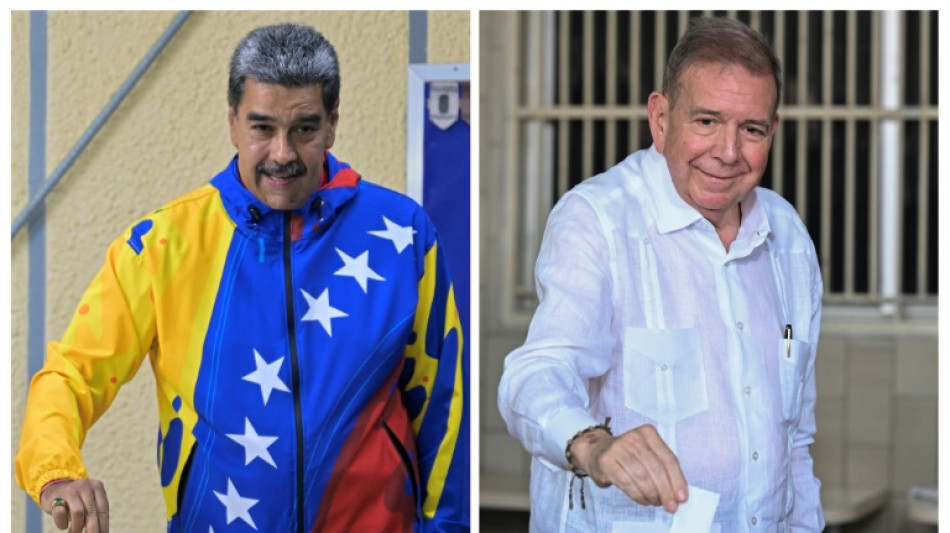
Millions vote in fraught Venezuelan presidential election / Photo: Juan BARRETO, Raul ARBOLEDA - AFP
Venezuelans turned out in their millions Sunday to elect a president amid high tension marked by official attacks on the opposition candidate challenging incumbent Nicolas Maduro.
Maduro, who had previously warned of a "bloodbath" if he loses, said Sunday he would "make sure" the final result from the regime-aligned CNE electoral authority is "defended."
CNE chief Elvis Amoroso, for his part, described the opposition as "enemies of Venezuela," and claimed its candidate Edmundo Gonzalez Urrutia "rejects the constitution."
Independent polls suggest Sunday's vote poses the biggest challenge yet to 25 years of "Chavismo," the populist movement founded by Maduro's socialist predecessor and mentor, Hugo Chavez.
But analysts say the president is unlikely to concede defeat.
Maduro, 61, is seeking a third six-year term at the helm of the once wealthy petro-state where GDP dropped by 80 percent in a decade, pushing more than seven million of its 30 million citizens to emigrate.
He is accused of locking up critics and harassing the opposition in a climate of rising authoritarianism.
Based on its own numbers, the regime insists it will prevail over Gonzalez Urrutia, a 74-year-old former diplomat reluctantly thrust to the top of the opposition ticket after its wildly popular leader Maria Corina Machado was disqualified.
Maduro counts on a loyal electoral machinery, military leadership and state institutions in a system of well-established political patronage.
- 'Prepared to defend' -
Gonzalez Urrutia said Sunday the opposition was "prepared to defend" the vote and trusted "our armed forces to respect the decision of our people."
Machado, for her part, cited figures showing that more than nine million people had voted by lunchtime -- suggesting a possibly "historic" turnout.
Analysts told AFP a large turnout would benefit the opposition and make it harder to fudge the figures, as the Maduro government has been accused of doing in the past.
AFP witnessed long queues at many ballot stations hours before polls opened for 12 hours at 6:00 am (1000 GMT). Some voters arrived the night before.
Sunday's election is the product of a deal reached last year between the government and opposition with backing of the United States -- which temporarily eased sanctions imposed after Maduro's 2018 reelection was rejected as a sham by most Western and Latin American countries.
US Secretary of State Antony Blinken on Sunday urged everyone involved to "respect the democratic process" and said the international community "is going to be watching this very closely."
Washington is keen for a return to stability in Venezuela -- an ally of Cuba, Russia and China that boasts the world's largest oil reserves but diminished production capacity.
Economic misery in the South American nation has also been a major source of migration pressure on the US southern border.
- 'Beyond Venezuela' -
"It's clear that if Maduro grabs power by force or with violence, we would see an even greater wave in a very short period of time: three, four, five million Venezuelans more leaving," Machado said after voting in Caracas.
This, she told a reporter in English, "would create a huge pressure and escalation in the region and of course on the southern border of the United States."
A peaceful transition, in turn, would mean an end to the exodus and the return to Venezuela of millions of its citizens, said Machado.
"What's at stake here goes beyond our borders, beyond Venezuela."
Most Venezuelans live on just a few dollars a month, with the health care and education systems in disrepair and biting shortages of electricity and fuel.
The government blames sanctions, but observers point the finger at corruption and government inefficiency.
On Friday, a Venezuelan NGO said Caracas was holding 305 "political prisoners" and had arrested 135 people with links to the opposition campaign since January.
Concerns for the fairness of the vote were further stoked when Caracas blocked international observers at the last minute, including four Latin American ex-presidents who had their plane held up in Panama on Friday.
Observers from the European Union had their invitation withdrawn weeks ago by authorities that have allowed a small delegation from the US-based Carter Center.
The word "change" is on the lips of many Venezuelans.
About 21 million Venezuelans are registered to vote, but only an estimated 17 million still in the country are eligible.
A.Gerard--LCdB