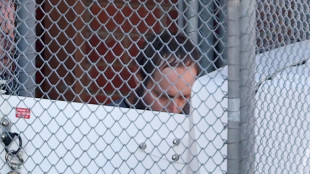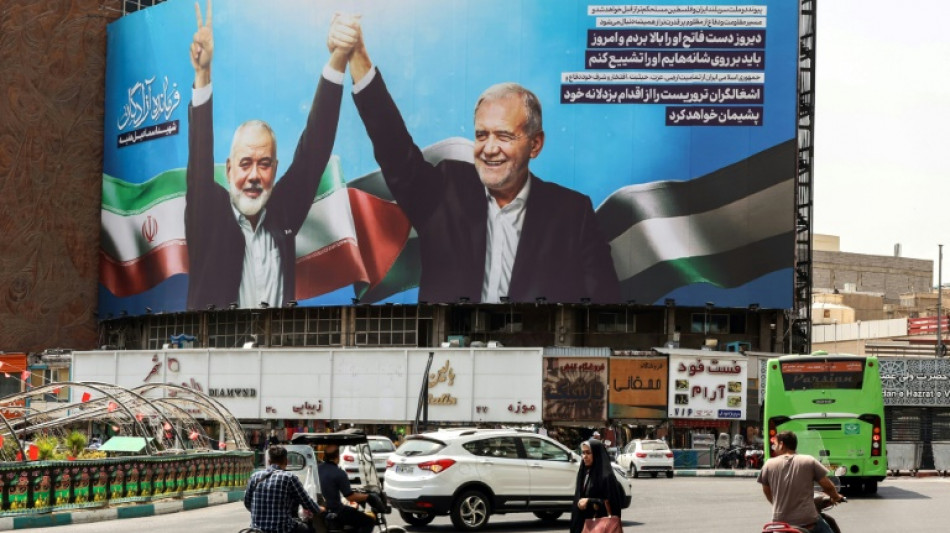
Iran, allies ready Israel response as funerals held for militant leaders / Photo: - - AFP
Iran and its regional allies vowed retaliation on Thursday for the deaths of Hamas and Hezbollah leaders, raising regional tensions as mourners filled Tehran's city centre calling for revenge.
A public funeral was held for Hamas's political chief Ismail Haniyeh in the Iranian capital where he was killed early Wednesday in an attack which Israel has not commented on.
Haniyeh's body was then flown to Qatar, where he had resided and where he is to be laid to rest on Friday, when his group called for a "day of furious rage" in the Palestinian territories and across the region.
Hezbollah chief Hassan Nasrallah, addressing the funeral of the Lebanese group's top military commander, said Israel and "those who are behind it must await our inevitable response" to Fuad Shukr's and Haniyeh's killings within hours of each other.
"You do not know what red lines you crossed," Nasrallah said, addressing Israel, a day after Shukr was killed in a strike in south Beirut.
Israel, which said Shukr's assassination was a response to deadly rocket fire last week on the annexed Golan Heights, warned its adversaries on Thursday they would "pay a very high price" for any "aggression".
"Israel is at a very high level of preparation for any scenario, both defensive and offensive," Prime Minister Benjamin Netanyahu said in a statement.
"Those who attack us, we will attack in return."
A source close to Hezbollah told AFP that Iranian officials met in Tehran on Wednesday with representatives of the so-called "axis of resistance", a loose alliance of Tehran-backed groups hostile to Israel, to discuss their next steps.
"Two scenarios were discussed: a simultaneous response from Iran and its allies or a staggered response from each party," said the source who had been briefed on the meeting, requesting anonymity to discuss sensitive matters.
Analysts told AFP that the retaliation would be measured to avoid a wider conflagration.
Iran and the groups it backs "will more than likely try to avert a war, while also strongly deterring Israel from continuing with this new policy, this targeted shock and awe," said Amal Saad, a Hezbollah researcher and lecturer at Britain's Cardiff University.
In Tehran, Iran's supreme leader Ayatollah Ali Khamenei led prayers for Haniyeh having earlier threatened "harsh punishment" for his killing.
- 'Roaring marches' -
Crowds, including women shrouded in black, carried posters of Haniyeh and Palestinian flags in a procession and ceremony that began at Tehran University, an AFP correspondent reported.
Senior Iranian officials, including President Masoud Pezeshkian and Revolutionary Guards chief General Hossein Salami, attended the ceremony, state television images showed.
Iran's Revolutionary Guards announced the day before that Haniyeh and a bodyguard were killed in a pre-dawn strike Wednesday on their accommodation in Tehran.
The New York Times however reported, citing anonymous sources including two Iranian officials, that the blast was caused by an explosive device planted several months ago.
Qatar-based Haniyeh had been visiting Tehran for Pezeshkian's swearing-in on Tuesday.
Pezeshkian said Iran "will continue to support with firmer determination the axis of resistance", the official IRNA news agency said.
Qatar-based network Al Jazeera reported said the plane carrying Haniyeh's body had landed in Doha, where the Palestinian leader is to be buried following prayers at the Qatari capital's largest mosque.
Hamas called in a statement for a day of protests on Friday.
"Let roaring anger marches start from every mosque," it said.
- 300-day war -
The international community has called for calm and a focus on securing a ceasefire in the Gaza Strip -- which Haniyeh had accused Israel of obstructing.
United Nations chief Antonio Guterres said the strikes in Tehran and Beirut represented a "dangerous escalation".
US Secretary of State Antony Blinken reiterated appeals for an end to fighting. He said achieving peace "starts with a ceasefire" and called on "all parties" to "stop escalatory actions".
But the prime minister of key ceasefire broker Qatar said Haniyeh's killing had thrown the whole Gaza war mediation process into doubt.
"How can mediation succeed when one party assassinates the negotiator on the other side?" Sheikh Mohammed bin Abdulrahman Al-Thani said on social media site X.
Jordanian Foreign Minister Ayman Safadi told a news conference that Israel "has turned rogue" by killing "the one who was negotiating the (hostage-prisoner) exchange deal".
The killings are the latest of several major incidents that have inflamed regional tensions during the Gaza war which has drawn in Iran-backed militant groups in Syria, Lebanon, Iraq and Yemen.
Beyond Gaza, clashes continued on Thursday with Lebanese authorities reporting four Syrians killed in an Israeli strike.
Israel has vowed to destroy Hamas in retaliation for its October 7 attack that resulted in the deaths of 1,197 people, mostly civilians, according to an AFP tally based on official Israeli figures.
Militants also seized 251 hostages, 111 of whom are still held captive in Gaza, including 39 the military says are dead.
Concern over the fate of those still held has grown among Israelis, who demonstrated demanding a deal to free them in Tel Aviv on Thursday, marking the war's 300th day.
Israel's retaliatory campaign against Hamas has killed at least 39,480 people in Gaza, according to the Hamas-run territory's health ministry, which does not give details of civilian and militant deaths.
burs-mz/ami/kir
B.Hendrix--LCdB