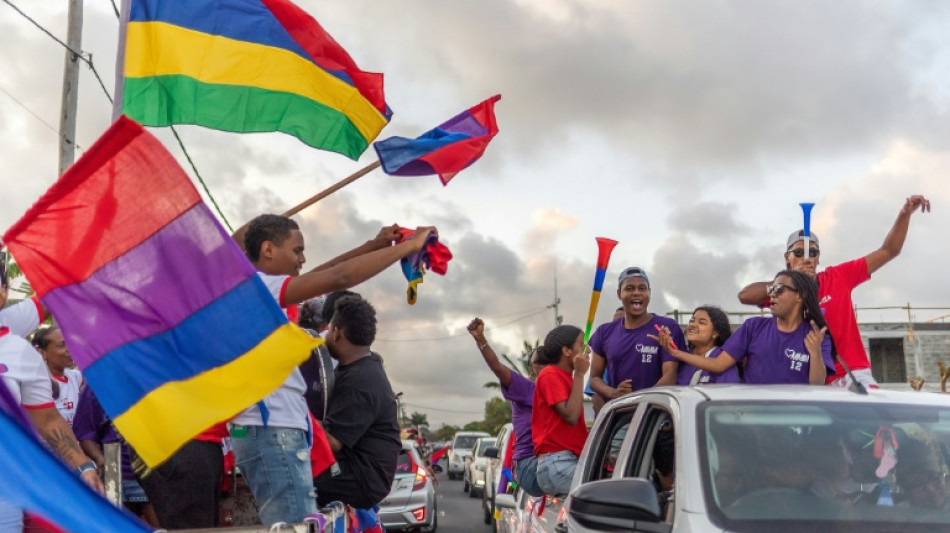
Mauritius opposition leader claims sweeping vote win / Photo: Laura Morosoli - AFP
Mauritius opposition leader Navin Ramgoolam said Tuesday that his alliance had won a crushing election victory over the governing coalition, after the incumbent prime minister conceded he faced a "huge defeat".
Ramgoolam, a two-time former prime minister, told crowds of jubilant supporters in his constituency that his Alliance of Change had made a clean sweep of parliamentary seats on the island of Mauritius in Sunday's vote.
"I hope PKJ resigns soon. He was beaten 60-0," Ramgoolam said, referring to Prime Minister Pravind Jugnauth.
"The power of the people is stronger than a dictatorship," the 77-year-old added to boisterous cheers and blaring horns.
There were 60 National Assembly seats up for grabs on the island of Mauritius and another two on Rodrigues. The remaining eight are allocated under what is dubbed the "best loser" system.
The winner-takes-all election model means single coalitions often dominate the 70-seat parliament in the Indian Ocean archipelago.
If confirmed, it would be the third time since Mauritius became independent from Britain in 1968 that there has been a 60-0 score, media reports said.
Final official results are expected Tuesday after the election in what is considered one of Africa's richest and most stable democracies.
Jugnauth had said Monday that his Lepep alliance, led by his Militant Socialist Movement (MSM), was "heading towards a huge defeat".
- Wire-tapping scandal -
Only last month, Jugnauth, who has been in office since 2017, was celebrating a historic deal that saw Britain cede sovereignty over the Chagos Islands to Mauritius after a long-running dispute.
But the vote was overshadowed by an explosive wire-tapping scandal, when secretly recorded phone calls of politicians, diplomats, members of civil society and journalists were leaked online.
During the campaign, both camps promised to improve the lot of ordinary Mauritians who face cost-of-living difficulties despite robust economic growth.
Measures outlined in the Alliance of Change manifesto include the creation of a fund to support families facing hardship, free public transport, increased pensions and reduced fuel prices, as well as efforts to tackle corruption and boost the green economy.
It also called for constitutional and electoral reforms including changing how the president and parliament speaker are chosen.
The majority-Hindu nation has seen substantial stability and growth since independence, building an economy based on tourism as well as financial services and textile manufacturing.
Gross domestic product per capita in 2022 was more than $10,000, according to the World Bank. But analysts have highlighted growing concerns about governance and corruption as well as the need to diversify the Mauritian economy.
Both Jugnauth and Ramgoolam are members of the dynasties that have dominated the leadership of Mauritius since independence.
Ramgoolam, who previously worked as a doctor and a lawyer, served as prime minister between 1995 and 2000 and again from 2005 to 2014.
He is the son of Seewoosagur Ramgoolam, who led Mauritius to independence from Britain in 1968.
Several teams sent to observe the legislative election -- the 12th since independence -- are due to issue their verdicts on Tuesday.
Indian Prime Minister Navendra Modi was the first foreign leader to publicly congratulate Ramgoolam, who is of Indian ancestry.
Y.Simons--LCdB