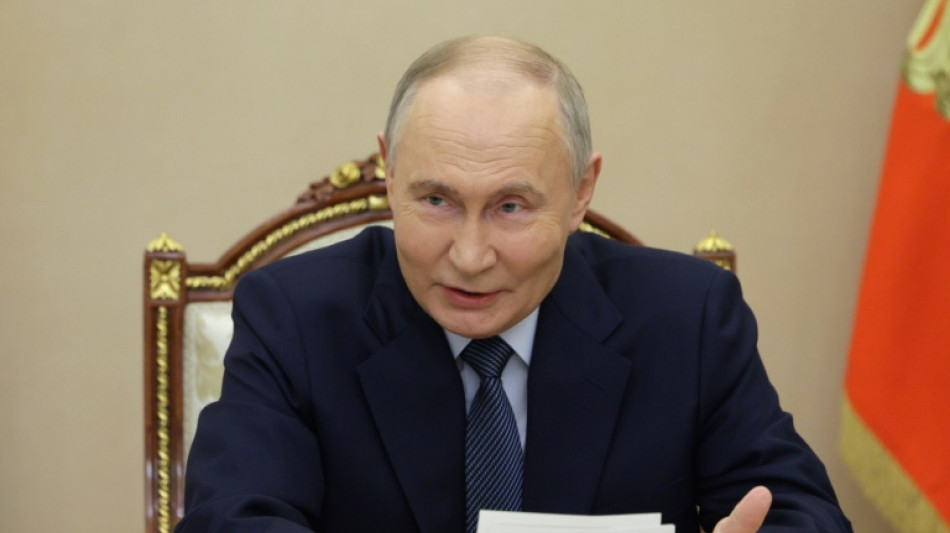
Putin vows more tests of nuke-capable missile fired at Ukraine / Photo: Gavriil GRIGOROV - POOL/AFP
Russian President Vladimir Putin on Friday promised more combat test-firing of an experimental hypersonic missile launched at Ukraine, as Volodymyr Zelensky appealed for updated air-defence systems to meet the new threat.
The latest statements from the leaders came hours after Ukraine's parliament shut down over heightened fears of a missile attack.
A day after Moscow fired the new missile at the Ukrainian city of Dnipro, Putin said there would be more tests of the new Oreshnik missile.
"We will continue these tests, including in combat conditions, depending on the situation and character of the security threats posted to Russia," Putin said in a televised meeting with military chiefs.
Russia would also begin serial production of the experimental weapon, he added.
Ukraine's President Volodymyr Zelensky said Friday it was already looking for updated air-defence systems from its allies in response to the new threat.
Earlier Friday, China's foreign ministry had repeated its call for "calm" and "restraint" in the war after Russia confirmed it had fired the ballistic missile.
In his video address however, Zelensky said: "From Russia, this is a mockery of the position of states such as China, states of the Global South, some leaders who call for restraint every time."
- Missile threat -
The introduction of the new weapon into the battlefield has further raised tensions in the nearly three-year-long war, and comes as Kyiv's forces are struggling on the ground.
On Friday, Russia claimed the capture of another village in eastern Ukraine.
Putin's hints Thursday of strikes on Western countries raised fears of the war spilling over into a global conflict.
That sent the Russian ruble plunging on Friday to its lowest level against the US dollar since March 2022.
In a hawkish address to the nation on Thursday, Putin said Russia reserved the right to fire missiles at countries that allow Kyiv to hit Russian territory with their weapons, after the United States and the UK gave Kyiv the green light to do so.
Those strikes could be by the new Oreshnik missile.
Experts believe it flies at 10 times the speed of sound and may be able to strike targets up to 5,500 kilometres (3,400 miles) away -- enough to make good on Putin's threats of targeting Kyiv's European allies but not enough to reach the United States.
Polish Prime Minister Donald Tusk expressed the alarm felt by some in Europe Friday, speaking at a teachers' union event.
"The war in the east is entering a decisive phase. We all know this...," he said.
"The events of the last several dozen hours show that the threat is very serious and real when it comes to global conflict," he added.
- 'Russian madness' -
Branding the strike "this latest bout of Russian madness", Zelensky on Friday urged Ukraine's allies to step up their provision of air defences.
"Whatever the Russian missile threat, it cannot be ignored," the president added -- especially with Ukraine's army on the back foot.
A source in the Ukrainian military said Russian forces were advancing by "200-300 metres a day" near the besieged Ukrainian logistics hub of Kurakhove, in the eastern Donetsk region that the Kremlin claims is part of Russia.
In Moscow, Defence Minister Andrei Belousov said Russia's advances in war-battered eastern Ukraine had "ground down" Kyiv's best units.
Russia also said its forces had "liberated" the frontline village of Novodmytrivka, about 10 kilometres north of Kurakhove.
Moscow is accused of deploying thousands of North Korean troops to the border region of Kursk, where it is massing forces to wrest back territory seized by Ukrainian forces.
US Defense Secretary Lloyd Austin said Saturday that about 10,000 North Koreans were being trained and "integrated into the Russian formations".
"I fully expect to see them engaged in combat soon," he told reporters during a stopover in Pacific island nation Fiji.
- 'Russia will overcome' -
In Kyiv, frequently targeted by Russian drones and missiles, parliament cancelled its usual Friday questions to the government over fears of a strike.
Several MPs said they were working remotely and that Friday's session had been scrapped. Lawmaker Yevgenia Kravchuk told AFP there were signs of "increased risks of attacks" to come.
Unlike the rest of the capital, the government district has until now been spared of bombings.
Analysts say Moscow and Kyiv are racing to gain battlefield advantages ahead of January 2025, when Donald Trump is due to take office in the United States. Trump has vowed to end the war, without saying how.
Thursday's Oreshnik missile attack, which apparently targeted an aerospace manufacturing plant in the central Ukrainian city of Dnipro, sparked immediate condemnation from Kyiv's allies.
In the streets of Moscow however, supporters of President Vladimir Putin voiced confidence in Russia's victory.
But Yulia Kim, a 52-year-old doctor, said: "I am worried that a nuclear war will start".
burs-jj/sbk/tym/cwl
L.Moonen--LCdB