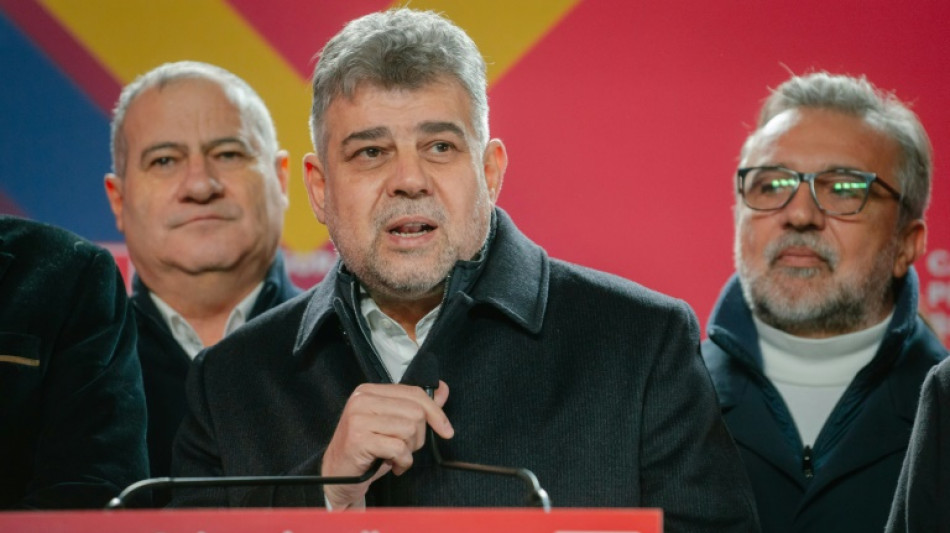
Pro-Russia candidate leads Romanian polls, PM out of the race / Photo: Andrei Pungovschi - AFP
A pro-Russia far-right candidate took a surprise lead Monday in Romania's presidential election, knocking the EU-leaning premier out of the race that will be decided in a December run off.
The result is a political earthquake in the country of 19 million, a NATO member which has so far resisted nationalist appeals, setting itself apart from neighbours Hungary and Slovakia.
Far-right candidate Calin Georgescu was in pole position with 22.94 percent of the ballot, followed by the little-known Elena Lasconi, the centre-right mayor of a small town.
Prime Minister Marcel Ciolacu was in third place with 19.15 percent of the ballot in Sunday's election after 99 percent of the vote was counted, eliminating him from the December 8 run off.
Exit polls in the race for the largely ceremonial post initially had showed the premier with a comfortable lead and put another far-right candidate, George Simion, in second.
Georgescu surged in recent days with a viral TikTok campaign calling for an end to aid for Ukraine. He has also sounded a sceptical note on Romania's NATO membership.
"Tonight, the Romanian people cried out for peace. And they shouted very loudly, extremely loudly", he said late Sunday.
- 'Man of integrity' -
"The far right is by far the big winner of this election", political scientist Cristian Pirvulescu told AFP of the result that sent shockwaves across the country.
Maria Chis, 70, said she was surprised by Georgescu's lead in the first round but had been impressed after watching his TikTok videos.
"He seems a man of integrity, serious and patriotic. He inspires seriousness. I think only someone like him can bring change," said the pensioner who had shunned the ballot.
Alex Tudose, the owner of a construction company, was gloomy.
"There is sorrow, disappointment that after so many years in Euro-Atlantic structures we voted for a pro-Russian by over 20 percent," the 42-year-old said.
"There is clearly a strong fragmentation both in society and in the political class and I think we saw that yesterday," he said.
Spokesman Dmitry Peskov said the Kremlin did not know much about Georgescu: "I can't say that we are very familiar with the worldview of this candidate, as far it concerns relations with our country."
Ciolacu's Social Democrat party has shaped Romania's politics for more than three decades.
But with concerns mounting over inflation and the war in neighbouring Ukraine, the far right had appeared to be gaining ground ahead of the vote.
The stakes are high for Romania, which has a 650-kilometre (400-mile) border with Ukraine and has become more important since Russia invaded its neighbour in 2022.
The Black Sea nation now plays a "vital strategic role" for NATO -- as it is a base for more than 5,000 soldiers -- and the transit of Ukrainian grain, the New Strategy Center think tank said.
The campaign was marked by controversy and personal attacks, with Simion, who came fourth, facing accusations of meeting with Russian spies -- a claim he has denied.
Ciolacu has been criticised for his use of private jets.
I.Kusters--LCdB