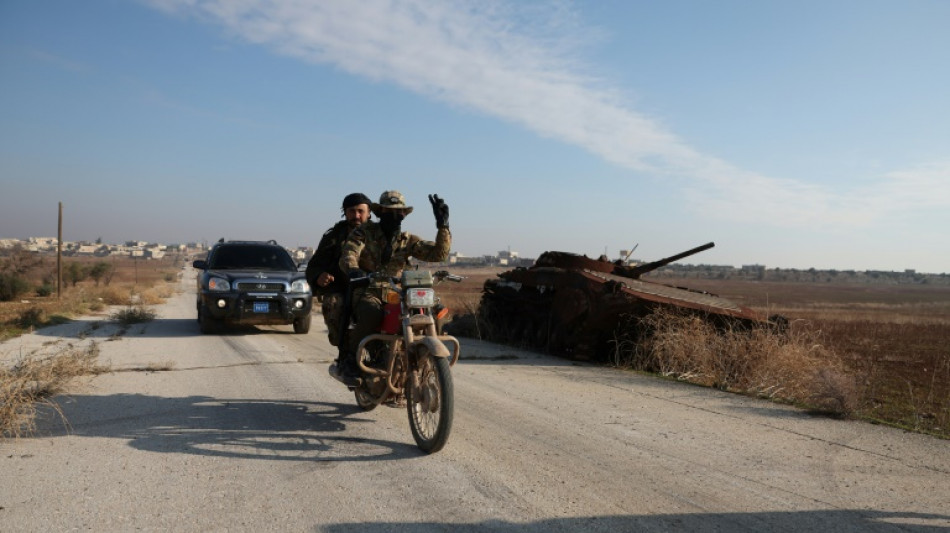
Syria jihadists, allies shell major city Aleppo in shock offensive / Photo: Omar HAJ KADOUR - AFP
Jihadists and their Turkish-backed allies shelled Syria's second city Aleppo on Friday, in a major offensive against government troops that has sparked some of the deadliest fighting the country has seen in years.
The violence has killed 255 people, according to a Syrian war monitor, most of them combatants on both sides but also including civilians. The toll also includes 24 civilians, most killed in Russian air strikes.
The offensive began at a sensitive time for Syria and the region, with a fragile ceasefire between the Iran-backed Hezbollah and Israel taking effect earlier this week in neighbouring Lebanon.
By Friday, they had wrested more than 50 towns and villages in north and northwestern Syria, according to the Syrian Observatory for Human Rights, the biggest advances that anti-government factions had made in years.
Army reinforcements have arrived in Aleppo, a Syrian government security official told AFP, requesting anonymity to discuss sensitive matters. The official added that "there are fierce battles and clashes west of Aleppo, but they have not reached the city".
This week, jihadists and factions backed by Turkey, which neighbours Syria and supported the rebellion against Syrian President Bashar al-Assad, launched a major surprise offensive against government forces.
They shelled a university student residence on Friday in government-held Aleppo, northern Syria's main city, killing four civilians according to state media.
The United Nations Office for the Coordination of Humanitarian Affairs said "more than 14,000 people –- nearly half are children -- have been displaced" by the violence.
Aleppo resident Sarmad, 51, told AFP he could hear "the sounds of missiles and artillery shelling around the clock".
"We're scared that war will break out and we'll be displaced from our homes again," he said.
Nasser Hamdo, 36, who works in a pastry shop, said he had been glued to the news since hostilities began.
The fighters had on Thursday cut the highway linking Aleppo to Syria's capital Damascus, about 300 kilometres (185 miles) south, according to the Britain-based Observatory.
"We're worried that roads getting blocked could cause fuel prices to soar and prevent goods from reaching the city," Hamdo said.
- International players -
Syria's civil war began when Assad's forces cracked down in 2011 on pro-democracy protests.
Since then, the conflict has killed more than 500,000 people, displaced millions and morphed into a complex war drawing in jihadists and foreign powers, including Assad allies Russia, Iran and Hezbollah.
Kremlin spokesman Dmitry Peskov on Friday described the situation in Aleppo as "an infringement on the sovereignty of Syria."
He expressed support for "the government of Syria to quickly restore order in this district and restore the constitutional order."
At a press conference earlier this week, Mohamed Bashir of the jihadist Hayat Tahrir al-Sham (HTS) said: "This operation aims to repel the sources of fire of the criminal enemy from the frontlines."
HTS, led by Al-Qaeda's former Syria branch, controls swathes of the Idlib region as well as small parts of neighbouring Aleppo, Hama and Latakia provinces.
The Idlib area where the jihadists are based has been subject to a Turkey and Russia-brokered truce since 2020. The ceasefire has been repeatedly violated but had largely been holding.
An AFP correspondent based in rebel-held areas saw jihadists advancing in tanks as intense exchanges of fire took place in an area just seven kilometres from the city of Aleppo.
AFP images showed damaged and abandoned Syrian army tanks and other military vehicles in the region.
The correspondent said the jihadists and their Turkey-backed allies took orders from a joint military operations command.
Analyst Nick Heras, of the New Lines Institute for Strategy and Policy, said the fighters were "trying to preempt the possibility of a Syrian military campaign in the region of Aleppo".
According to Heras, the Syrian government and its key backer Russia had been preparing for such a campaign.
Russia intervened in Syria's civil war in 2015, turning the momentum of the conflict in favour of the president, whose forces at the time had lost control of most of country.
Turkey, Heras said, may be "sending a message to both Damascus and Moscow to back down from their military efforts in northwest Syria".
- 'Totally unprepared' -
Other interests are also at stake.
Iran-backed militias have a heavy presence in the Aleppo region after providing crucial ground support to the army in its recapture of rebel-held districts of the city in 2016.
Anti-government forces are, according to Heras, "in a better position to take and seize villages than Russian-backed Syrian government forces, while the Iranians are focused on Lebanon".
During its war with Hezbollah in Lebanon, Israel intensified its strikes on Iran-backed groups in Syria including Hezbollah.
Rami Abdel Rahman, director of the Observatory, said Assad's forces "were totally unprepared" for the attack.
"It is strange to see regime forces being dealt such big blows despite Russian air cover and early signs that HTS was going to launch this operation," Abdel Rahman said.
"Were they depending on Hezbollah, which is now busy in Lebanon?"
J.Hermans--LCdB