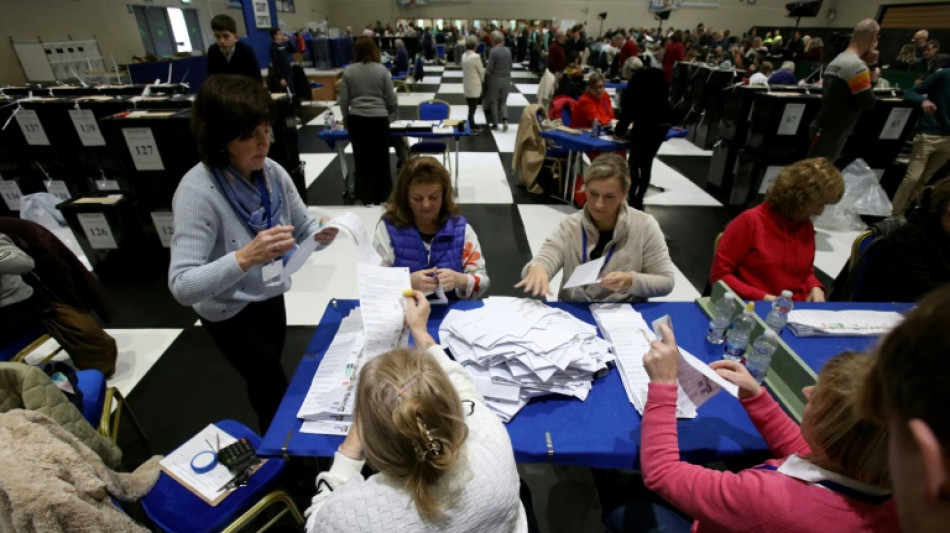
Incumbent centre-right in 'driving seat' in Irish vote / Photo: PAUL FAITH - AFP
Vote counting in Ireland's general election began Saturday with an exit poll indicating a tight finish with the incumbent centre-right coalition most likely to form the next government.
After voting concluded Friday, the exit poll indicated that the leftist-nationalist Sinn Fein, the main opposition party, narrowly led with 21.1 percent of the vote.
But neck and neck on 21.0 percent was the centre-right Fine Gael whose leader is the outgoing prime minister Simon Harris.
Fine Gael's centre-right partner in the outgoing coalition -- Fianna Fail, led by deputy prime minister Micheal Martin -- were slightly further back in third with 19.5 percent.
"Forming a government will depend on two of the three being able to cooperate with one another," Lisa Keenan, a political scientist at Trinity College Dublin, told AFP.
But Fine Gael and Fianna Fail are "in the driving seat to reestablish coalition" in the new 174-seat lower chamber of parliament, said the Irish Times newspaper.
During the campaign both Fianna Fail and Fine Gael ruled out entering coalition with Sinn Fein, who also prioritise Irish unification.
"Sinn Fein could well finish first in the popular vote for the second time in a row, but face another five years in opposition," said the paper.
- Horse-trading ahead -
At the last general election in 2020, Sinn Fein -- the former political wing of the paramilitary Irish Republican Army -- won the largest vote share but could not find willing coalition partners.
That led to weeks of horsetrading, ending up with Fine Gael, which has been in power since 2011, agreeing a deal with Fianna Fail.
Partial results are expected throughout Saturday, while a final result may not be clear for days.
During the last parliamentary term, the role of prime minister rotated between the Fianna Fail and Fine Gael leaders.
The smaller Green Party made up the governing coalition.
EU member Ireland's proportional representation system sees votes of eliminated candidates redistributed during multiple rounds of counting.
While the exit poll suggests Fine Gael and Fianna Fail's performance is down on the last election, "their supporters are increasingly willing to transfer from one to the other," as the count rounds progress, Keenan told AFP.
Smaller opposition parties including the Social Democrats, and Labour would be in the mix for coalition talks after the final result according to analysts.
Non-aligned independent candidates could also play a role in the next government if sought by the frontrunner parties to make up an 88-seat majority in the Dail.
The three-week campaign, launched after Harris called a snap election November 8, was marked by rancour over housing and cost-of-living crises, public spending and immigration.
Harris, who became Ireland's youngest-ever taoiseach (prime minister) when he took over in April, held a solid lead entering the campaign.
But the party lost ground, in particular after Harris was seen in a viral clip appearing rude and dismissive to a care worker on the campaign trail.
Both centre-right parties stressed their pro-business and pro-EU credentials and said returning them to power would ensure stability, particularly with turmoil abroad and the risk of external shocks.
Ireland's high-growth economy depends on foreign direct investment and lavish corporate tax returns from mainly US tech and pharma giants, and would suffer if incoming US president Donald Trump follows through on pledges to slap tariffs on imports and repatriate corporate tax of US firms.
The exit poll revealed "no enthusiasm for the government, despite the buoyant economy," Eoin O'Malley, a political scientist at Dublin City University, told AFP.
"But neither is there any enthusiasm for the opposition parties," he said.
But it rallied on the back of a campaign heavily focused on housing policy and claimed it is the only alternative to Fine Gael and Fianna Fail, which have swapped power since Irish independence from Britain in 1921.
N.Lambert--LCdB