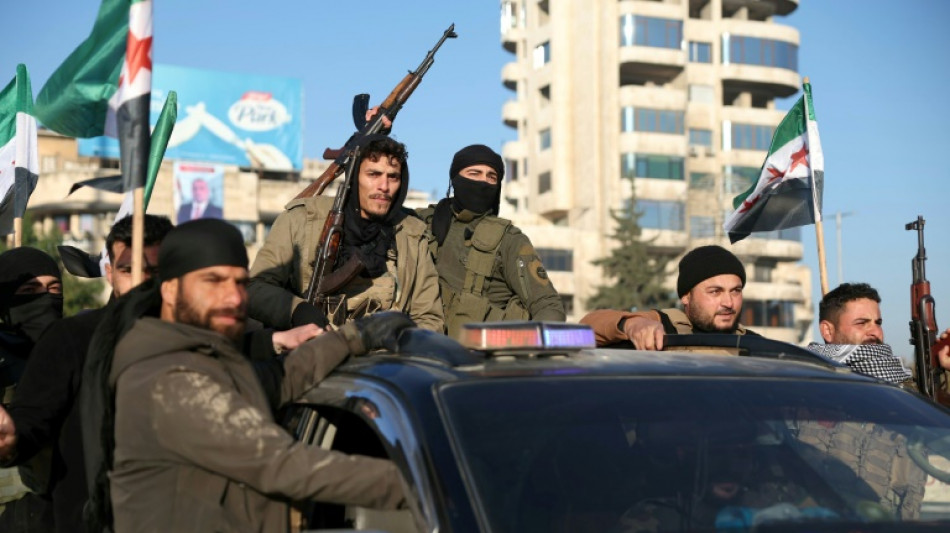
Syria war monitor says rebels control most of Aleppo / Photo: Omar HAJ KADOUR - AFP
A monitor of Syria's war said on Saturday that rebels controlled most of Aleppo, reporting Russian air strikes on parts of Syria's second city for the first time since 2016.
Fighters have pressed a lightning offensive against forces of the Iranian- and Russian-backed Syrian government since Wednesday, as a fragile ceasefire took effect in neighbouring Lebanon between Israel and the Iran-backed Hezbollah group, a Damascus ally, after two months of all-out war.
"Hayat Tahrir al-Sham (HTS) and allied factions... took control of most of the city and government centres and prisons", said the Britain-based Syrian Observatory for Human Rights, "without meeting great resistance".
Overnight, Russian "warplanes launched raids on areas of Aleppo city for the first time since 2016", added the Observatory which relies on a network of sources inside Syria.
HTS, a jihadist alliance led by Al-Qaeda's former Syria branch, controls swathes of the Idlib region in Syria's northwest, as well as parts of neighbouring Aleppo, Hama and Latakia provinces.
The Syrian Observatory for Human Rights said later on Saturday that "at least 16 civilians were killed and 20 others wounded" when "warplanes, likely Russian, targeted civilian vehicles" at a roundabout in the part of the city that has been overrun by fighters.
Syria's army admitted on Saturday that rebels had entered "large parts" of Aleppo and said "dozens of men from our armed forces were killed and others wounded".
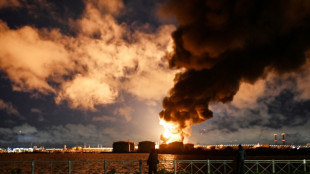
AFPTV footage showed fires burning in part of the city after the air strikes, while AFP images showed rebels outside the city's landmark citadel.
Observatory chief Rami Abdel Rahman told AFP that "at this moment, the Syrian regime appears to have been abandoned by its main allies Iran and Russia, with Moscow until now carrying out symbolic strikes".
- 'Waiting 10 years' -
Other fighters were seen posing with a rebel flag outside a police building bearing a large poster of Assad, and standing below a partially-burning billboard of the president.
Syria's army said "armed terrorist organisations" -- a term it uses for all its adversaries -- launched "a broad attack from multiple axes on the Aleppo and Idlib fronts" and reported fierce battles "over a strip exceeding 100 kilometres (60 miles)".
The Observatory said the overnight air strikes coincided with "the arrival of large (rebel) military reinforcements" to the area. The war monitor said rebels had taken more than 80 towns and villages in the north.
It raised the death toll in days of clashes to 327 -- 183 from HTS and allied factions, 100 soldiers and pro-government forces, as well as 44 civilians.
"We've been waiting for this" for years, said rebel fighter Mohamed Hammadi, 29, from a square in Aleppo, a city of around two million people that was Syria's pre-war manufacturing hub.
He said the offensive was "to liberate Aleppo, to kick out the Iranian militias, the militias of Hezbollah, and to lift the oppression against our brothers in the city."
"We going to clear all of Syria, God willing," he added.
Iran-backed groups have a heavy presence in the Aleppo region after providing crucial ground support when the Syrian army -- backed by Russian air power -- recaptured rebel-held areas of the city in 2016.
- Gunfire -
Pro-government radio station Sham FM reported Saturday that "armed groups were present in a number of streets and neighbourhoods in Aleppo city amid air strikes targeting fighters' positions west of the city".
"Most civilians are avoiding leaving their homes and public and private institutions in the city are almost completely shut," it added.
The Observatory said that "the governor of Aleppo and the police and security branch commanders withdrew from the city centre".
Some rebels prayed in the city centre and fired celebratory gunfire, later patrolling on foot in central Aleppo, images showed. An opposition flag hung from a traffic light.
The jihadists and their allies had made other advances in the north, including seizure of the strategically located town of Saraqib, on the road to Aleppo about 40 kilometres (25 miles) southwest, the Observatory had said.
Since 2020, the Idlib area has been subject to a Turkey and Russia-brokered truce which had largely been holding despite repeated violations.
Syria's conflict broke out after Assad crushed anti-government protests in 2011, spiralling into a complex conflict that has drawn in foreign armies and jihadists and killed more than half a million people.
V.Nijs--LCdB