Georgia PM vows 'no negotiations' amid mass pro-EU protests / Photo: Giorgi ARJEVANIDZE - AFP
Georgia's prime minister on Monday vowed no negotiations with the Black Sea country's opposition, as thousands took to the streets of Tbilisi to protest his decision to shelve talks on joining the EU.
The Black Sea nation has been rocked by turmoil since the governing Georgian Dream party claimed victory in October 26 parliamentary elections that the pro-European opposition said were fraudulent.
Facing a boycott of parliament by opposition MPs and attempts by the pro-EU president to annul the election results, Prime Minister Irakli Kobakhidze announced last week that Georgia was shelving accession talks with the European Union until 2028.
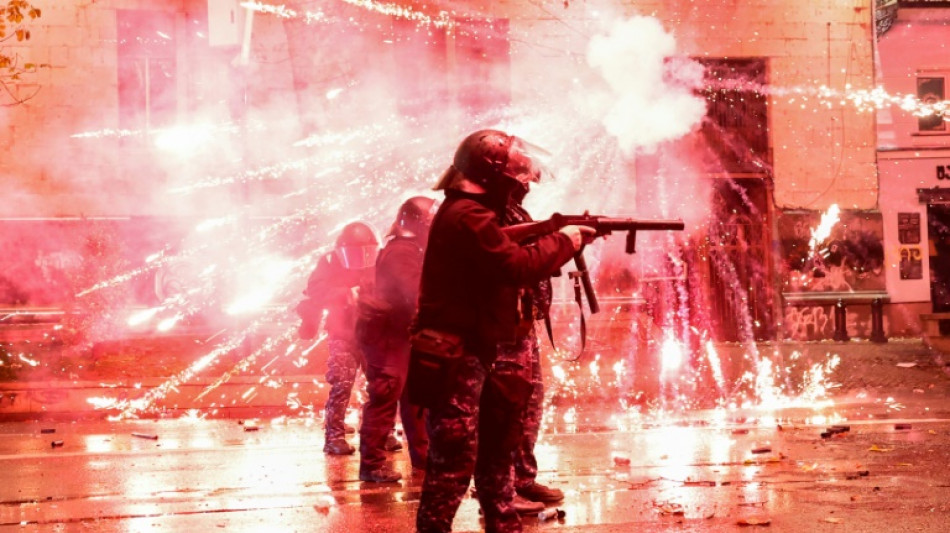
The decision triggered uproar -- cast as a "betrayal" and "coup" by critics -- sparking intense clashes between protestors and police in the centre of Tbilisi in a series of late-night protests.
Tens of thousands of people, waving Georgian and EU flags, gathered outside the parliament building on Monday for the fifth consecutive day of protest, AFP reporters saw.
Amid no sign of let-up, Kobakhidze on Monday adopted a hardline towards the demonstrators, telling reporters: "No negotiations."
He claimed that the protests were "funded from abroad" and vowed that "there will be no revolution in Georgia."
He also lambasted Western countries for failing to condemn "organised violence" by protesters, as they have criticised excessive force by Georgian police.
- 'No negotiations' -
Georgia's constitution commits the country to seek membership of the European Union, and opinion polls regularly show 80 percent of the country in favour.
The prime minister has said that joining the bloc "by 2030" is still his "top priority", a claim not accepted by protesters angry at the formal shelving of talks.
On Monday he said the government would make "maximum efforts" to join the EU, despite ruling out talks on accession for the next four years. He said he had discussed EU integration with Georgian diplomats earlier that day.
The demonstrators are backed by Georgia's pro-EU president Salome Zurabishvili, who has vowed to stay in office until fresh elections, despite her term being officially set to end.
"Another powerful night of Georgians standing firm to defend their constitution and their European choice," she said on X, after police used tear gas and water cannons to disperse massive demonstrations in Tbilisi on Sunday.
"The determination in the streets shows no signs of stopping!" she added.
The opposition is boycotting the new parliament, and Zurabishvili has asked the constitutional court to annul the election result, declaring the new parliament and government "illegitimate".
Critics accuse Georgian Dream, in power for more than a decade, of having steered the country away from the European Union and closer to Russia, an accusation it denies.
Russia on Monday defended Georgia's crackdown on protesters.
Kremlin spokesman Dmitry Peskov said Tbilisi is acting to "stabilise" the situation, accusing protesters of wanting to "stir up" unrest.
He said he drew a "direct parallel" with Ukraine's 2014 "Maidan" protest, which ousted a Kremlin-backed leader who reneged on an EU partnership agreement.
Moscow responded to that by annexing the Crimean peninsula and backing anti-Kyiv separatist militias in the country's east.
- 'Systematic beatings' -
Dozens have been injured in the protests since Thursday including demonstrators, police and journalists, according to officials and activists, though the exact numbers were unclear.
Demonstrators have launched fireworks towards police, started fires and thrown projectiles, while police have been seen charging into and beating protestors.
Authorities have also deployed water cannon, tear gas and rubber bullets against the crowds.
Zurabishvili said Monday that those detained by police "have been subjected to systematic beatings" after arrest.
The "majority of the arrested protesters have injuries to their heads and faces, broken face bones, eye sockets, open wounds," she said.
The leader of the opposition United National Movement party, Levan Khabeishvili, told journalists he was attacked by around 15 masked police attempting to detain him but managed to escape with the help of protesters.
Monday also saw anti-government strikes break out at companies and educational institutions, national media reported, while several diplomats and ambassadors have signed letters criticising the move to suspend the EU accession bid.
S.Denis--LCdB