Jordan to host Syria talks after Damascus erupts in celebration / Photo: Omar HAJ KADOUR - AFP
Jordan will host US, EU, Turkish and Arab diplomats on Saturday for high-level talks on Syria, a day after celebrations in Damascus and nationwide rejoicing at the ouster of president Bashar al-Assad.
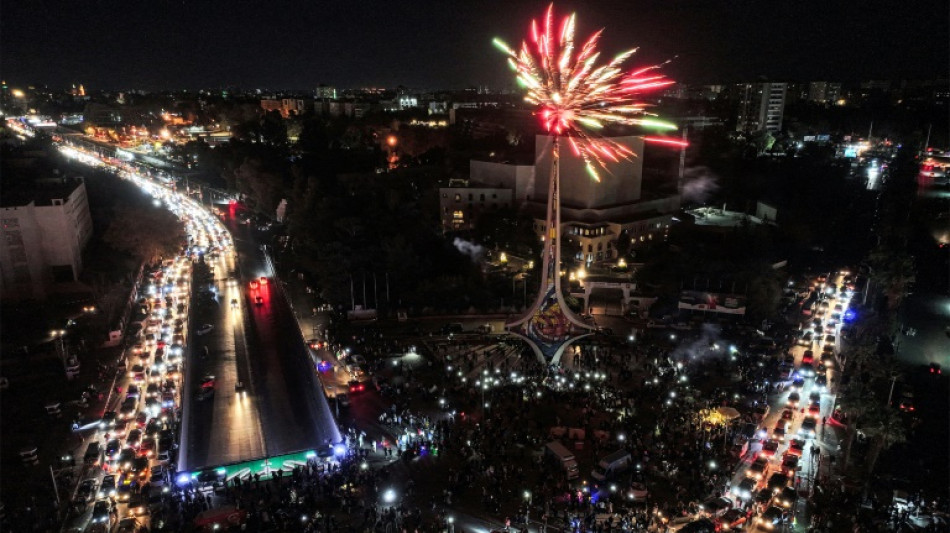
Syrians celebrated the day they called the "Friday of victory" with fireworks heralding the fall of the Assad dynasty.
More than half a century of brutal rule by his clan came to a sudden end on Sunday, after a lightning rebel offensive swept across the country and took the capital.
Assad's fall has also led to fast-moving diplomatic developments, with US Secretary of State Antony Blinken among envoys set to discuss Syria on Saturday in the Jordanian city of Aqaba.
Turkey, meanwhile, will reopen its embassy in Damascus, closed since 2012 amid calls by Ankara for Assad to step down.
A Qatari diplomat said a delegation from the Gulf emirate would visit Syria on Sunday to meet transitional government officials and discuss aid and the reopening of their embassy.
Unlike other Arab states, Qatar never restored diplomatic ties with Assad after a rupture in 2011.
Assad has fled Syria, closing an era in which suspected dissidents were jailed or killed, and capping nearly 14 years of war that killed more than 500,000 people and displaced millions.
- 'Tears of joy' -
Abu Mohammed al-Jolani, head of the Islamist group Hayat Tahrir al-Sham (HTS) which spearheaded the offensive, had called on Syrians "to go to the streets to express their joy".
Celebrations continued into the night on the first Friday -- the Muslim day of rest and prayer -- since Assad took flight.
Umayyad Square in Damascus was jammed with vehicles, people and waving flags as fireworks shot into the air, AFPTV live images showed.
Thousands flocked to the capital's landmark Umayyad Mosque, some raising the three-star Syrian independence flag that none dared wave in the capital during Assad's repressive rule.
Crowds also gathered in the squares and streets of other Syrian cities, including Homs, Hama and Idlib.
There was a festive and relaxed atmosphere as hundreds rallied in the main square of Syria's second city Aleppo, a scene of fierce fighting during the country's civil war, AFP correspondents said.
A huge billboard depicting Assad and his father Hafez was set on fire.
Ahmad Abd al-Majed, 39, an engineer who returned to Aleppo from Turkey, said that many shed "tears of joy and happiness".
"Syrians deserve to be happy," he said.
In the southern city of Sweida, the heartland of Syria's Druze minority, Bayan al-Hinnawi, 77, never believed he would live to see such a day.
"It's a wonderful sight. Nobody could have imagined this could happen", said Hinnawi, who spent 17 years in prison.
- Tens of thousands missing -
Sunni Muslim HTS is rooted in Syria's branch of Al-Qaeda and designated a terrorist organisation by many Western governments.
The group has sought to moderate its rhetoric, and the interim government insists the rights of all Syrians will be protected -- as will the rule of law.
The European Union was seeking "to establish contacts" with the new rulers soon, an EU official told AFP on condition of anonymity.
The UN refugee agency said the new government had sent "constructive" initial signals, including asking the organisation to stay in the country.
Leaders of the Group of Seven (G7) democratic countries, who met virtually on Friday, expressed hope for "a peaceful and orderly transition through the definition of an inclusive political process" in Syria.
Inside much of Syria, the focus is turning towards unravelling the secrets of Assad's rule, particularly the network of detention centres and suspected torture sites.
Syrians have descended upon prisons, hospitals and morgues in search of long-disappeared loved ones.
"I turned the world upside down looking," Abu Mohammed told AFP as he searched for news of three missing relatives at the Mazzeh airbase in Damascus.
"We just want a hint of where they were."
The International Committee of the Red Cross said it documented more than 35,000 disappearances during Assad's rule, with the actual number likely far higher.
While Syrians celebrate the end of Assad's brutal rule, they face a struggle for necessities in a country ravaged by war, sanctions and runaway inflation.
On Friday, the EU announced the launch of an "air bridge" operation to deliver an initial 50 tonnes of health supplies via neighbouring Turkey.
- Israel ready to stay in buffer zone -
Assad was propped up by Russia -- where a senior Russian official told US media he has fled -- as well as Iran and Lebanon's Hezbollah militant group.
Turkish Foreign Minister Hakan Fidan told private NTV television that his country had urged Russia and Iran not to intervene militarily "to ensure minimum loss of life".
The rebels launched their offensive on November 27, the same day a ceasefire took effect in the Israel-Hezbollah war, which saw Israel inflict staggering losses on Assad's Lebanese ally.
Both Israel and Turkey, which backs some of the rebels who ousted Assad, have since carried out strikes inside Syria.
Israel has also sent troops into a UN-patrolled buffer zone that separated Israeli and Syrian forces on the Golan Heights, in a move the UN said violated a 1974 armistice.
The army has been ordered to "prepare to remain" there throughout the winter, Defence Minister Israel Katz's office said Friday.
X.Thijs--LCdB