US says in contact with new Syria rulers / Photo: Bakr ALKASEM - AFP
The United States has made contact with Syria's victorious Hayat Tahrir al-Sham rebels, Secretary of State Antony Blinken said on Saturday, despite previously designating the group as terrorists.
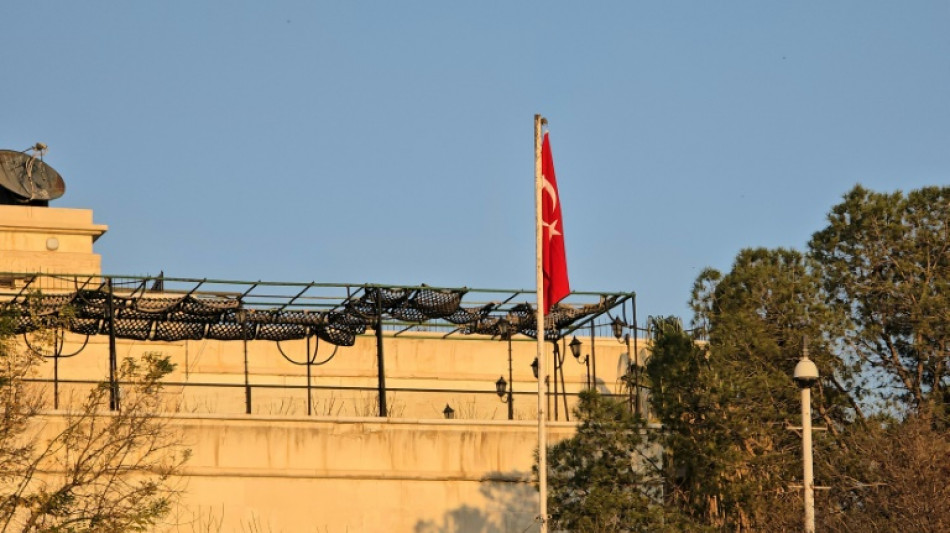
Blinken's comments, after talks on Syria in Jordan, came as Turkey reopened its embassy in Damascus, nearly a week after the Islamist-led rebels toppled president Bashar al-Assad, and 12 years after Ankara's diplomatic mission was shuttered early in Syria's civil war.
"We've been in contact with HTS and with other parties," Blinken told reporters, without specifying how the "direct contact" took place.
Blinken spoke after he joined Middle Eastern, Turkish and Western diplomats in Jordan for talks on Syria, and a day after nationwide celebrations at Assad's ouster.
Ankara has been a major player in Syria's conflict, holding considerable sway in the northwest, financing armed groups there, and maintaining a working relationship with HTS which spearheaded the offensive that brought down Assad.
The Turkish flag was raised over the diplomatic mission in an embassy district of Damascus, in the presence of the new charge d'affaires Burhan Koroglu, an AFP journalist said.
Blinken, on a regional Syria-focused tour, said the talks in Aqaba, Jordan, agreed on the need for an "inclusive and representative" government in Damascus.
Jordan's King Abdullah II similarly stressed, during the meeting, the need for "a free, secure, stable and unified Syria."
UN special envoy for Syria Geir Pedersen urged participants to provide humanitarian aid and to ensure "that state institutions do not collapse".
"If we can achieve that, perhaps there is a new opportunity for the Syrian people," he said.
A Qatari diplomat said on Friday that a delegation from the Gulf emirate would visit Syria on Sunday to meet transitional government officials for talks on aid and the reopening of its embassy.
Unlike other Arab states, Qatar never restored diplomatic ties with Assad after a rupture in 2011.
Assad has fled Syria, closing an era in which suspected dissidents were jailed or killed, and capping nearly 14 years of war that killed more than 500,000 people and displaced millions.
- 'So much tragedy' -
A day before the meetings in Jordan, Syrians had celebrated what they called the "Friday of victory", with fireworks heralding the Assad dynasty's fall.
Sunni Muslim HTS is rooted in Syria's branch of Al-Qaeda and is designated a "terrorist" organisation by many Western governments.
But the group has sought to moderate its rhetoric, and the interim government insists the rights of all Syrians will be protected, as will the rule of law.
"We appreciate some of the positive words we heard in recent days, but what matters is action -– and sustained action," Blinken said.
If a transition moves forward, "we in turn will look at various sanctions and other measures that we have taken", he added.
Pubs and liquor stores in Damascus initially closed following the rebel victory but are now tentatively reopening.
"'You have the right to work and live your life as you did before'," Safi, the landlord of Papa bar in the Old City, said police have told him.
But in Abu Dhabi, Anwar Gargash, a presidential adviser in the United Arab Emirates, said "we need to be on guard" despite HTS's talk of unity.
Thousands of Syrians have swarmed the country's notorious houses of detention over the past week, looking for evidence that might lead them to loved ones who disappeared under Assad's repressive rule.
And some former prisoners, like Mohammed Darwish, are also returning as free men to where they were once incarcerated, trying to find closure.
"When the door closed behind us, we were plunged into the depths of despair. This cell was witness to so much tragedy," he said, back at his former windowless cell in a Damascus prison.
Syrians also face a struggle for necessities in a country ravaged by war, runaway inflation, and sanctions that were imposed against his government.
On Friday, the EU announced the launch of an "air bridge" to deliver an initial 50 tonnes of health supplies via Turkey.
- 'Dumb politics' -
Assad was propped up by Russia -- where a senior Russian official told US media he has fled -- as well as Iran and Lebanon's Hezbollah militant group.
The rebels launched their offensive on November 27, the same day a ceasefire took effect in the Israel-Hezbollah war in Lebanon, in which Assad's ally suffered staggering losses.
Naim Qassem, the leader of Iran-backed Hezbollah, on Saturday said he hoped Syria's new rulers see Israel "as an enemy" and do not normalise ties with the country.
Both Israel and Turkey have carried out strikes inside Syria since Assad's fall.
A war monitor said Israeli strikes early Saturday "destroyed a scientific institute" and other related military facilities in Barzeh, northern Damascus, targeted a "military airport" in the capital's countryside, and also struck in the Qalamun area.
To Gargash, the UAE adviser, such strikes are "dumb politics", even though "to structurally degrade Syrian capabilities might be seen a sensible thing from an Israeli practical point of view".
Israel has also ordered troops into a UN-patrolled buffer zone that separated Israeli and Syrian forces on the Golan Heights, a move the UN said violated a 1974 armistice.
HTS leader Abu Mohammed al-Jolani, who is now using his real name Ahmed al-Sharaa, said the Israeli move "threatens a new unjustified escalation in the region".
But "the general exhaustion in Syria after years of war and conflict does not allow us to enter new conflicts," he said in an online statement.
O.Dupont--LCdB