13 peacekeepers killed as fighting rages in eastern DRCongo / Photo: Jospin Mwisha - AFP
Thirteen soldiers serving with peacekeeping forces -- from South Africa, Malawi and Uruguay -- have been killed in recent fighting in eastern Democratic Republic of Congo, where the Congolese army is battling Rwandan-backed M23 fighters.
Their governments announced the losses in statements Saturday as M23 forces tried to advance on Goma, the key city in the mineral-rich east and home to more than a million people.
In response, the government in Kinshasa recalled its diplomats from Kigali with immediate effect.
The African Union and European Union joined international calls for an immediate halt to the fighting, and the UN Security Council has called an emergency meeting for Monday.
"The South African National Defence Force (SANDF) lost nine members by Friday, January 24, 2025, after two days of fierce fighting," said a statement from the country's defence ministry Saturday.
Seven of the dead were serving in the regional force sent by the Southern African Development Community (SADC), and two were UN peacekeepers, it added.
Earlier Saturday, a Malawian army spokesman said three of its soldiers with the SADC force had been killed during clashes with M23 forces.
And Uruguay's military announced Saturday that one of its members serving with the UN peacekeepers had been killed and four others wounded.
- 'Irresponsible actions' -
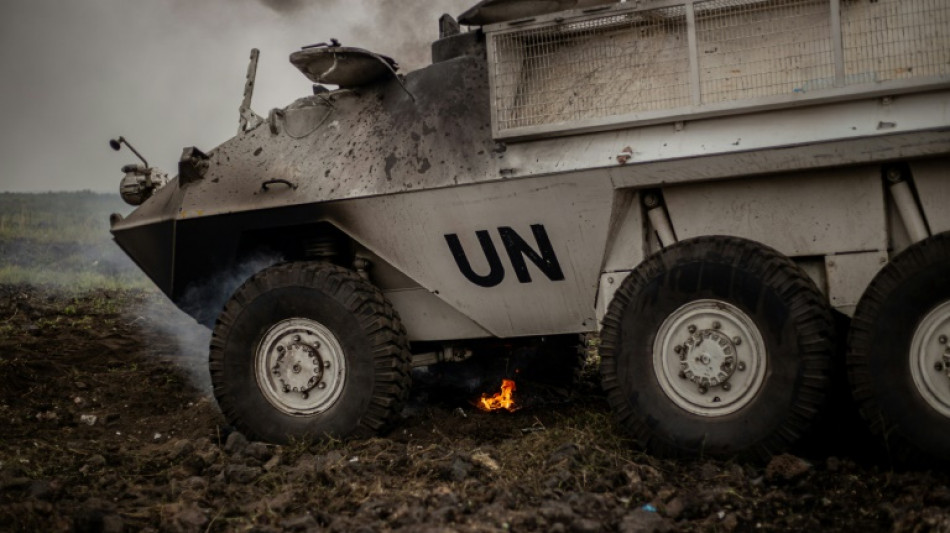
An AFP reporter saw a burned-out, smoking armoured vehicle of the UN peacekeeping force MONUSCO on the road between Goma and Sake, scene of intense fighting in recent days.
In Goma, the main city of the restive North Kivu province, artillery detonations in the distance resonated as far as the city centre.
The European Union on Saturday urged the M23 to halt its advance.
"Rwanda must cease its support for the M23 and withdraw," said EU foreign policy chief Kaja Kallas.
"The EU strongly condemns Rwanda's military presence in the DRC as a clear violation of international law, the UN charter and the territorial integrity of the DRC."
The African Union, in its statement, called for the "immediate cessation" of fighting, urging "the parties to preserve the lives of civilians".
Angolan President Joao Lourenco, the African Union's mediator between Rwanda and the DRC, denounced "irresponsible actions by the M23 and its supporters" which would have "harmful consequences for regional security".
The UN has begun evacuating "non-essential" staff from Goma to neighbouring Uganda and to the Congolese capital Kinshasa. Britain, the United States and France on Friday asked their citizens to leave Goma.
- More than a hundred wounded -
The United Nations Mission in the Democratic Republic of Congo (MONUSCO) said its Quick Reaction Forces had "been actively engaged in intense combat" with its heavy artillery firing against M23 positions.
Some 15,000 peacekeepers are present in the DRC.
The DRCongo announced it was pulling its diplomats from Kigali in a letter to Rwanda's embassy in Kinshasa that the president's office released to the media.
Already on Thursday, UN Secretary-General Antonio Guterres expressed fears that the fighting could aggravate "the risk of a regional war".
More than a hundred people wounded in the fighting around Goma since Thursday have been treated by medical teams from the International Committee of the Red Cross (ICRC) in Goma.
According to the UN, 400,000 people have been forced to flee the fighting since the beginning of January.
Goma is at the epicentre of the violence that has rocked eastern DRC for 30 years, where diplomatic efforts to resolve the crisis have failed.
In December, a planned meeting between DRC President Felix Tshisekedi and Rwandan President Paul Kagame as part of an Angola-led peace process was cancelled at the last minute.
- Rwanda slams UN -
The conflict between the M23, supported by 3,000 to 4,000 Rwandan soldiers, and the Congolese army has lasted for more than three years, worsening the chronic humanitarian crisis in the region.
The DRC accuses Rwanda of wanting to seize the riches of eastern Congo, which Kigali denies.
The diplomatic temperature rose sharply Saturday as Rwanda slammed MONUSCO for what Kigali called "incendiary" language.
The UN force had called for "a sustainable and final solution to the conflict that has triggered massive displacement, humanitarian needs and human sufferings".
"Dialogue between the DRC government and the rebels from an aggrieved Congolese community that has been victim of systematic persecution is the only way to resolve this conflict," Makolo added.
V.Nijs--LCdB