Militants slam Trump idea of relocating Palestinians / Photo: Eyad BABA - AFP
Hamas and militant allies Islamic Jihad on Sunday reacted with fury and defiance to a plan floated by US President Donald Trump to "clean out" Gaza, where a fragile truce between Israel and Hamas aimed at permanently ending the war enters its second week.
There was no immediate reaction from Israeli Prime Minister Benjamin Netanyahu but a far-right minister welcomed Trump's "great" idea.
Israel and Hamas accused each other of ceasefire breaches linked to the latest hostage-prisoner swap that occurred on Saturday under the truce deal that came into effect on January 19.
The swap saw four Israeli women hostages, all soldiers, and 200 Palestinian prisoners released to joyful scenes, in the second such exchange so far.
But after 15 months of war, Trump called Gaza a "demolition site" and said that he had spoken to Jordan's King Abdullah II about moving Palestinians out of the territory.
"I'd like Egypt to take people. And I'd like Jordan to take people," Trump told reporters aboard Air Force One, adding that he expected to talk to Egyptian President Abdel Fattah al-Sisi on Sunday.
Most Gazans are Palestinian refugees or their descendants.
For Palestinians, any attempt to move them from Gaza would evoke dark historical memories of what the Arab world calls the "Nakba" or catastrophe -- the mass displacement of Palestinians during Israel's creation 75 years ago.
Egypt has previously warned against any "forced displacement" of Palestinians from Gaza into the Sinai desert, which Sisi said could jeopardise the peace treaty Egypt signed with Israel in 1979.
Jordan is already home to around 2.3 million registered Palestinian refugees, according to the United Nations.
"You're talking about probably a million and half people, and we just clean out that whole thing," Trump said of Gaza, whose population is about 2.4 million.
"I'd rather get involved with some of the Arab nations and build housing at a different location where they can maybe live in peace for a change," Trump said, adding that moving Gaza's inhabitants could be "temporarily or could be long term".
- 'Deplorable' -
Bassem Naim, a member of Hamas's political bureau, told AFP that Palestinians would "foil such projects" as they have done to similar plans "for displacement and alternative homelands over the decades".
Gazans, he said, "will not accept any offers or solutions, even if their apparent intentions are good under the banner of reconstruction, as proposed by US President Trump."
Islamic Jihad, which fought alongside Hamas in Gaza, called Trump's idea "deplorable" and said that it encourages "war crimes and crimes against humanity by forcing our people to leave their land".
Far-right Israeli Finance Minister Bezalel Smotrich, who opposed the Gaza truce deal, said that Trump's suggestion of "helping them find other places to start a better life is a great idea".
He added: "Only out-of-the-box thinking with new solutions will bring a solution of peace and security."
The vast majority of Gaza's people have been displaced, often multiple times, by the Gaza war that began after Hamas's attack on southern Israel on October 7, 2023.
The United Nations says close to 70 percent of the territory's buildings are damaged or destroyed.
- Waiting to enter -
A last-minute dispute on Saturday prevented the expected return of hundreds of thousands of displaced Palestinians to northern Gaza.
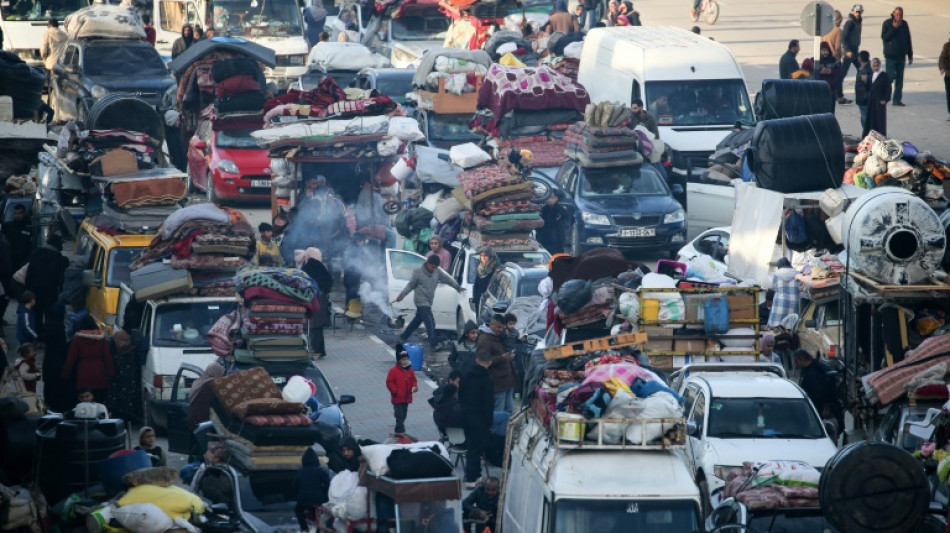
On Sunday, cars and carts loaded with belongings lined up near the blocked Netzarim Corridor that they would cross to enter the north.
Israel announced it would prevent Palestinians' passage to the north until the release of Arbel Yehud, a civilian woman hostage who Netanyahu's office said "was supposed to be released" on Saturday.
On Sunday, Netanyahu's office said that Hamas had committed two ceasefire violations during the latest exchange. Not releasing Yehud was one, and the group also did not provide "the detailed list of all hostages' statuses", the office said.
Hamas later on Sunday said that blocking returns to the north amounts to a truce violation and said it has provided "all the necessary guarantees" for Yehud's release.
Israel has also reached a ceasefire with Iran-backed Hezbollah in Lebanon, where the health ministry on Sunday said Israeli troops killed three residents and wounded 44 as hundreds of people tried to return to their homes on the deadline for Israeli forces to withdraw from the area.
During the first phase of the Gaza truce, 33 hostages should be freed in staggered releases over six weeks in exchange for around 1,900 Palestinians held in Israeli jails.
A total of seven hostages and 289 Palestinians have so far been freed, as well as one Jordanian prisoner freed by Israel.
Of the 251 hostages seized during Hamas's October 7, 2023 attack that triggered the war, 87 remain in Gaza including 34 the military says are dead.
The Hamas attack resulted in the deaths of 1,210 people, mostly civilians, according to an AFP tally based on official Israeli figures.
Israel's retaliatory offensive killed at least 47,283 people in Gaza, the majority civilians, according to figures from the Hamas-run territory's health ministry which the United Nations considers reliable.
burs-ami/it/bc
L.Dumont--LCdB