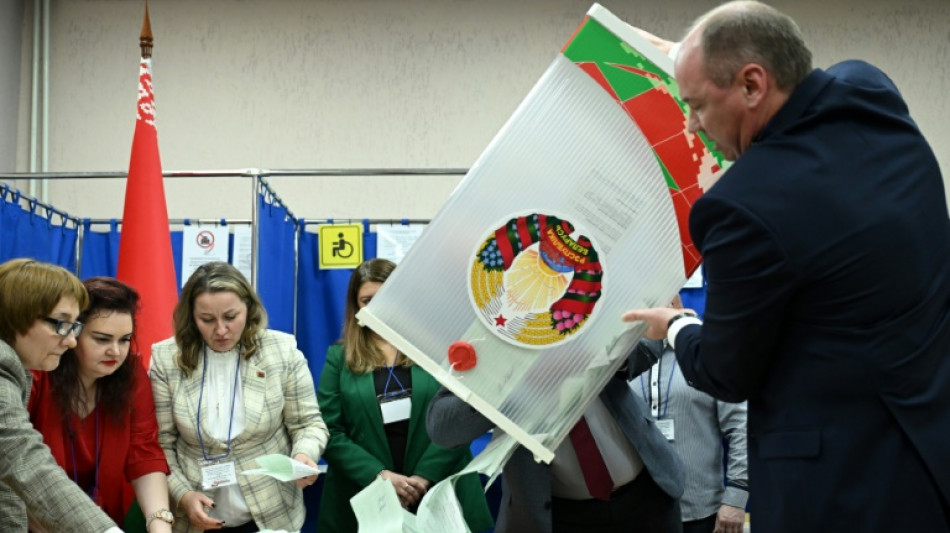
Lukashenko extends three-decade rule in election deonounced by West / Photo: Natalia KOLESNIKOVA - AFP
Belarus autocrat Alexander Lukashenko, in power since 1994, won a seventh consecutive term in office Sunday in an election denounced by the European Union and the exiled opposition.
With his opponents in prison or exiled, the 70-year-old ruler appeared to have won 87.6 percent of the vote according to an official exit poll.
Lukashenko has orchestrated a ruthless crackdown on opponents since huge protests against him in 2020. This time around, the candidates picked to run against him actually campaigned in his favour.
Exiled opposition leader Svetlana Tikhanovskaya called the election a "farce", while the EU described it as a "sham".
Lukashenko, however, said he did not care whether or not the bloc recognised the results.
And he had "no regrets" over letting his "older brother" Russian President Vladimir Putin's troops enter Ukraine through Belarus in 2022 -- despite hundreds of thousands of deaths in the three-year conflict.
The vote took place five years into unprecedented repression in Belarus, during which time rights groups say the country has jailed more than 1,200 political prisoners.
In Sunday's election victory he won more of the vote than in 2020, when he won 81.04 percent.
- The 'illusion of choice' -
Belarus's 2020 election ended in nationwide protests with demonstrators accusing Lukashenko of rigging the vote.
Tens of thousands of Belarusians fled their country in the aftermath of the 2020 protests as the KGB embarked on a repression spree, mainly to neighbouring Poland and Lithuania.
Lukashenko said Sunday his opponents were behind bars or abroad out of choice.
"Some chose prison, some exile," he said.
"If it is prison then it's those who opened their mouths too widely," he added.
Repenting and asking for pardon were preconditions for any prisoner releases, he said during a news conference that lasted four hours and 25 minutes.
In Warsaw, home to many exiled Belarusians, opposition leader Tikhanovskaya described Lukashenko as a "criminal who has seized power".
Many people wore masks and some refused to speak to AFP, explaining they had relatives in Belarus and criticism could make trouble for them.
"It's just a country with the illusion of choice," 22-year-old student Aliaxandra said, adding that some of her countrymen had been living in fear "for decades".
Tikhanovskaya told AFP in an interview this month she wanted dissidents to be ready for an opportunity for change in Belarus. But she admitted that it was "not the moment".
- 'Peace in this country' -
Her allies in Belarus are held in harsh prisons -- often incommunicado and in isolation.
Lukashenko accused imprisoned protest leader Maria Kolesnikova -- who tore up her passport during a forced deportation by the KGB in 2020 -- of "breaking" prison rules.
He said he personally gave the order for Kolesnikova to be "shown to the people" last November -- when photos of her were released in a first sign of life for over a year.
Fears for the health of Kolesnikova -- who was hospitalised while in prison -- have risen for months, but Lukashenko said: "She is fine."
Criticism of the strongman is banned. Most people AFP spoke to in Minsk and other towns voiced support for him.
In Minsk, 74-year-old pensioner Nadezhda Guzhalovskaya said she voted for Lukashenko due to a lack of other options.
"Maybe everything here is not perfect, we don't have democracy," admitted Guzhalovskaya.
But Irina Lebedeva said that "thanks to our president there is peace in this country," repeating the government's position that the 2020 street protest leaders had created chaos.
- Reliant on Russia -
The United Nations estimates that some 300,000 Belarusians have left the country since 2020 out of a population of nine million.
They will not be able to cast ballots, with Belarus having scrapped voting abroad.
In the run-up to the election, the Lukashenko administration pardoned around 200 political prisoners.
Known as "Europe's last dictator" -- a nickname he embraces -- Lukashenko's Belarus has retained much of the Soviet Union's traditions and infrastructure.
If he completes his term, which would finish in 2030, he will have been in power for 36 years.
B.Francois--LCdB