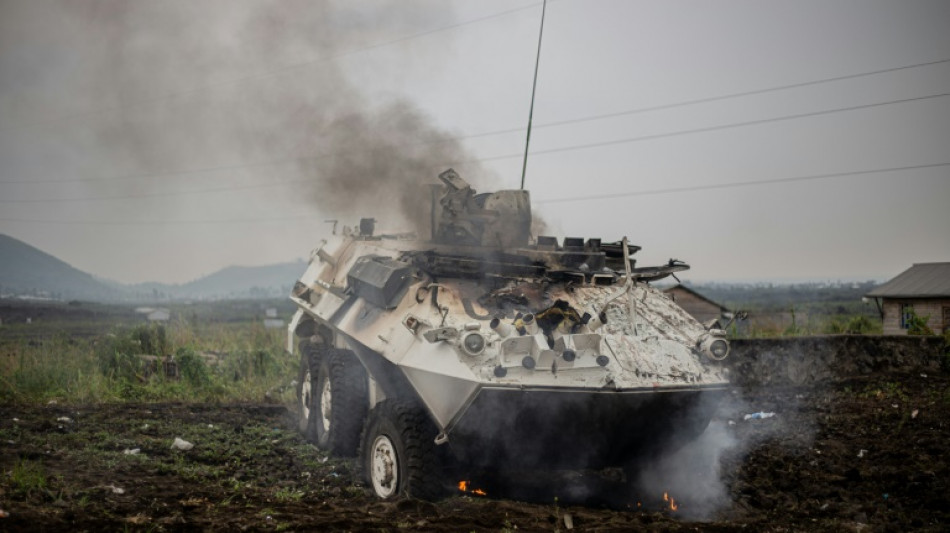
DR Congo urges UN to punish Rwanda for 'declaration of war' / Photo: Jospin Mwisha - AFP
The Democratic Republic of Congo on Sunday called for the United Nations to sanction Rwanda, accusing its neighbour of issuing a "declaration of war" by sending more troops over the border.
Kinshasa said the reinforcements were joining fighters with the Rwandan-backed M23 force closing in on Goma, capital of DRCongo's North Kivu province.
Already backed by several thousand Rwandan soldiers, the M23 has in recent days advanced against Congolese troops defending the city.
Around a dozen foreign peacekeepers have been killed in the escalating clashes, and UN chief Antonio Guterres on Sunday called on Kigali to pull its armed forces out of the country.
At an emergency meeting of the UN Security Council Sunday brought forward by a day in response to the crisis, Kinshasa's top diplomat warned that fresh Rwandan troops were pouring over the border "in an open and deliberate violation of our national sovereignty.
"This is a frontal assault, a declaration of war that no longer hides behind diplomatic artifice," said Congolese Foreign Minister Therese Kayikwamba Wagner.
Between 500 and 1,000 Rwandan soldiers arrived on Sunday to reinforce the M23 near Goma, UN sources told AFP.
Kayikwamba urged the UN body -- the only UN institution with the power to impose binding resolutions on its members -- to "impose targeted sanctions including asset freezes and travel bans" on Rwandan officials in response.
- 'Cease support' -
Both the DRC and Rwanda have withdrawn their diplomats from each other's capitals in a breakdown of relations.
After peace talks between Rwandan President Paul Kagame and DRC's Felix Tshisekedi were cancelled in mid-December, the M23 quickly advanced towards Goma.
The strategic city is home to more than a million residents and nearly as many displaced people.
In the city centre, heavy detonations have been echoing since dawn on Sunday, according to AFP correspondents in Goma, while most businesses were closed.
As the fighting drew closer, new columns of displaced people arrived in the city, while a Rwandan drone struck DRC positions just a few kilometres north of Goma.
With Rwanda's intervention drawing a growing chorus of international condemnation, the African Union and United States this weekend added their voices to demands for an immediate ceasefire.
Ahead of the emergency meeting UN Secretary-General Guterres on Sunday urged Kigali to withdraw its support for the M23.
Guterres called "on the M23 to immediately cease all hostile actions and withdraw from occupied areas" and for Rwanda "to cease support to the M23 and withdraw from DRC territory", according to a statement by his spokesman Stephane Dujarric.
- Mineral export ban -
Up till now the UN Security Council has never named Rwanda as a party in the conflict.
But a UN experts' report charged that Kigali was using the M23 to secure access to the DRC's mineral wealth, exporting it abroad for its own gain.
Late on Saturday the DRC said it was pulling its diplomats from Kigali in a letter to Rwanda's embassy in Kinshasa.
Rwanda's Foreign Affairs Minister Olivier Nduhungirehe then told AFP that Kigali had "evacuated" its final diplomat from the DRC on Friday "as he was under regular threats by Congolese officials".
Goma was briefly occupied at the end of 2012 by the M23, or March 23 Movement, but the group withdrew after a deal.
It was militarily defeated by DRC forces and the UN in 2013 but regrouped several years later.
Half a dozen ceasefires and truces have already been declared and broken in the region. The last ceasefire was signed at the end of July.
- Peacekeeper deaths -
For more than 30 decades the eastern DRC has been riven with violence, with rival armed groups and ethnic militias vying for supremacy.
The central African country is also home to some 15,000 peacekeepers, many with the United Nations Mission in the Democratic Republic of Congo, or MONUSCO.
On Saturday, three countries announced the deaths of a total of 13 soldiers serving as peacekeepers in the conflict zone.
Nine of the victims were from South Africa, another three were Malawian and the last one was from Uruguay.
In response to the violence UN has begun evacuating "non-essential" staff from Goma to neighbouring Uganda and to the Congolese capital Kinshasa.
O.Dupont--LCdB