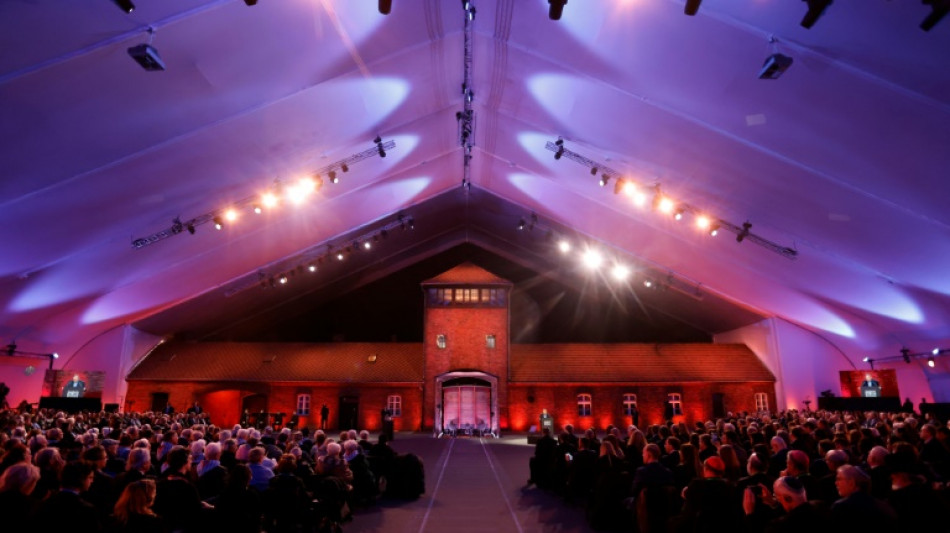
Auschwitz survivors decry anti-Semitism on 80th anniversary / Photo: Wojtek RADWANSKI - AFP
Some of the few remaining survivors of Auschwitz returned to the Nazi death camp on Monday, condemning a "huge rise" in anti-Semitism on the 80th anniversary of its liberation.
Auschwitz was the largest of the extermination camps built by Nazi Germany and has become a symbol of the Holocaust of six million European Jews. One million Jews and more than 100,000 non-Jews died at the site between 1940 and 1945.
"Eighty years after liberation, the world is again in crisis," warned Tova Friedman, 86, adding that "the rampant anti-Semitism that is spreading among the nations is shocking".
Along with Marian Turski, Janina Iwanska, and Leon Weintraub, Friedman was one of four former prisoners who spoke at the ceremony.
In total 50 fellow survivors gathered at the main commemoration outside the gates of Auschwitz II-Birkenau, joined by dozens of world leaders.
Earlier on Monday, elderly former inmates, some wearing scarves in the blue-and-white stripes of their death camp uniforms, laid flowers at the site, touching the camp's Wall of Death in silence.
"Today, and now, we see a huge rise in anti-Semitism and it is precisely anti-Semitism that led to the Holocaust," Turski, 98, warned those at the ceremony.
Weintraub, a 99-year-old Polish-born Swedish physician, asked for the young to "be sensitive" to intolerance and discrimination and condemned the proliferation of Nazi-inspired movements in Europe.
- 'Never be silent' -
Also speaking at the ceremony, World Jewish Congress president Ronald Lauder said the horrors of Auschwitz and Hamas's attack on Israel on October 7, 2023 were both inspired by "the age-old hatred of Jews".
Anti-Semitism "had its willing supporters then, and it has them now," he said.
"On January 27, 1945 when the Red Army entered these gates, the world finally saw where the step-by-step progress of anti-Semitism leads. It leads right here."
"Today all of us must take a pledge to never be silent when it comes to anti-Semitism or for that matter any other hatred," Lauder said.
The streets of Oswiecim were mainly deserted except for police and fleets of official cars. The camp was closed to the public and largely silent except for the fluttering of the Auschwitz Museum flags.
Ukrainian President Volodymyr Zelensky, Britain's King Charles III and French President Emmanuel Macron and dozens of other international leaders attended the commemoration.
Organisers had however decided not to include political speeches to keep the focus on the survivors.
- 'Responsibility of remembrance' -
In a statement, Zelensky said the world must unite "to prevent evil from winning".
Russia's President Vladimir Putin praised the role of Soviet soldiers in ending the "total evil" of Auschwitz.
Until its invasion of Ukraine in 2022, a Russian delegation had always attended the ceremony but Moscow was barred again this year.
Organisers said this could be the last major anniversary with such a large group of survivors.
"We all know that in 10 years it will not be possible to have a large group for the 90th anniversary," Auschwitz Museum spokesman Pawel Sawicki said.
"As the number of Holocaust survivors regrettably diminishes with the passage of time, the responsibility of remembrance rests far heavier on our shoulders and on those of generations yet unborn," King Charles said on a visit to Jewish community centre in Krakow on Monday.
Auschwitz was created in 1940 using barracks in Oswiecim, southern Poland. Its name was Germanised into Auschwitz by the Nazis.
The first 728 Polish political prisoners arrived on June 14 of that year.
On January 17, 1945, as Soviet troops advanced, the Nazi SS forced 60,000 emaciated prisoners to walk west in what became known as the "Death March".
From January 21-26, the Germans blew up the Birkenau gas chambers and crematoria and withdrew as Soviet troops approached.
On January 27, Soviet troops found 7,000 survivors when they arrived.
The day of its liberation has been designated by the United Nations as Holocaust Remembrance Day.
- 'Will they believe us?' -
Ahead of the anniversary, survivors spoke to AFP about the need to preserve the memory of what happened in the death camp and warned of rising hatred and anti-Semitism. They also expressed fears that history could repeat itself.
Julia Wallach, who is nearly 100, cannot recall the events without crying.
"It is too difficult to talk about, too hard," she said. The Parisian was dragged off a lorry destined for the gas chamber in Birkenau at the last minute.
But hard as it is to relive the horrors, she insisted she would continue to bear witness.
"As long as I can do it, I will do it." Nearby, her granddaughter Frankie asked: "Will they believe us when we talk about this when she is not there?"
E.Willems--LCdB