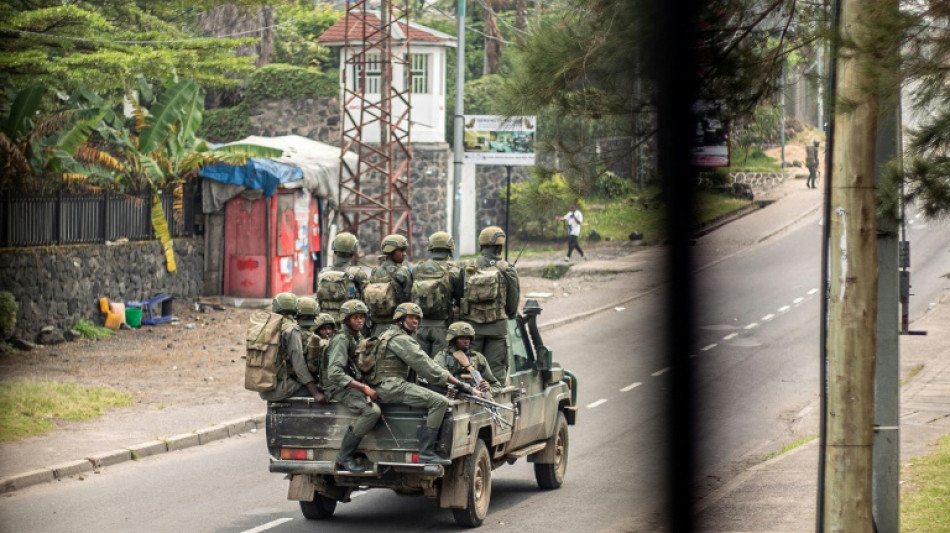
Key DR Congo city on brink as pro-Rwanda forces take airport / Photo: - - AFP
An armed group backed by Rwandan troops took control of the besieged Democratic Republic of Congo city of Goma's airport on Tuesday, a security source said, following three days of clashes that have killed more than 100 people.
Nearly 1,000 have also been wounded, according to an AFP tally of tolls from Goma's overflowing hospitals, in three days of intense fighting that have left the eastern DRC's main city on the brink of falling to the Tutsi-led M23 armed group and its Rwandan allies.
The M23's seizure of Goma's airport would represent a major blow to the Congolese army, which has surrendered swathes of the mineral-rich North Kivu province to the M23 and the Rwandan army for weeks.
After entering central Goma on Sunday, days of street-to-street combat involving mortars and gunfire have left bodies strewn across the city's streets while columns of M23 fighters marched through the eastern provincial capital.
It has not been clear which parts of Goma were under the control of Congolese forces or the Rwandan-backed M23, which claimed it had taken the city on Sunday night.
A security source told AFP that M23 fighters had taken the airport on Tuesday, adding that "more than 1,200 Congolese soldiers have surrendered and are confined" to the airport base of the UN's mission in the DRC.
The lightning offensive marks a major escalation in the DRC's troubled east, haunted by the legacy of the 1994 Rwanda genocide and plagued by fighting between armed groups backed by regional rivals in its aftermath.
It has also triggered a spiralling humanitarian crisis, with the UN warning of hundreds of thousands forced from their homes, serious food shortages, looted aid, overwhelmed hospitals and the potential spread of disease.
The streets of Goma, a city of one million that sits on the shores of Lake Kivu and on the border with Rwanda, were almost deserted on Tuesday after heavy fighting the day before.
Destin Jamaica Kela, one of around 1,200 people from Goma registered by Rwanda to have fled over the border in the last 24 hours, told AFP that "things changed very fast".
"Bombs were falling and killing other people everywhere, we saw dead bodies," the 24-year-old said.
- Protesters attack embassies -
On the other side of the country, roughly the size of continental western Europe, protesters in the capital Kinshasa attacked the embassies of various nations.
Rwanda, France, Belgium, the United States, Kenya, Uganda and South Africa were among those targeted, with demonstrators torching tyres outside several.
The US Embassy told its citizens to leave the country following the attacks while the European Union's foreign policy chief Kaja Kallas branded them as "unacceptable" and "deeply troubling".
The International Committee of the Red Cross said it was striving to help respond to a massive influx of wounded to Goma's "overwhelmed" hospitals, warning that some patients were "lying on the floor due to lack of space".
It also warned there could be "unimaginable consequences" if samples of Ebola and other pathogens held at a local laboratory in Goma were allowed to spread amid the fighting.
The violence around Goma has forced half a million people from their homes since the start of the year, according to the UN refugee agency.
- 'Lay down arms': African Union -
At a UN Security Council meeting on the crisis on Tuesday, the world body's peacekeeping force in the DRC warned that the fighting risked reigniting ethnic conflicts dating to the Rwandan genocide and beyond.
"In the past four days, the Human Rights Office has documented at least one case of ethnically motivated lynching in a (displaced persons) site in Goma," Vivian van de Perre of the UN's DRC mission MONUSCO said.
After a previous meeting of the council on Sunday, the Congolese government expressed "dismay" at its "vague" statement, which stopped short of naming Rwanda.
At an emergency meeting on Tuesday, the African Union called on the M23 to "lay down arms", also without naming Rwanda.
The DRC has accused Rwanda of wanting to profit from the region's abundant minerals, which include gold, coltan, copper and cobalt, calling for stronger UN action.
Rwanda has denied the claims, saying its aim is to tackle an armed group called the FDLR, created by former Hutu leaders of the 1994 genocide in Rwanda who massacred Tutsis.
A total of 17 peacekeepers from a southern African regional force and the UN's DRC mission have been killed in the fighting.
The M23 briefly occupied Goma at the end of 2012 and was defeated by Congolese forces and the UN the following year.
The group re-emerged in late 2021 and started seizing large swathes of North Kivu province.
A ceasefire in August failed to keep the peace and Angola-mediated talks were abruptly cancelled last month.
burs-cld-dl/ach/js
P.Matthys--LCdB