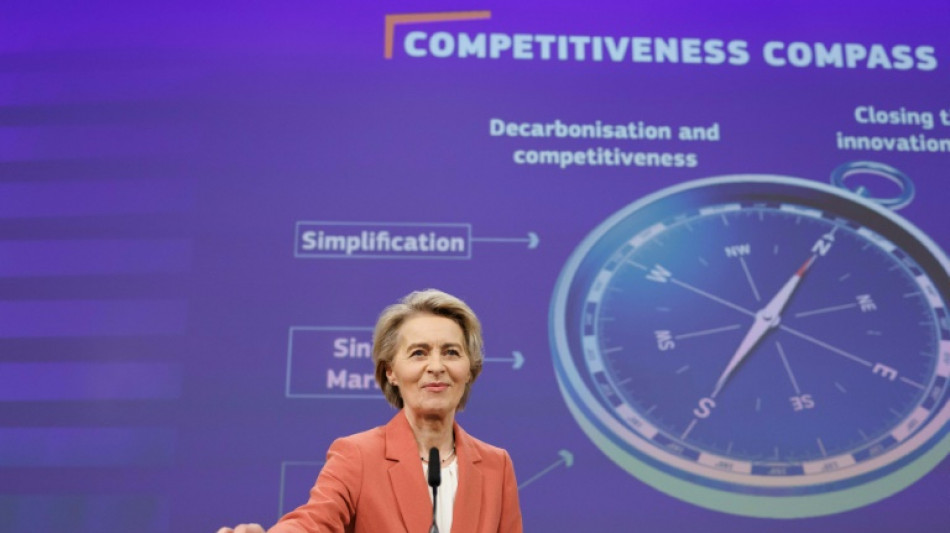
Facing Trump and China, EU unveils pro-business roadmap / Photo: Simon Wohlfahrt - AFP
The EU unveiled a much-anticipated blueprint to revamp Europe's economic model on Wednesday, marking a shift towards a more business-friendly Brussels after five years of heavy focus on green goals.
With US President Donald Trump promising tariffs and a gargantuan AI push, and China rising in key industrial and digital sectors, the 27-nation bloc is under pressure to make life easier for the companies driving its own growth.
"We need to reignite Europe's innovation engine," EU chief Ursula von der Leyen told a news conference to present the "competitiveness compass" -- the first major initiative of her second mandate.
The European Commission's recent priorities of climate change and business ethics left many firms complaining about excessive regulation compounding high energy costs and weak investments.
Heeding their call, the EU hopes to get back in the race by turning recommendations made last year by former Italian leaders Enrico Letta and Mario Draghi into a tangible plan of action.
But von der Leyen vowed the bloc remained committed to reaching carbon neutrality within 25 years to reduce dangerous climate change -- while also slashing red tape.
"The goals are cast in stone that we have by 2050," she said, although Europe would need to be "flexible" on how to reach them during "a very complex transition."
- Simplification shock -
Under the new blueprint, dozens of laws will be revised, with rules on environmental and human rights supply chain standards, corporate sustainability and chemical safety all facing a trim.
The "simplification shock" -- as billed by commission vice-president Stephane Sejourne -- has set alarm bells ringing with environmentalists.
"Under the guise of 'simplification', this initiative will dismantle essential safeguards for European citizens, the environment and the climate," warned Kim Claes at Friends of the Earth Europe.
But Markus Beyrer, director general at the EU-wide lobby group BusinessEurope, welcomed the plan as "a clear signal that the EU is committed to strengthening Europe's economy".
A new category of mid-sized company will be created to reduce the regulatory burden for thousands of firms, according to the text.
A European legal regime, distinct from the 27 member states' national jurisdictions, is to be set up to allow innovative companies to benefit from a single, harmonised set of rules on insolvency, labour law and taxation.
- Reducing energy costs -
Europe is suffering from energy costs that are much higher than those of its international competitors after the war in Ukraine cut off supplies of cheap Russian gas.
Von der Leyen told a gathering of the world's elite in Davos last week the bloc must "continue to diversify our energy supplies" and expand clean power sources including nuclear -- once a Brussels taboo.
The "compass" plan also recommends facilitating long-term power purchase agreements and boosting investment in the energy grid.
- Green industry push -
"Targeted, simplified aid" will encourage industrial decarbonisation, with Sejourne hoping the priority goes towards greening the "top 100 CO2-emitting sites", which alone account for more than half of Europe's industrial emissions.
The plan also envisages the creation of labels to spur demand for low-carbon products -- such as "green" steel, which Brussels is keen on but is in low demand due to its prohibitive costs.
Specific plans are to be drawn up for troubled sectors such as chemicals, steel and automotive.
- Mines and mergers -
The EU plan also calls for the bloc's competition watchdog to take into account the huge investment needs of technology companies when assessing mergers in "strategic sectors".
At present, the focus is on the potential impact on prices, which hinders the creation of European behemoths.
To reduce dependency on China and other countries for rare earths and raw materials, Sejourne wants more of the stuff to be mined in Europe.
The commissioner said he has already received 170 mining exploitation or research projects -- which often face local opposition over environmental impacts -- and has vowed to "facilitate" the issuance of permits.
The compass envisages the creation of a platform for the "joint purchase" of critical raw materials and the development of international partnerships to strengthen supply lines for green technologies, like solar and wind power, chips and pharmaceutical ingredients.
A "European preference in public procurement" for critical sectors and technologies is also mentioned.
- Building the savings union -
More than three decades after its launch, the EU's single market is still fragmented when it comes to sectors such as telecoms, energy and defence, where different national rules hamper competitiveness.
"Removing remaining barriers" is among the priorities cited in the compass's draft.
While Europe boasts a single currency, its start-ups remain incapable of matching the giant fundraising drives enjoyed by their US competitors.
To address that, von der Leyen in Davos promised to create a "European savings and investments union".
G.Hendrickx--LCdB