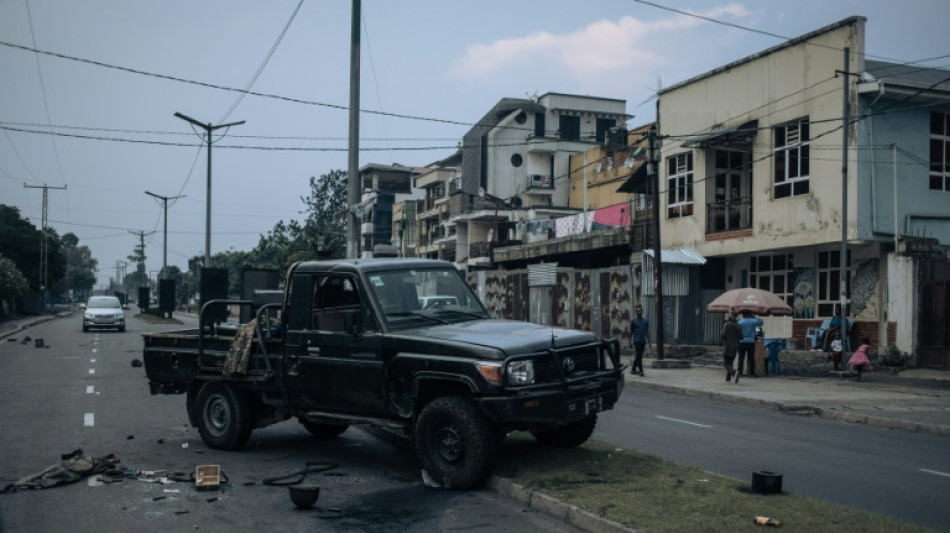
Rwanda-backed M23 advances towards second DR Congo regional capital / Photo: ALEXIS HUGUET - AFP
The Rwandan-backed armed group M23 moved south as it closed in on a key military airport in DR Congo on Friday, a day after pledging to take the capital Kinshasa and as international criticism mounted.
The group's capture of most of Goma, the capital of North Kivu province, earlier in the week was a dramatic escalation in a region that has seen decades of conflict involving multiple armed groups.
Rwanda says its primary interest is to eradicate fighters linked to the 1994 genocide but is accused of seeking to profit from the region's reserves of minerals used in global electronics.
The crisis has rattled the continent and international observers, with a southern African regional bloc holding an emergency summit in Zimbabwe's capital Harare on Friday.
M23 fighters are now moving south.
Local sources told AFP on Thursday that fighting was concentrated some 30 kilometres (19 miles) from the city of Kavumu.
The city has a strategic military airfield and is where the Congolese army has laid down its defensive line just 40 km north of South Kivu's provincial capital Bukavu.
The United Nations warned it was concerned by "credible reports that the M23 is moving rapidly towards the city of Bukavu".
The second biggest city in eastern Democratic Republic of Congo after Goma, Bukavu has a population believed to be around two million.
The Congolese army has yet to comment on the latest M23 advances but President Felix Tshisekedi said earlier this week that a "vigorous" military response was under way.
Information about the fast-moving offensive has remained unclear, but so far M23 fighters have met limited resistance from the ill-equipped and poorly paid Congolese forces.
In Goma, residents have emerged to count the dead and search for food, as hospitals struggled to cope with the wounded.
"We do not want to live under the thumb of these people," one person, who asked not to be named, told AFP.
The United Nations, United States, European Union, China, Britain, France and mediator Angola have all called on Rwanda to withdraw its forces.
Britain said Thursday it was considering reviewing aid to Rwanda.
- 'Not Rwandans' -
Rwanda has hit back at the criticism, with government spokesperson Yolande Makolo saying the UK did not deliver "a direct warning" about aid.
"The international community has its fair share of the blame in the current situation," she posted on X.
Rwandan President Paul Kagame also strongly rejected accusations that Kigali is supporting the armed group, saying: "M23 are not Rwandans -- they are Congolese."
On Friday, the 16-nation Southern African Development Community will hold an extraordinary meeting to discuss the "worrying situation".
Kagame and Angolan President Joao Lourenco, the African Union-appointed mediator between Kigali and Kinshasa on the conflict, will not attend.
The meeting follows soaring tensions between Kagame and South African President Cyril Ramaphosa after the deaths of 13 South African soldiers in DRC's east.
"We are ready to defend ourselves if we are attacked by a coalition including South African forces," Rwandan Foreign Minister Olivier Nduhungirehe told South African public broadcaster SABC late Thursday.
- 'We will not leave' -
The M23 and Rwandan troops entered Goma on Sunday. During days of intense clashes that killed more than 100 people, the group seized control over much of the city as many Congolese soldiers surrendered or fled.
"We are in Goma and we will not leave," Corneille Nangaa, head of a coalition of groups including the M23, said on Thursday.
"We will continue the march of liberation all the way to Kinshasa," he added.
The offensive has heightened an already dire humanitarian crisis in the region, causing food and water shortages and forcing half a million people from their homes this month, the UN said.
Africa's health agency warned that the "unnecessary war" in eastern DRC -- a hotspot for infectious diseases including mpox -- raised the risk of pandemic.
The DRC has accused Rwanda of waging an offensive to profit from the region's mineral wealth.
Rwanda has denied the accusations.
burs-cld-rbu-dl/kjm
W.Blondeel--LCdB