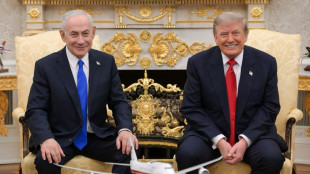
Netanyahu to meet Trump on Israel-Hamas truce / Photo: ANDREW CABALLERO-REYNOLDS - AFP
Israeli Prime Minister Benjamin Netanyahu meets Donald Trump Tuesday to discuss the truce with Hamas, as the US president said Palestinians would "love" his plan to move them out of war-battered Gaza.
Trump told reporters just ahead of the meeting that he was "here to listen" to key ally Netanyahu, the first foreign leader to visit the White House since the US leader's return to power.
But after Trump claimed credit for securing the Israel-Hamas truce after more than 15 months of fighting and bombing, he was likely to urge Netanyahu to stick to the ceasefire deal -- parts of which have yet to be finalized.
Trump also doubled down on his suggestion that Palestinians should get a "fresh, beautiful piece of land" in either Egypt or Jordan, as his envoy said Gaza would remain uninhabitable for years.
"I think they'd love to leave Gaza if they had an option," Trump said in the Oval Office.
"If we could find the right piece of land, or numerous pieces of land, and build them some really nice places... I think that would be a lot better than going back to Gaza."
Egypt and Jordan have flatly rejected this, and on Tuesday their leaders stressed "the need to commit to the united Arab position" that would help achieve peace, according to the Egyptian presidency.
Gazans have also denounced Trump's idea.
"Trump thinks Gaza is a pile of garbage -- absolutely not," said 34-year-old Hatem Azzam, a resident of the southern city of Rafah.
- 'Preposterous' -
Israel said hours ahead of the White House talks it was sending a team to mediator Qatar to discuss the second phase of the agreement, which could lead to a more permanent end to the war.
Palestinian group Hamas said Tuesday negotiations for the second phase had begun, with spokesman Abdel Latif al-Qanou saying the focus was on "shelter, relief and reconstruction".
Before the leaders' meeting, Trump's Middle East envoy Steve Witkoff told reporters that it was "unfair" and "preposterous" to suggest Gaza can be rebuilt and made habitable within five years of the war's end.
Under the ceasefire, Palestinian militants and Israel have begun exchanging hostages held in Gaza for prisoners in Israeli custody.
The war began when Hamas attacked Israel on October 7, 2023, taking into Gaza 251 hostages, 76 of whom are still held in the Palestinian territory including 34 the Israeli military says are dead.
Families of the Israeli hostages have been urging all sides to ensure the agreement is maintained so their loved ones can be freed.
Netanyahu, the first foreign leader hosted by Trump since his return to office, said before leaving for Washington that Israel had "redrawn the map" of the Middle East since the war began and drew in regional allies of Hamas.
"I believe that working closely with President Trump we can redraw it even further, and for the better," he said.
- 'Maximum pressure' -
Trump's team said they would be pushing efforts towards a normalization deal between Israel and Saudi Arabia which froze with the Gaza war.
But they will also be discussing Iran.
Ahead of the meeting Trump signed an order reinstating what he called the "maximum pressure" policy against Iran over allegations that the country is trying to develop nuclear weapons.
But he said he wanted a deal with Iran that would end its nuclear program and would be ready for talks with its leadership.
Since the Gaza ceasefire took effect on January 19, Israel has launched a deadly operation against militants in the occupied West Bank's north.
UN aid agency UNRWA -- which is now banned in Israel -- warned that the heavily impacted refugee camp of Jenin was "going into a catastrophic direction".
On Tuesday, the Israeli army said a gunman killed two soldiers before being shot dead in an attack south of Jenin.
Under the Gaza truce's ongoing 42-day first phase, 18 hostages have been freed so far in exchange for some 600 mostly Palestinian prisoners from Israeli jails.
Hamas's October 7, 2023 attack resulted in the deaths of 1,210 people on Israeli side, mostly civilians, according to an AFP tally based on official Israeli figures.
Israel's retaliatory response has killed at least 47,518 people in Gaza, the majority civilians, according to the Hamas-run territory's health ministry. The UN considers these figures as reliable.
burs-dk/st
S.Denis--LCdB