Nutzen Sie La Quotidienne de Bruxelles mit personalisierter Werbung, Werbetracking, Nutzungsanalyse und externen Multimedia-Inhalten. Details zu Cookies und Verarbeitungszwecken sowie zu Ihrer jederzeitigen Widerrufsmöglichkeit finden Sie unten, im Cookie-Manager sowie in unserer Datenschutzerklärung.
Use La Quotidienne de Bruxelles with personalised advertising, ad tracking, usage analysis and external multimedia content. Details on cookies and processing purposes as well as your revocation option at any time can be found below, in the cookie manager as well as in our privacy policy.
Utilizar La Quotidienne de Bruxelles con publicidad personalizada, seguimiento de anuncios, análisis de uso y contenido multimedia externo. Los detalles sobre las cookies y los propósitos de procesamiento, así como su opción de revocación en cualquier momento, se pueden encontrar a continuación, en el gestor de cookies, así como en nuestra política de privacidad.
Utilisez le La Quotidienne de Bruxelles avec des publicités personnalisées, un suivi publicitaire, une analyse de l'utilisation et des contenus multimédias externes. Vous trouverez des détails sur les cookies et les objectifs de traitement ainsi que sur votre possibilité de révocation à tout moment ci-dessous, dans le gestionnaire de cookies ainsi que dans notre déclaration de protection des données.
Utilizzare La Quotidienne de Bruxelles con pubblicità personalizzata, tracciamento degli annunci, analisi dell'utilizzo e contenuti multimediali esterni. I dettagli sui cookie e sulle finalità di elaborazione, nonché la possibilità di revocarli in qualsiasi momento, sono riportati di seguito nel Cookie Manager e nella nostra Informativa sulla privacy.
Utilizar o La Quotidienne de Bruxelles com publicidade personalizada, rastreio de anúncios, análise de utilização e conteúdo multimédia externo. Detalhes sobre cookies e fins de processamento, bem como a sua opção de revogação em qualquer altura, podem ser encontrados abaixo, no Gestor de Cookies, bem como na nossa Política de Privacidade.
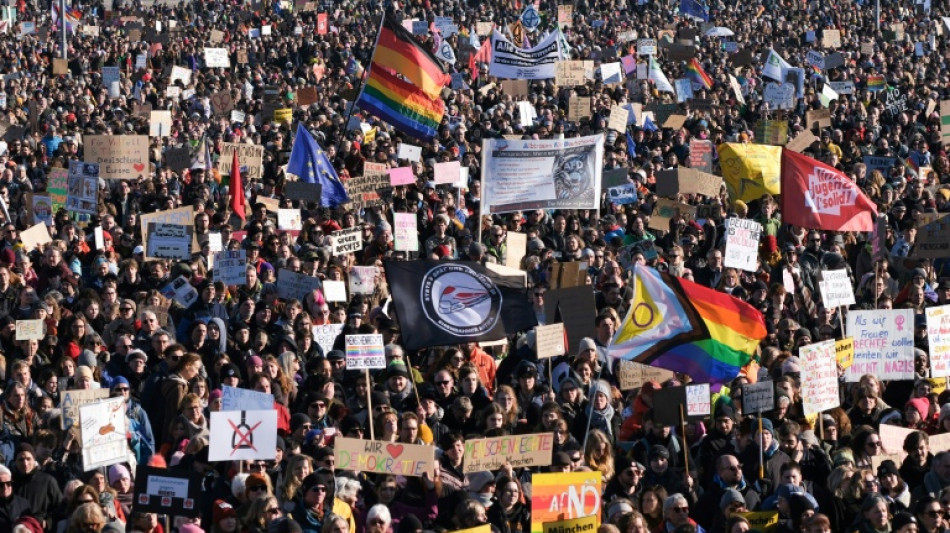
Fresh protests against the extreme right drew massive crowds in Germany on Saturday, including 250,000 people in Munich, authorities said, as the country heads for clutch elections.
Text size:
The latest rallies came after an estimated 160,000 people marched in Berlin last weekend to protest recent overtures by Germany's conservatives to the far-right Alternative for Germany (AfD) ahead of parliamentary elections on February 23.
Organisers of the largest protest, dubbed ""Munich is multicolour", put the turnout at more than 320,000 people.
With legislative elections two weeks away, demonstrators rallied under the slogan "democracy needs you", warning against any party working together with the AfD.
Germany has long had an unwritten rule against working with the far right, dating back to the aftermath of the horrors wrought by the Nazis in World War II.
But protesters say the Christian Democratic Union (CDU), the frontrunner in the polls, breached that so-called "firewall" by seeking the AfD's support in parliament for an anti-immigration bill.
Organisers said the Munich protest aimed to send a "strong signal in favour of diversity, human dignity, cohesion and democracy".
Protesters swarmed Munich's famed Theresienwiese, a sprawling esplanade in the city centre which plays host to the Oktoberfest beer festival each autumn. They carried placards attacking CDU leader Friedrich Merz, bearing messages such as "Shame on you!"
"I want democrats to take back control," said 64-year-old protester Joachim Hageboeck.
"It's bad enough that Austria, America and other countries have so many fascists in charge. We have to oppose them."
"Even potatoes are foreign," said Sascha Mehlins, 29, who was sporting a placard with the same message.
Another protest in the northern city of Hanover drew 24,000 people, according to police.
The CDU has ruled out forming a government with the AfD, which is polling in second place ahead of the elections.
- 'Betraying' Germany -
"We would be betraying our country," Merz on Saturday told a rally in Nuremberg of the CSU, the CDU's Bavarian sister party.
"Anyone who really wants change in Germany must not vote for the AfD."
Merz's toughened-up immigration stance came after police arrested an Afghan man following a deadly knife attack a week ago against a group of kindergarten children.
It was the latest in a series of deadly attacks that have soured moods in Germany over the arrival of millions of war refugees and other asylum seekers in recent years.
Merz, whose party is polling around 30 percent, is banking on going "all in" on immigration to peel away voters tempted by the AfD's strident anti-migrant policies.
Critics argue this gamble will only pander to the extremes in German politics, in a country still seeking to atone for the Nazi regime and the Holocaust.
Meanwhile the Greens and Social Democrats of incumbent Chancellor Olaf Scholz -- who have both sharply criticised Merz's AfD overtures -- are trailing on around 15 percent.