Hamas says Israel withdraws from key Gaza road / Photo: Eyad BABA - AFP
A Hamas official said Israeli troops on Sunday completed their withdrawal from a strategic road bisecting the Gaza Strip, part of a fragile truce deal that Israel said it was implementing.
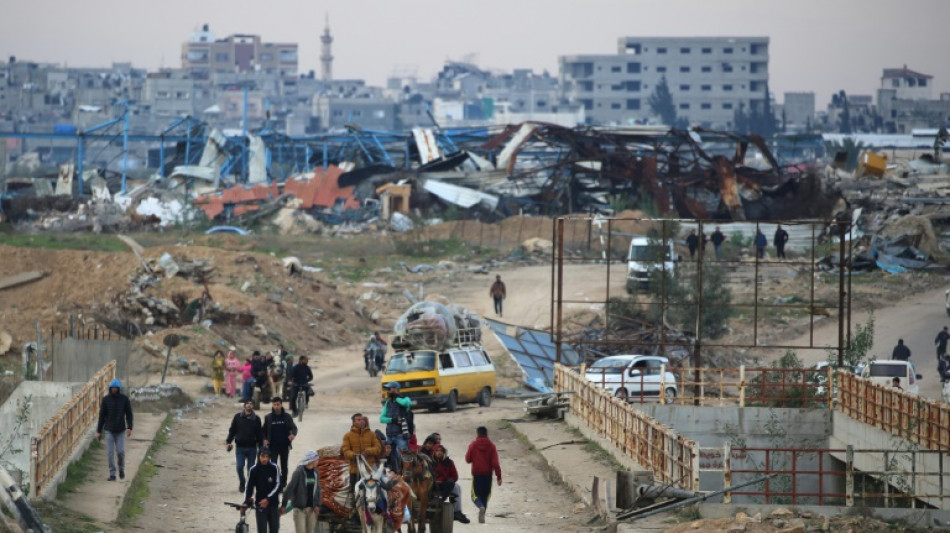
"Israeli forces have dismantled their positions and military posts and completely withdrawn their tanks from the Netzarim Corridor on Salaheddin Road, allowing vehicles to pass freely in both directions," an official from the Hamas-run interior ministry said.
An AFP journalist in the Netzarim area, which controls key access points between the territory's north and south, said that no Israeli forces were present on Sunday.
AFP journalists saw cars, buses, pickup trucks and donkey carts travelling on Salaheddin Road from both the north and south, crossing the Netzarim Corridor where an Israeli checkpoint used to stand.
According to a senior Hamas official, the Israeli withdrawal from Netzarim had been scheduled for Sunday under the terms of a truce that took effect on January 19, after more than 15 months of war between Israel and Hamas.
AFP is unable to independently verify the details of the ceasefire agreement as its text has not been made public.
Asked about Sunday's withdrawal, an Israeli security official, who requested anonymity, told AFP: "We are preparing to implement the ceasefire agreement according to the guidelines of the political echelon."
The war began with Hamas's October 7, 2023 attack on Israel, and after months of fruitless negotiations, a ceasefire was sealed in the lead-up to US President Donald Trump's inauguration for a second term.
- Hotsage-prisoner swap -
The 2023 attack, the deadliest in Israeli history, resulted in the deaths of 1,210 people, mostly civilians, according to an AFP tally of official Israeli figures.
Hamas took 251 people hostage into Gaza, of whom 73 remain in the territory, including 34 the Israeli military says are dead.
The health ministry in the Hamas-run Gaza Strip said on Saturday that at least 48,181 people had been killed in the Palestinian territory in the war.
Under the terms of the ceasefire, Israel and Hamas are conducting multiple rounds of hostage-prisoner swaps.
The fifth such exchange took place on Saturday, and saw the release of three Israeli hostages and 183 Palestinian prisoners.
Israeli Prime Minister Benjamin Netanyahu denounced Hamas as "monsters" after the handover of the three captives, who appeared emaciated and were forced to speak on a stage ahead of their release.
The hospital treating the hostages said Or Levy and Eli Sharabi were in a "poor medical condition", while Ohad Ben Ami was in a "severe nutritional state".
"Dad, is it really you? I can't believe you're here," said one Ben Ami's daughters, her eyes wide with disbelief, as the freed Israeli-German hostage embraced her at Tel Aviv's Ichilov Hospital.
Of the prisoners freed from Israeli jails, the Palestinian Prisoners' Club advocacy group said seven required hospitalisation and decried "brutality" and mistreatment in jail.
"We always dreamed that this would happen, that one day the prison director would be forced to open the gates," said freed prisoner Shadi Barghouti, still in a grey prison tracksuit.
- 'Do the job' -
The latest exchange came as negotiations were set to begin on the next phase of the ceasefire, which is intended to pave the way for a permanent end to the war.
But senior Hamas official Bassem Naim on Saturday said Israel's stalling an "lack of commitment in implementing the first phase... exposes this agreement to danger and thus it may stop or collapse".
Earlier this week, Trump sparked global outrage by suggesting the United States should take control of the Gaza Strip and clear out its inhabitants.
He said Egypt or Jordan could take in Palestinians from Gaza -- an idea both countries have flatly rejected.
The Israeli defence minister this week ordered the army to prepare for "voluntary" departures from Gaza, as Trump ruled out sending American troops to the territory.
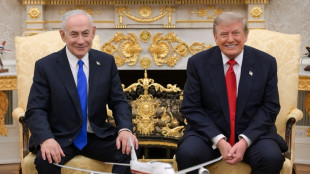
In an interview with Fox News on Saturday, Netanyahu hailed the plan and said Israel was willing to "do the job".
"I think that President Trump's proposal is the first fresh idea in years, and it has the potential to change everything in Gaza," said Netanyahu.
"All Trump is saying, 'I want to open the gate and give them an option to relocate temporarily while we rebuild the place physically'," Netanyahu said.
Trump "never said he wants American troops to do the job. Guess what? We'll do the job," Netanyahu added.
Egyptian Foreign Minister Badr Abdelatty was heading to Washington on Sunday, while Jordan's King Abdullah II was due to meet Trump at the White House on February 11.
V.Nijs--LCdB